• Wyszukiwanie zaawansowane
  • Kategorie
  • Kategorie BISAC
  • Książki na zamówienie
  • Promocje
  • Granty
  • Książka na prezent
  • Opinie
  • Pomoc
  • Załóż konto
  • Zaloguj się

Second Generation Biometrics: The Ethical, Legal and Social Context » książka


zaloguj się | załóż konto
Logo Krainaksiazek.pl

koszyk

konto

szukaj
topmenu
Księgarnia internetowa
Szukaj
Książki na zamówienie
Promocje
Granty
Książka na prezent
Moje konto
Pomoc
 
 
Wyszukiwanie zaawansowane
Pusty koszyk
Bezpłatna dostawa dla zamówień powyżej 20 złBezpłatna dostawa dla zamówień powyżej 20 zł

Kategorie główne

• Nauka
 [2939893]
• Literatura piękna
 [1808953]

  więcej...
• Turystyka
 [70366]
• Informatyka
 [150555]
• Komiksy
 [35137]
• Encyklopedie
 [23160]
• Dziecięca
 [608786]
• Hobby
 [136447]
• AudioBooki
 [1631]
• Literatura faktu
 [225099]
• Muzyka CD
 [360]
• Słowniki
 [2914]
• Inne
 [442115]
• Kalendarze
 [1068]
• Podręczniki
 [166599]
• Poradniki
 [468390]
• Religia
 [506548]
• Czasopisma
 [506]
• Sport
 [61109]
• Sztuka
 [241608]
• CD, DVD, Video
 [3308]
• Technologie
 [218981]
• Zdrowie
 [98614]
• Książkowe Klimaty
 [124]
• Zabawki
 [2174]
• Puzzle, gry
 [3275]
• Literatura w języku ukraińskim
 [260]
• Art. papiernicze i szkolne
 [7376]
Kategorie szczegółowe BISAC

Second Generation Biometrics: The Ethical, Legal and Social Context

ISBN-13: 9789400738911 / Angielski / Twarda / 2012 / 354 str.
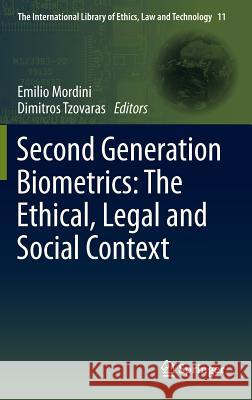
Emilio Mordini; Dimitros Tzovaras
Second Generation Biometrics: The Ethical, Legal and Social Context Emilio Mordini Dimitros Tzovaras 9789400738911 Springer - książkaWidoczna okładka, to zdjęcie poglądowe, a rzeczywista szata graficzna może różnić się od prezentowanej.

Second Generation Biometrics: The Ethical, Legal and Social Context

ISBN-13: 9789400738911 / Angielski / Twarda / 2012 / 354 str.

Emilio Mordini; Dimitros Tzovaras
cena 401,58
(netto: 382,46 VAT:  5%)

Najniższa cena z 30 dni: 385,52
Termin realizacji zamówienia:
ok. 22 dni roboczych.

Darmowa dostawa!
inne wydania

While a sharp debate is emerging about whether conventional biometric technology offers society any significant advantages over other forms of identification, and whether it constitutes a threat to privacy, technology is rapidly progressing. Politicians and the public are still discussing fingerprinting and iris scan, while scientists and engineers are already testing futuristic solutions. Second generation biometrics - which include multimodal biometrics, behavioural biometrics, dynamic face recognition, EEG and ECG biometrics, remote iris recognition, and other, still more astonishing, applications - is a reality which promises to overturn any current ethical standard about human identification. Robots which recognise their masters, CCTV which detects intentions, voice responders which analyse emotions: these are only a few applications in progress to be developed. This book is the first ever published on ethical, social and privacy implications of second generation biometrics. Authors include both distinguished scientists in the biometric field and prominent ethical, privacy and social scholars. This makes this book an invaluable tool for policy makers, technologists, social scientists, privacy authorities involved in biometric policy setting. Moreover it is a precious instrument to update scholars from different disciplines who are interested in biometrics and itswider social, ethical and political implications.


Kategorie:
Nauka, Filozofia
Kategorie BISAC:
Philosophy > Ethics & Moral Philosophy
Computers > Social Aspects
Philosophy > Reference
Wydawca:
Springer
Seria wydawnicza:
International Library of Ethics, Law and Technology
Język:
Angielski
ISBN-13:
9789400738911
Rok wydania:
2012
Wydanie:
2012
Numer serii:
000355069
Ilość stron:
354
Waga:
0.68 kg
Wymiary:
23.39 x 15.6 x 2.06
Oprawa:
Twarda
Wolumenów:
01
Dodatkowe informacje:
Bibliografia
Wydanie ilustrowane

Foreword

Viviane Reding - Vice-President of the European Commission, EU Commissioner for Justice, Fundamental Rights and Citizenship

General Introduction

Emilio Mordini, Dimitrios Tzovaras and Holly Ashton

SECTION ONE: “Foundations and Issues”

Epistemological Foundation of Biometrics

Giampaolo Ghilardi - Università di Milano

Flavio Keller - Professor of Human Physiology, Università Campus Bio-Medico

Biometric Recognition: an Overview

Anil K. Jain – Professor at Departments of Computer Science & Engineering, Electrical & Computer Engineering and Statistics & Probability at Michigan State University

Ajay Kumar - The Hong Kong Polytechnic University, Hung Hom, Hong Kong

Biometrics, Privacy and Agency

Annemarie Sprokkereef - Researcher at Tilburg Institute for Law, Technology, and Society

Paul de Hert - Professor of Law Faculty of Law and Criminology of Vrije Universiteit Brussel

SECTION TWO: “Emerging Biometrics and Technology Trends”

Gait and Anthropometric Profile Biometrics: A Step Forward

Dimosthenis Ioannidis & Dimitrios Tzovaras - Informatics and Telematics Institute, Centre for Research and Technology Hellas

Gabriele Dalle Mura, Gaetano Valenza & Alessandro Tognetti – Interdepartmental Research Centre "E. Piaggio", Faculty of Engineering, University of Pisa

Marcello Ferro - Institute of Computational Linguistics “A. Zampolli” (ILC) National Research Council (CNR) of of Pisa

Giovanni Pioggia - Institute of Clinical Physiology of CNR

Activity and Event Related Biometrics

Anastasios Drosou & Dimitrios Tzovaras – Informatics and Telematics Institute, Centre for Research and Technology Hellas

Electrophysiological Biometrics: Opportunities and Risks

Alejandro Riera, Stephen Dunne, Iván Cester & Giulio Ruffini - Starlab Barcelona SL

Intelligent Biometrics

Farzin Deravi - Reader in Information Engineering Department of Electronics at the University of Kent

SECTION THREE: “Identity, Intentions and Emotions”

Behavioural Biometrics and Human Identity

Ben Schouten & Rob van Kranenburg - Fontys University of Applied Science

Albert Ali Salah - University of Amsterdam

Behavioural Biometrics and Risk Identification

Guenter Schumacher - European Commission – Joint Research Centre. Institute for the Protection and Security of the Citizen

Facial Recognition, Facial Expression and Intention Detection

Massimo Tistarelli - Computer Vision Laboratory, University of Sassari

Susan E. Barrett - Lehigh University, Bethlehem, PA, U.S.A.

Alice O’Toole - University of Texas at Dallas, Richardson, TX, U.S. A.

The Transparent Body - Medical Information, Physical Privacy and Respect for Body Integrity

Emilio Mordini & Holly Ashton – Centre for Science, Society, and Citizenship, Rome

SECTION FOUR: “New Biometrics in Context”

Security in the Danger Zone: Normative Issues of Next Generation Biometrics

Irma Van der Ploeg – Professor Infonomics & New Media Research Center, Zuyd University

The Dark side of the Moon : Accountability, Ethics and New Biometrics

Juliet Lodge - Director of the Jean Monnet European Centre of Excellence, Institute for Communication Studies, University of Leeds

Conclusions

Emilio Mordini

Greek DPA Decision for ACTIBIO pilots in Greece

While a sharp debate is emerging about whether conventional biometric technology offers society any significant advantages over other forms of identification, and whether it constitutes a threat to privacy, technology is rapidly progressing. Politicians and the public are still discussing fingerprinting and iris scan, while scientists and engineers are already testing futuristic solutions. Second generation biometrics - which include multimodal biometrics, behavioural biometrics, dynamic face recognition, EEG and ECG biometrics, remote iris recognition, and other, still more astonishing, applications – is a reality which promises to overturn any current ethical standard about human identification. Robots which recognise their masters, CCTV which detects intentions, voice responders which analyse emotions: these are only a few applications in progress to be developed.

This book is the first ever published on ethical, social and privacy implications of second generation biometrics. Authors include both distinguished scientists in the biometric field and prominent ethical, privacy and social scholars. This makes this book an invaluable tool for policy makers, technologists, social scientists, privacy authorities involved in biometric policy setting. Moreover it is a precious instrument to update scholars from different disciplines who are interested in biometrics and its wider social, ethical and political implications.



Udostępnij

Facebook - konto krainaksiazek.pl


Opinie o Krainaksiazek.pl na Opineo.pl

Partner Mybenefit

Krainaksiazek.pl w programie rzetelna firma Krainaksiaze.pl - płatności przez paypal

Czytaj nas na:

Facebook - krainaksiazek.pl
  • książki na zamówienie
  • granty
  • książka na prezent
  • kontakt
  • pomoc
  • opinie
  • regulamin
  • polityka prywatności

Zobacz:

  • Księgarnia czeska

  • Wydawnictwo Książkowe Klimaty

1997-2026 DolnySlask.com Agencja Internetowa

© 1997-2022 krainaksiazek.pl
     
KONTAKT | REGULAMIN | POLITYKA PRYWATNOŚCI | USTAWIENIA PRYWATNOŚCI
Zobacz: Księgarnia Czeska | Wydawnictwo Książkowe Klimaty | Mapa strony | Lista autorów
KrainaKsiazek.PL - Księgarnia Internetowa

Polityka prywatnosci - link
Krainaksiazek.pl - płatnośc Przelewy24
Przechowalnia Przechowalnia





