• Wyszukiwanie zaawansowane
  • Kategorie
  • Kategorie BISAC
  • Książki na zamówienie
  • Promocje
  • Granty
  • Książka na prezent
  • Opinie
  • Pomoc
  • Załóż konto
  • Zaloguj się

Seaports in International Law » książka


zaloguj się | załóż konto
Logo Krainaksiazek.pl

koszyk

konto

szukaj
topmenu
Księgarnia internetowa
Szukaj
Książki na zamówienie
Promocje
Granty
Książka na prezent
Moje konto
Pomoc
 
 
Wyszukiwanie zaawansowane
Pusty koszyk
Bezpłatna dostawa dla zamówień powyżej 20 złBezpłatna dostawa dla zamówień powyżej 20 zł

Kategorie główne

• Nauka
 [2939893]
• Literatura piękna
 [1808953]

  więcej...
• Turystyka
 [70366]
• Informatyka
 [150555]
• Komiksy
 [35137]
• Encyklopedie
 [23160]
• Dziecięca
 [608786]
• Hobby
 [136447]
• AudioBooki
 [1631]
• Literatura faktu
 [225099]
• Muzyka CD
 [360]
• Słowniki
 [2914]
• Inne
 [442115]
• Kalendarze
 [1068]
• Podręczniki
 [166599]
• Poradniki
 [468390]
• Religia
 [506548]
• Czasopisma
 [506]
• Sport
 [61109]
• Sztuka
 [241608]
• CD, DVD, Video
 [3308]
• Technologie
 [218981]
• Zdrowie
 [98614]
• Książkowe Klimaty
 [124]
• Zabawki
 [2174]
• Puzzle, gry
 [3275]
• Literatura w języku ukraińskim
 [260]
• Art. papiernicze i szkolne
 [7376]
Kategorie szczegółowe BISAC

Seaports in International Law

ISBN-13: 9783319603957 / Angielski / Miękka / 2017 / 114 str.
Marco Casagrande
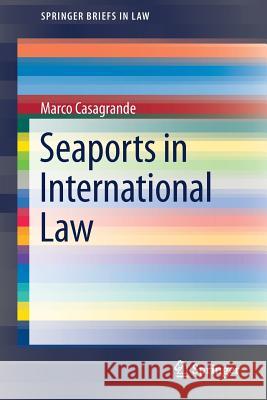
Seaports in International Law Marco Casagrande 9783319603957 Springer - książkaWidoczna okładka, to zdjęcie poglądowe, a rzeczywista szata graficzna może różnić się od prezentowanej.

Seaports in International Law

ISBN-13: 9783319603957 / Angielski / Miękka / 2017 / 114 str.

Marco Casagrande
cena 241,50
(netto: 230,00 VAT:  5%)

Najniższa cena z 30 dni: 231,29
Termin realizacji zamówienia:
ok. 22 dni roboczych.

Darmowa dostawa!

This is the first book to offer a comprehensive overview of modern seaports from a legal perspective. Further, it provides a basic toolkit for establishing a legal doctrine of seaports, the instruments of said toolkit being the very few legal norms specifically targeting seaports, which are examined as such rather than through the lens of other, more established disciplines, such as the law of the sea or transportation law. It is a first, necessary step toward giving seaports the status they rightfully deserve in legal studies.Despite centuries of international law studies and decades of EU law evolution, seaports have remained stuck in limbo. From a law of the sea perspective, seaports belong to the land, an approach that is often clearly reflected in national maritime legislation. The other branches of international law do not focus on seaports, since they are considered to belong to the sea. The port communities, for their part, have availed themselves of the "port specificity" concept. In recent decades, containerization has transformed ports into key hubs of the globalized economy, but also into vital checkpoints of the War on Terror, due to the security risks posed by the millions of sealed containers circulating worldwide. Moreover, tragic maritime incidents have shown that seaports are the only reliable sentinels of the seas, being the only places where the systematic inspection of ships is feasible. This has led to the adoption of specific international and EU rules. Those rules, however, remain fragmented, highly specialized and technical; as such, they are unsuitable for creating an organic legal seaport regime: this objective can only be achieved with a significant contribution from legal doctrine.


Kategorie:
Nauka, Prawo i administracja
Kategorie BISAC:
Law > International
Business & Economics > Production & Operations Management
Law > Comparative
Wydawca:
Springer
Seria wydawnicza:
Springerbriefs in Law
Język:
Angielski
ISBN-13:
9783319603957
Rok wydania:
2017
Wydanie:
2017
Numer serii:
000445207
Ilość stron:
114
Waga:
1.94 kg
Wymiary:
23.5 x 15.5
Oprawa:
Miękka
Wolumenów:
01
Dodatkowe informacje:
Wydanie ilustrowane

Part I – Introduction: 1 The Lack of Interest for Seaports in the International Law and Doctrine.- 2 The Port and the International Law in General: A Land Appendix.- 3 The Port and the Law of the Sea: An Accessory to the Waters.- Part II – The Pre-Industrial Port: 4 Paolo Sarpi’s Legal Doctrine.- 5 The Colonial Factories.- Part III – The Industrial Port: 6 The Longshoremen’s Organizations.- 7 The 1923 Geneva Convention on Seaports.- 8 The Forgotten Ports and Port Installations: Lotus Case, Wimbledon Case, Suez Crisis.- 9 When You Are Forced to Remember the Port: The Laws of Wars from the Hague Conventions to the Cuban Crisis.- 10 The Mar del Plata Convention.- 11 The Montego Bay Convention.- Part IV – The Port of Globalization: 12 An Unprecedented Economic Significance and the Ascendance of the Multinational Terminal Operators.- 13 The Decline of the Longshoremen’s Organizations and Their Resistance in Europe.- 14 Flags of Convenience and Port State Control.- 15 Port Security: The Dubai Ports World Case and the ISPS Code.- 16 From the Traditional to the Multimodal Seaport: The Right to Access.- 17 Seaports in International Commercial Law.- Part V – Assessment and Perspectives: 18 Common Features in the International Regulation of Seaports.- 19 A Contribution from Private International Law and some Municipal Legal Orders?.- 20 Starting from a Unitary Notion of Port.

This is the first book to offer a comprehensive overview of modern seaports from a legal perspective. Further, it provides a basic toolkit for establishing a legal doctrine of seaports, the instruments of said toolkit being the very few legal norms specifically targeting seaports, which are examined as such rather than through the lens of other, more established disciplines, such as the law of the sea or transportation law. It is a first, necessary step toward giving seaports the status they rightfully deserve in legal studies.

Despite centuries of international law studies and decades of EU law evolution, seaports have remained stuck in limbo. From a law of the sea perspective, seaports belong to the land, an approach that is often clearly reflected in national maritime legislation. The other branches of international law do not focus on seaports, since they are considered to belong to the sea. The port communities, for their part, have availed themselves of the “port specificity” concept. 

In recent decades, containerization has transformed ports into key hubs of the globalized economy, but also into vital checkpoints of the War on Terror, due to the security risks posed by the millions of sealed containers circulating worldwide. Moreover, tragic maritime incidents have shown that seaports are the only reliable sentinels of the seas, being the only places where the systematic inspection of ships is feasible. This has led to the adoption of specific international and EU rules. Those rules, however, remain fragmented, highly specialized and technical; as such, they are unsuitable for creating an organic legal seaport regime: this objective can only be achieved with a significant contribution from legal doctrine.




Udostępnij

Facebook - konto krainaksiazek.pl


Opinie o Krainaksiazek.pl na Opineo.pl

Partner Mybenefit

Krainaksiazek.pl w programie rzetelna firma Krainaksiaze.pl - płatności przez paypal

Czytaj nas na:

Facebook - krainaksiazek.pl
  • książki na zamówienie
  • granty
  • książka na prezent
  • kontakt
  • pomoc
  • opinie
  • regulamin
  • polityka prywatności

Zobacz:

  • Księgarnia czeska

  • Wydawnictwo Książkowe Klimaty

1997-2026 DolnySlask.com Agencja Internetowa

© 1997-2022 krainaksiazek.pl
     
KONTAKT | REGULAMIN | POLITYKA PRYWATNOŚCI | USTAWIENIA PRYWATNOŚCI
Zobacz: Księgarnia Czeska | Wydawnictwo Książkowe Klimaty | Mapa strony | Lista autorów
KrainaKsiazek.PL - Księgarnia Internetowa

Polityka prywatnosci - link
Krainaksiazek.pl - płatnośc Przelewy24
Przechowalnia Przechowalnia




