2. SDGs and Sustainable Industrial Transformation: Key Policy Priorities and Opportunities for India. Prof. Nagesh Kumar (Keynote speaker)
3. Green Total Factor Productivity for India. Shruti Joshi, Siddhartha Nath, and Abhishek Ranjan
4. Integrating Autonomous and Planned Adaptation to Climate Change: The Case of Indian Agriculture. Brinda G Krishnan.
5. Climate Variability, Rising Drought and Livelihood Vulnerability of Farmers: A Gender-Environment Perception with Study Area in West Bengal. Dipanwita Chakraborty and Pramod Kumar.
6. Reconsidering 3 R's of Non-Biodegradable (Plastic) Waste Management: An Experiment design using indirect control randomization. Nikkita Gupta.
7. Social Cost-Benefit Analysis of landfilling vs. WTE – a case of Mumbai, India. Nishith Jardosh and Vinish Kathuria.
8. Climate Change Perception and Gender Responsiveness: Contribution of Conservation Agriculture farms of Terai Zone, West Bengal. Riti Chatterjee and Pravat Utpal Acharjee.
9. India’s COP26 Targets- Promises to keep or renege? Sandhya Krishnan and Janvi Panani.
Section B: Health and Nutrition (Covering SDG 2, SDG 3)
10. The 2021/22 Food Crisis- Causes, Impacts and the Way Forward. Prof. Joachim von Braun (Keynote Speaker)
11. Farm Production Diversity and Women’s Dietary Diversity in Rural Bihar and Odisha. Balram Kumar.
12. The Burden of Diseases and Injuries in India in 2019: An Analysis of Disability Adjusted Life Years Perspective. Chandan Kumar Swain and Himanshu Sekhar Rout.
13. Access to Improved Maternal and Child Healthcare Services: The Extent of Coverage and Inequality in India with Particular Reference to Assam. Pallabi Gogoi.
14. Universal Health coverage and Health insurance in India: a panel data analysis. Rupali Tamuly.
15. Analyzing the Background Characteristics and Determinants of Malnutrition among children in Uttar Pradesh. Srinarayan.
16. How Digital Technology is Changing Economics: A Challenge for Policymakers. Prof Kaushik Basu.(Keynote Speaker)
17. Growth Divergence between Indian States. Taniya Ghosh and Kaustubh.
18. Inequality in Household Consumption Expenditure: Study in the context of Manipur, a North-Eastern State of India. Loitongbam Hena Devi and Utpal Kumar De
19. Financial Inclusion, Young Women Entrepreneurs, and Rural Livelihood in India. Durairaj Kumarasamy, Prakash Singh, and Sukhvinder Kaur.
20. Spatial Disparities in the Educational Development: Evidence from an Indian State. Rukmani Mahala and Rachita Gulati.
21. Empirical Analysis of Monetary Policy in a Targeting Framework: a case of Covid-19 Pandemic and Russia-Ukraine War. Sayar Ahmad Shah and Bhavesh Garg.
A. Ganesh-Kumar is Professor at the Indira Gandhi Institute of Development Research (IGIDR), Mumbai. He is a Ph.D. from the Indian Statistical Institute, Kolkata. He specializes in computable general equilibrium (CGE) modelling with a focus on food security and grain management policies; issues in agricultural trade; pricing policies; spatial dimensions of Indian economy; and policies for sustainable human development and economic growth.
Vijay Laxmi Pandey is Professor at the Indira Gandhi Institute of Development Research (IGIDR), Mumbai. She is a Ph.D. from the G.B Pant University of Agriculture and Technology, Pant Nagar, Uttarakhand. She specializes in primary data collection and analysis with a focus on agriculture and nutrition, food security; gender issues; and policies for sustainable development.
Bharti Nandwani is an Assistant Professor of Economics at Indira Gandhi Institute of Development Research (IGIDR). Her research work lies in the areas of political economy and economics of education. Her work in the political economy area has documented the implementation gaps and unintended consequences of decentralisation initiatives introduced for Scheduled Tribes (STs). Within the economics of education field, she has explored the role of local community participation in school governance and involvement of women in school administration.
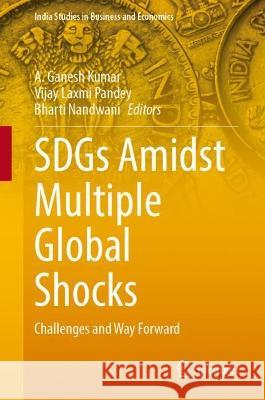
This book provides a comprehensive perspective by taking an interdisciplinary approach to issues of attaining SDGs in India. It starts with policy priorities and opportunities for interlinking of different SDGs with sustainable industrial transformation. Subsequently, various chapters present a blend of analytical methods that are primarily rooted in economics and yet have an inter-disciplinary approach, highlighting pathways towards achieving SDGs, especially SDG1, SDG2, SDG3, SDG4, SDG10, SDG11, SDG13, and SDG15. Gender equality and empowerment of women is a common cross-cutting issue across all three themes towards achieving SDG targets. Chapters are divided into three themes climate change, health and nutrition, and poverty and inequality, with a special chapter devoted to each theme providing the overall picture. The book’s content is a great resource for students, researchers, policymakers, and development practitioners studying these SDGs related to India as the country moves forward on its growth path.