• Wyszukiwanie zaawansowane
  • Kategorie
  • Kategorie BISAC
  • Książki na zamówienie
  • Promocje
  • Granty
  • Książka na prezent
  • Opinie
  • Pomoc
  • Załóż konto
  • Zaloguj się

Scanning Electron Microscopy and X-Ray Microanalysis: A Text for Biologists, Materials Scientists, and Geologists » książka


zaloguj się | załóż konto
Logo Krainaksiazek.pl

koszyk

konto

szukaj
topmenu
Księgarnia internetowa
Szukaj
Książki na zamówienie
Promocje
Granty
Książka na prezent
Moje konto
Pomoc
 
 
Wyszukiwanie zaawansowane
Pusty koszyk
Bezpłatna dostawa dla zamówień powyżej 20 złBezpłatna dostawa dla zamówień powyżej 20 zł

Kategorie główne

• Nauka
 [2949965]
• Literatura piękna
 [1857847]

  więcej...
• Turystyka
 [70818]
• Informatyka
 [151303]
• Komiksy
 [35733]
• Encyklopedie
 [23180]
• Dziecięca
 [617748]
• Hobby
 [139972]
• AudioBooki
 [1650]
• Literatura faktu
 [228361]
• Muzyka CD
 [398]
• Słowniki
 [2862]
• Inne
 [444732]
• Kalendarze
 [1620]
• Podręczniki
 [167233]
• Poradniki
 [482388]
• Religia
 [509867]
• Czasopisma
 [533]
• Sport
 [61361]
• Sztuka
 [243125]
• CD, DVD, Video
 [3451]
• Technologie
 [219309]
• Zdrowie
 [101347]
• Książkowe Klimaty
 [123]
• Zabawki
 [2362]
• Puzzle, gry
 [3791]
• Literatura w języku ukraińskim
 [253]
• Art. papiernicze i szkolne
 [7933]
Kategorie szczegółowe BISAC

Scanning Electron Microscopy and X-Ray Microanalysis: A Text for Biologists, Materials Scientists, and Geologists

ISBN-13: 9781461332756 / Angielski / Miękka / 2013 / 673 str.
Joseph Goldstein; Dale E. Newbury; Patrick Echlin
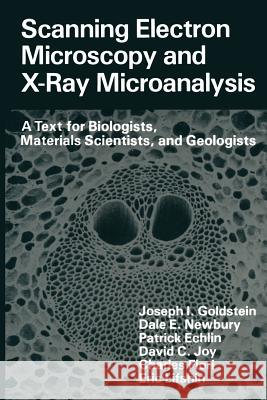
Scanning Electron Microscopy and X-Ray Microanalysis: A Text for Biologists, Materials Scientists, and Geologists Goldstein, Joseph 9781461332756 Springer - książkaWidoczna okładka, to zdjęcie poglądowe, a rzeczywista szata graficzna może różnić się od prezentowanej.

Scanning Electron Microscopy and X-Ray Microanalysis: A Text for Biologists, Materials Scientists, and Geologists

ISBN-13: 9781461332756 / Angielski / Miękka / 2013 / 673 str.

Joseph Goldstein; Dale E. Newbury; Patrick Echlin
cena 403,47
(netto: 384,26 VAT:  5%)

Najniższa cena z 30 dni: 385,52
Termin realizacji zamówienia:
ok. 22 dni roboczych
Bez gwarancji dostawy przed świętami

Darmowa dostawa!

This book has evolved by processes of selection and expansion from its predecessor, Practical Scanning Electron Microscopy (PSEM), published by Plenum Press in 1975. The interaction of the authors with students at the Short Course on Scanning Electron Microscopy and X-Ray Microanalysis held annually at Lehigh University has helped greatly in developing this textbook. The material has been chosen to provide a student with a general introduction to the techniques of scanning electron microscopy and x-ray microanalysis suitable for application in such fields as biology, geology, solid state physics, and materials science. Following the format of PSEM, this book gives the student a basic knowledge of (1) the user-controlled functions of the electron optics of the scanning electron microscope and electron microprobe, (2) the characteristics of electron-beam-sample inter- actions, (3) image formation and interpretation, (4) x-ray spectrometry, and (5) quantitative x-ray microanalysis. Each of these topics has been updated and in most cases expanded over the material presented in PSEM in order to give the reader sufficient coverage to understand these topics and apply the information in the laboratory. Throughout the text, we have attempted to emphasize practical aspects of the techniques, describing those instru- ment parameters which the microscopist can and must manipulate to obtain optimum information from the specimen. Certain areas in particular have been expanded in response to their increasing importance in the SEM field. Thus energy-dispersive x-ray spectrometry, which has undergone a tremendous surge in growth, is treated in substantial detail.


Kategorie:
Nauka, Biologia i przyroda
Kategorie BISAC:
Science > Earth Sciences - General
Science > Biologia rozwoju
Technology & Engineering > Materials Science - General
Wydawca:
Springer
Język:
Angielski
ISBN-13:
9781461332756
Rok wydania:
2013
Wydanie:
1981
Ilość stron:
673
Waga:
1.04 kg
Wymiary:
15.8 x 23.4 x 3.7
Oprawa:
Miękka
Wolumenów:
01

1. Introduction.- 1.1. Evolution of the Scanning Electron Microscope.- 1.2. Evolution of the Electron Probe Microanalyzer.- 1.3. Outline of This Book.- 2. Electron Optics.- 2.1. Electron Guns.- 2.1.1. Thermionic Emission.- 2.1.2. Tungsten Cathode.- 2.1.3. The Lanthanum Hexaboride (LaB6) Cathode.- 2.1.4. Field Emission Gun.- 2.2. Electron Lenses.- 2.2.1. General Properties of Magnetic Lenses.- 2.2.2. Production of Minimum Spot Size.- 2.2.3. Aberrations in the Electron Optical Column.- 2.3. Electron Probe Diameter, dp, vs. Electron Probe Current i.- 2.3.1. Calculation of dmin and imax.- 2.3.2. Measurement of Microscope Parameters (dp, i, ?).- 2.3.3. High-Resolution Scanning Electron Microscopy.- 3. Electron-Beam-Specimen Interactions.- 3.1. Introduction.- 3.2. Scattering.- 3.2.1. Elastic Scattering.- 3.2.2. Inelastic Scattering.- 3.3. Interaction Volume.- 3.3.1. Experimental Evidence.- 3.3.2. Monte Carlo Calculations.- 3.4. Backscattered Electrons.- 3.4.1. Atomic Number Dependence.- 3.4.2. Energy Dependence.- 3.4.3. Tilt Dependence.- 3.4.4. Angular Distribution.- 3.4.5. Energy Distribution.- 3.4.6. Spatial Distribution.- 3.4.7. Sampling Depth.- 3.5. Signals from Inelastic Scattering.- 3.5.1. Secondary Electrons.- 3.5.2. X-Rays.- 3.5.3. Auger Electrons.- 3.5.4. Cathodoluminescence.- 3.6. Summary.- 4. Image Formation in the Scanning Electron Microscope.- 4.1. Introduction.- 4.2. The Basic SEM Imaging Process.- 4.2.1. Scanning Action.- 4.2.2. Image Construction (Mapping).- 4.2.3. Magnification.- 4.2.4. Picture Element (Picture Point).- 4.2.5. Depth of Field.- 4.2.6. Image Distortions.- 4.3. Stereomicroscopy.- 4.4. Detectors.- 4.4.1. Electron Detectors.- 4.4.2. Cathodoluminescence Detectors.- 4.5. The Roles of Specimen and Detector in Contrast Formation.- 4.5.1. Contrast.- 4.5.2. Atomic Number (Compositional) Contrast (Backscattered Electron Signal).- 4.5.3. Compositional Contrast (Secondary-Electron Signal).- 4.5.4. Contrast Components.- 4.5.5. Topographic Contrast.- 4.6. Image Quality.- 4.6.1. Signal Quality and Contrast Information.- 4.6.2. Strategy in SEM Imaging.- 4.6.3. Resolution Limitations.- 4.7. Signal Processing for the Display of Contrast Information.- 4.7.1. The Visibility Problem.- 4.7.2. Signal Processing Techniques.- 4.7.3. Combinations of Detectors.- 4.7.4. Beam Energy Effects.- 4.7.5. Summary.- 5. X-Ray Spectral Measurement: WDS and EDS.- 5.1. Introduction.- 5.2. Wavelength-Dispersive Spectrometer.- 5.2.1. Basic Design.- 5.2.2. The X-Ray Detector.- 5.2.3. Detector Electronics.- 5.3. Energy-Dispersive X-Ray Spectrometer.- 5.3.1. Operating Principles.- 5.3.2. The Detection Process.- 5.3.3. Artifacts of the Detection Process.- 5.3.4. The Main Amplifier and Pulse Pileup Rejection.- 5.3.5. Artifacts from the Detector Environment.- 5.3.6. The Multichannel Analyzer.- 5.3.7. Summary of EDS Operation and Artifacts.- 5.4. Comparison of Wavelength-Dispersive Spectrometers with Energy-Dispersive Spectrometers.- 5.4.1. Geometrical Collection Efficiency.- 5.4.2. Quantum Efficiency.- 5.4.3. Resolution.- 5.4.4. Spectral Acceptance Range.- 5.4.5. Maximum Count Rate.- 5.4.6. Minimum Probe Size.- 5.4.7. Speed of Analysis.- 5.4.8. Spectral Artifacts.- Appendix: Initial Detector Setup and Testing.- 6. Qualitative X-Ray Analysis.- 6.1. Introduction.- 6.2. EDS Qualitative Analysis.- 6.2.1. X-Ray Lines.- 6.2.2. Guidelines for EDS Qualitative Analysis.- 6.2.3. Pathological Overlaps in EDS Qualitative Analysis.- 6.2.4. Examples of EDS Qualitative Analysis.- 6.3. WDS Qualitative Analysis.- 6.3.1. Measurement of X-Ray Lines.- 6.3.2. Guidelines for WDS Qualitative Analysis.- 6.4. X-Ray Scanning.- 7. Quantitative X-Ray Microanalysis.- 7.1. Introduction.- 7.2. ZAF Technique.- 7.2.1. Introduction.- 7.2.2. The Absorption Factor, A.- 7.2.3. The Atomic Number Factor, Z.- 7.2.4. The Characteristic Fluorescence Correction, F.- 7.2.5. The Continuum Fluorescence Correction.- 7.2.6. Summary Discussion of the ZAF Method.- 7.3. The Empirical Method.- 7.4. Quantitative Analysis with Nonnormal Electron Beam Incidence.- 7.5. Analysis of Particles and Rough Surfaces.- 7.5.1. Geometric Effects.- 7.5.2. Compensating for Geometric Effects.- 7.5.3. Summary.- 7.6. Analysis of Thin Films and Foils.- 7.6.1. Thin Foils.- 7.6.2. Thin Films on Substrates.- 7.7. Quantitative Analysis of Biological Material.- 7.7.1. Introduction.- 7.7.2. Mass Loss and Artifacts during Analysis.- 7.7.3. Bulk Samples.- 7.7.4. Thick Sections on Bulk Substrates.- 7.7.5. Thin Samples.- 7.7.6. The Continuum Method.- 7.7.7. Thick Specimens on Very Thin Supports.- 7.7.8. Microdroplets.- 7.7.9. Standards.- 7.7.10. Conclusion.- Appendix A: Continuum Method.- Appendix B: Worked Examples of Quantitative Analysis of Biological Material.- Notation.- 8. Practical Techniques of X-Ray Analysis.- 8.1. General Considerations of Data Handling.- 8.2. Background Shape.- 8.2.1. Background Modeling.- 8.2.2. Background Filtering.- 8.3. Peak Overlap.- 8.3.1. Linearity.- 8.3.2. Goodness of Fit.- 8.3.3. The Linear Methods.- 8.3.4. The Nonlinear Methods.- 8.3.5. Error Estimation.- 8.4. Dead-Time Correction.- 8.5. Example of Quantitative Analysis.- 8.6. Precision and Sensitivity in X-Ray Analysis.- 8.6.1. Statistical Basis for Calculating Precision and Sensitivity.- 8.6.2. Sample Homogeneity.- 8.6.3. Analytical Sensitivity.- 8.6.4. Trace Element Analysis.- 8.7. Light Element Analysis.- 9. Materials Specimen Preparation for SEM and X-Ray Microanalysis.- 9.1. Metals and Ceramics.- 9.1.1. Scanning Electron Microscopy.- 9.1.2. X-Ray Microanalysis.- 9.2. Particles and Fibers.- 9.3. Hydrous Materials.- 9.3.1. Soils and Clays.- 9.3.2. Polymers.- 10. Coating Techniques for SEM and Microanalysis.- 10.1. Introduction.- 10.1.1. Specimen Characteristics.- 10.1.2. Alternatives to Coating.- 10.1.3. Thin-Film Technology.- 10.2. Thermal Evaporation.- 10.2.1. High-Vacuum Evaporation.- 10.2.2. Low-Vacuum Evaporation.- 10.3. Sputter Coating.- 10.3.1. Ion Beam Sputtering.- 10.3.2. Diode or Direct Current Sputtering.- 10.3.3. Cool Diode Sputtering.- 10.3.4. Sputtering Techniques.- 10.3.5. Choice of Target.- 10.3.6. Coating Thickness.- 10.3.7. Advantages of Sputter Coating.- 10.3.8. Artifacts Associated with Sputter Coating.- 10.4. Specialized Coating Methods.- 10.4.1. High-Resolution Coating.- 10.4.2. Low-Temperature Coating.- 10.5. Determination of Coating Thickness.- 10.5.1. Estimation of Coating Thickness.- 10.5.2. Measurement during Coating.- 10.5.3. Measurement after Coating.- 10.5.4. Removing Coating Layers.- 11. Preparation of Biological Samples for Scanning Electron Microscopy.- 11.1. Introduction.- 11.2. Compromising the Microscope.- 11.2.1. Environmental Stages.- 11.2.2. Nonoptimal Microscope Performance.- 11.3. Compromising the Specimen.- 11.3.1. Correlative Microscopy.- 11.3.2. Specimen Selection.- 11.3.3. Specimen Cleaning.- 11.3.4. Specimen Stabilization.- 11.3.5. Exposure of Internal Surfaces.- 11.3.6. Localizing Areas of Known Physiological Activity.- 11.3.7. Specimen Dehydration.- 11.3.8. Specimen Supports.- 11.3.9. Specimen Conductivity.- 11.3.10. Heavy Metal Impregnation.- 11.3.11. Interpretation and Artifacts.- 12. Preparation of Biological Samples for X-Ray Microanalysis.- 12.1. Introduction.- 12.1.1. The Nature and Enormity of the Problem.- 12.1.2. Applications of X-Ray Microanalysis.- 12.1.3. Types of X-Ray Analytical Investigations.- 12.1.4. Types of Biological Specimens.- 12.1.5. Strategy.- 12.1.6. Criteria for Satisfactory Specimen Preparation.- 12.2. Ambient Temperature Preparative Procedures.- 12.2.1. Before Fixation.- 12.2.2. Fixation.- 12.2.3. Histochemical Techniques.- 12.2.4. Precipitation Techniques.- 12.2.5. Dehydration.- 12.2.6. Embedding.- 12.2.7. Sectioning and Fracturing.- 12.2.8. Specimen Supports.- 12.2.9. Specimen Staining.- 12.2.10. Specimen Coating.- 12.3. Low-Temperature Preparative Procedures.- 12.3.1. Specimen Pretreatment.- 12.3.2. Freezing Procedures.- 12.3.3. Movement of Elements within a Given Cellular Compartment.- 12.3.4. Postfreezing Procedures.- 12.3.5. Frozen-Hydrated and Partially Frozen-Hydrated Material.- 12.3.6. Freeze Drying.- 12.3.7. Freeze Substitution.- 12.3.8. Sectioning.- 12.3.9. Fracturing.- 12.3.10. Specimen Handling.- 12.4. Microincineration.- 13. Applications of the SEM and EPMA to Solid Samples and Biological Materials.- 13.1. Study of Aluminum-Iron Electrical Junctions.- 13.2. Study of Deformation in Situ in the Scanning Electron Microscope.- 13.3. Analysis of Phases in Raney Nickel Alloy.- 13.4. Quantitative Analysis of a New Mineral, Sinoite.- 13.5. Determination of the Equilibrium Phase Diagram for the Fe-Ni-C System.- 13.6. Study of Lunar Metal Particle 63344,1.- 13.7. Observation of Soft Plant Tissue with a High Water Content.- 13.8. Study of Multicellular Soft Plant Tissue with High Water Content.- 13.9. Examination of Single-Celled, Soft Animal Tissue with High Water Content.- 13.10. Observation of Hard Plant Tissue with a Low Water Content.- 13.11. Study of Single-Celled Plant Tissue with a Hard Outer Covering and Relatively Low Internal Water Content.- 13.12. Examination of Medium Soft Animal Tissue with a High Water Content.- 13.13. Study of Single-Celled Animal Tissue of High Water Content.- 14. Data Base.- Table 14.1. Atomic Number, Atomic Weight, and Density of Metals.- Table 14.2. Common Oxides of the Elements.- Table 14.3. Mass Absorption Coefficients for K? Lines.- Table 14.4. Mass Absorption Coefficients for L? Lines.- Table 14.5. Selected Mass Absorption Coefficients.- Table 14.6. K Series X-Ray Wavelengths and Energies.- Table 14.7. L Series X-Ray Wavelengths and Energies.- Table 14.8. M Series X-Ray Wavelengths and Energies.- Table 14.9. Fitting Parameters for Duncumb-Reed Backscattering Correction Factor R.- Table 14.10. J Values and Fluorescent Yield, ?, Values.- Table 14.11. Important Properties of Selected Coating Elements.- References.

Joseph Goldstein leitet seit 1974 weltweit Retreats und Seminare in buddhistischer Meditation und ist Mitbegründer der Insight Meditation Society.
Seine Praxis begann er 1967, als er als Friedensaktivist in Thailand auf den Buddhismus stieß. Heute gilt er als einer der führenden Vertreter eines westlichen Buddhismus. In deutscher Sprache wurde von ihm (gemeinsam mit Jack Kornfield) das Buch Einsicht durch Meditation veröffentlicht.

Goldstein, Joseph About the Author:
Joseph Goldstein is Sterlin... więcej >


Udostępnij

Facebook - konto krainaksiazek.pl


Opinie o Krainaksiazek.pl na Opineo.pl

Partner Mybenefit

Krainaksiazek.pl w programie rzetelna firma Krainaksiaze.pl - płatności przez paypal

Czytaj nas na:

Facebook - krainaksiazek.pl
  • książki na zamówienie
  • granty
  • książka na prezent
  • kontakt
  • pomoc
  • opinie
  • regulamin
  • polityka prywatności

Zobacz:

  • Księgarnia czeska

  • Wydawnictwo Książkowe Klimaty

1997-2025 DolnySlask.com Agencja Internetowa

© 1997-2022 krainaksiazek.pl
     
KONTAKT | REGULAMIN | POLITYKA PRYWATNOŚCI | USTAWIENIA PRYWATNOŚCI
Zobacz: Księgarnia Czeska | Wydawnictwo Książkowe Klimaty | Mapa strony | Lista autorów
KrainaKsiazek.PL - Księgarnia Internetowa

Polityka prywatnosci - link
Krainaksiazek.pl - płatnośc Przelewy24
Przechowalnia Przechowalnia





