• Wyszukiwanie zaawansowane
  • Kategorie
  • Kategorie BISAC
  • Książki na zamówienie
  • Promocje
  • Granty
  • Książka na prezent
  • Opinie
  • Pomoc
  • Załóż konto
  • Zaloguj się

Satellite Systems for Personal and Broadband Communications » książka


zaloguj się | załóż konto
Logo Krainaksiazek.pl

koszyk

konto

szukaj
topmenu
Księgarnia internetowa
Szukaj
Książki na zamówienie
Promocje
Granty
Książka na prezent
Moje konto
Pomoc
 
 
Wyszukiwanie zaawansowane
Pusty koszyk
Bezpłatna dostawa dla zamówień powyżej 20 złBezpłatna dostawa dla zamówień powyżej 20 zł

Kategorie główne

• Nauka
 [2949965]
• Literatura piękna
 [1857847]

  więcej...
• Turystyka
 [70818]
• Informatyka
 [151303]
• Komiksy
 [35733]
• Encyklopedie
 [23180]
• Dziecięca
 [617748]
• Hobby
 [139972]
• AudioBooki
 [1650]
• Literatura faktu
 [228361]
• Muzyka CD
 [398]
• Słowniki
 [2862]
• Inne
 [444732]
• Kalendarze
 [1620]
• Podręczniki
 [167233]
• Poradniki
 [482388]
• Religia
 [509867]
• Czasopisma
 [533]
• Sport
 [61361]
• Sztuka
 [243125]
• CD, DVD, Video
 [3451]
• Technologie
 [219309]
• Zdrowie
 [101347]
• Książkowe Klimaty
 [123]
• Zabawki
 [2362]
• Puzzle, gry
 [3791]
• Literatura w języku ukraińskim
 [253]
• Art. papiernicze i szkolne
 [7933]
Kategorie szczegółowe BISAC

Satellite Systems for Personal and Broadband Communications

ISBN-13: 9783642641015 / Angielski / Miękka / 2012 / 433 str.
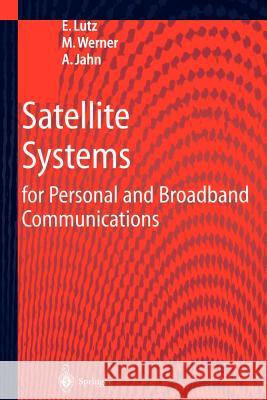
E. Lutz; M. Werner; A. Jahn
Satellite Systems for Personal and Broadband Communications E. Lutz M. Werner A. Jahn 9783642641015 Springer - książkaWidoczna okładka, to zdjęcie poglądowe, a rzeczywista szata graficzna może różnić się od prezentowanej.

Satellite Systems for Personal and Broadband Communications

ISBN-13: 9783642641015 / Angielski / Miękka / 2012 / 433 str.

E. Lutz; M. Werner; A. Jahn
cena 403,47
(netto: 384,26 VAT:  5%)

Najniższa cena z 30 dni: 385,52
Termin realizacji zamówienia:
ok. 22 dni roboczych
Bez gwarancji dostawy przed świętami

Darmowa dostawa!

The important role that satellites play in the field of communications will be manifested by a large number of new satellite systems to be implemented within the next few years. These new systems will basically belong to two categories: (i) satellite networks for mobile/personal communications, mainly with handheld terminals, and (ii) satellite networks for broadband multimedia communications, mainly for fixed but also for portable and mobile terminals. This book gives an overview of both families of satellite systems. In Part I, the basics of geostationary and non-geostationary satellite constellations are dealt with, as well as the principles of satellite communications. Part II deals with satellite systems for mobile/personal communications and ad dresses various aspects of networking (multiple access, cell structure, routing, etc.); it also deals with technology, regulation, and financing. Part III is ded icated to future satellite systems for broadband communications (Internet, multimedia) and discusses satellite-specific aspects of broadband communi cations, in particular on the basis of ATM and TCP /IP. A survey of existing and planned satellite systems completes the book. The authors of this book are scientists at the German Aerospace Center, DLR (Deutsches Zentrum fiir Luft- und Raumfahrt) and work in the Digital Networks group of the Institute for Communications and Navigation."


Kategorie:
Technologie
Kategorie BISAC:
Technology & Engineering > Automotive
Technology & Engineering > Telecommunications
Science > Geofizyka
Wydawca:
Springer
Język:
Angielski
ISBN-13:
9783642641015
Rok wydania:
2012
Wydanie:
Softcover Repri
Ilość stron:
433
Waga:
0.68 kg
Wymiary:
23.5 x 15.5
Oprawa:
Miękka
Wolumenów:
01

I. Basics.- 1. Introduction.- 1.1 Mobile and Personal Satellite Communications.- 1.1.1 Applications of Mobile Satellite Communications.- 1.1.2 Personal Satellite Communications.- 1.1.3 UMTS, IMT-2000.- 1.2 Broadband Multimedia Satellite Communications.- 1.3 Frequency Bands.- 1.4 Key Aspects of Satellite Communication Systems.- 2. Satellite Orbits, Constellations, and System Concepts.- 2.1 Satellite Orbits.- 2.1.1 Elliptical and Circular Orbits.- 2.1.2 Satellite Velocity and Orbit Period.- 2.1.3 Orientation of the Orbit Plane.- 2.1.4 Typical Circular Orbits.- 2.1.5 Orbit Perturbations.- 2.1.6 Ground Tracks.- 2.2 Satellite — Earth Geometry.- 2.2.1 Geometric Relations between Satellite and Earth Terminal.- 2.2.2 Coverage Area.- 2.3 Satellite Constellations.- 2.3.1 Inclined Walker Constellations.- 2.3.2 Polar Constellations.- 2.3.3 Asynchronous Polar Constellations.- 2.4 GEO System Concept.- 2.4.1 Inmarsat-3.- 2.4.2 EAST (Euro African Satellite Telecommunications).- 2.5 LEO System Concept.- 2.5.1 Globalstar.- 2.5.2 Intersatellite Links and On-Board Processing.- 2.5.3 Iridium.- 2.6 MEO System Concept.- 2.6.1 ICO.- 2.7 Satellite Launches.- 3. Signal Propagation and Link Budget.- 3.1 Satellite Link Budget.- 3.1.1 Antenna Characteristics.- 3.1.2 Free Space Loss and Received Power.- 3.1.3 Link Budget.- 3.1.4 Spot Beam Concept.- 3.2 Peculiarities of Satellite Links.- 3.2.1 Dependence on Elevation.- 3.2.2 Time Dependence of Satellite Links.- 3.2.3 Faraday Rotation.- 3.3 Signal Shadowing and Multipath Fading.- 3.3.1 Narrowband Model for the Land Mobile Satellite Channel.- 3.3.2 Satellite Channels at Higher Frequencies.- 3.3.3 Wideband Model for the Land Mobile Satellite Channel.- 3.4 Link Availability and Satellite Diversity.- 3.4.1 Concept of Satellite Diversity.- 3.4.2 Correlation of Channels.- 3.4.3 Link Availability and Satellite Diversity Service Area.- 3.5 System Implications.- 4. Signal Transmission.- 4.1 Speech Coding.- 4.1.1 Quality of Coded Speech.- 4.1.2 Overview of Speech Coding Schemes.- 4.2 Modulation.- 4.2.1 Modulation Schemes for Mobile Satellite Communications.- 4.2.2 Bandwidth Requirement of Modulated Signals.- 4.2.3 Bit Error Rate in the Gaussian Channel.- 4.2.4 Bit Error Rate in the Ricean and Rayleigh Fading Channel.- 4.3 Channel Coding (Forward Error Correction, FEC).- 4.3.1 Convolutional Coding.- 4.3.2 Block Coding.- 4.3.3 Error Protection with Cyclic Redundancy Check (CRC).- 4.3.4 RS Codes.- 4.3.5 Performance of Block Codes.- 4.3.6 Performance of Block Codes in Fading Channels.- 4.4 Automatic Repeat Request (ARQ).- 4.4.1 Stop-and-Wait ARQ.- 4.4.2 Go-Back-N ARQ.- 4.4.3 Selective-Repeat ARQ.- 4.5 Typical Error Control Schemes in Mobile Satellite Communications.- II. Satellite Systems for Mobile/Personal Communications.- 5. Multiple Access.- 5.1 Duplexing.- 5.1.1 Frequency-Division Duplexing (FDD).- 5.1.2 Time-Division Duplexing (TDD).- 5.2 Multiplexing.- 5.3 Multiple Access.- 5.4 Slotted Aloha Multiple Access.- 5.4.1 The Principle of Slotted Aloha.- 5.4.2 Throughput of Slotted Aloha.- 5.4.3 Mean Transmission Delay for Slotted Aloha.- 5.4.4 Pure Aloha Multiple Access.- 5.5 Frequency-Division Multiple Access, FDMA.- 5.5.1 Adjacent Channel Interference.- 5.5.2 Required Bandwidth for FDMA.- 5.5.3 Intermodulation.- 5.5.4 Pros and Cons of FDMA.- 5.6 Time-Division Multiple Access, TDMA.- 5.6.1 Bandwidth Demand and Efficiency of TDMA.- 5.6.2 Burst Synchronization in the Receiving Satellite.- 5.6.3 Slot Synchronization in the Transmitting TDMA Terminals.- 5.6.4 Pros and Cons of TDMA.- 5.7 Code-Division Multiple Access, CDMA.- 5.8 Direct-Sequence CDMA (DS-CDMA).- 5.8.1 Generation and Characteristics of Signature Sequences.- 5.8.2 Investigation of Asynchronous DS-CDMA in the Time Domain.- 5.8.3 Investigation of Asynchronous DS-CDMA in the Frequency Domain.- 5.8.4 Multi-Frequency CDMA, MF-CDMA.- 5.8.5 Qualcomm Return Link CDMA (Globalstar).- 5.8.6 Synchronous Orthogonal DS-CDMA with Coherent Detection.- 5.9 CDMA Receivers.- 5.9.1 PN Code Synchronization in the CDMA Receiver.- 5.9.2 Rake Receiver.- 5.9.3 CDMA Multiuser Detection.- 5.10 Characteristics of CDMA.- 5.11 CDMA for the Satellite UMTS Air Interface.- 5.11.1 The ESA Wideband CDMA Scheme.- 5.11.2 The ESA Wideband Hybrid CDMA/TDMA Scheme.- 6. Cellular Satellite Systems.- 6.1 Introduction.- 6.1.1 Concept of the Hexagonal Radio Cell Pattern.- 6.1.2 Cell Cluster and Frequency Reuse.- 6.2 Co-Channel Interference in the Uplink.- 6.2.1 Co-Channel Interference for FDMA and TDMA Uplinks.- 6.2.2 Co-Channel Interference for an Asynchronous DS-CDMA Uplink.- 6.3 Co-Channel Interference in the Downlink.- 6.3.1 Co-Channel Interference for FDMA and TDMA Downlinks.- 6.3.2 Co-Channel Interference for CDMA Downlinks.- 6.4 Bandwidth Demand and Traffic Capacity of Cellular Satellite Networks.- 6.4.1 Total System Bandwidth.- 6.4.2 Traffic Capacity per Radio Cell.- 6.4.3 Traffic Capacity of the System.- 6.4.4 Required User Link Capacity of a Satellite.- 6.4.5 Overall Network Capacity Considerations.- 7. Network Aspects.- 7.1 Architecture of Satellite Systems for Mobile/Personal Communications.- 7.2 Network Control.- 7.2.1 Tasks of Network Control.- 7.2.2 Signaling Channels of the Air Interface.- 7.3 Mobility Management.- 7.3.1 Service Area of a Gateway Station.- 7.3.2 Location Area.- 7.3.3 Registration and Location Update.- 7.4 Paging.- 7.5 Call Control.- 7.5.1 Setup of a Mobile Originating Call.- 7.5.2 Setup of a Mobile Terminating Call.- 7.6 Dynamic Channel Allocation.- 7.6.1 C/I-Based DCA.- 7.6.2 DCA Using a Cost Function.- 7.7 Handover.- 7.7.1 Handover Decision.- 7.7.2 Handover Procedure.- 7.7.3 Channel Allocation at Handover.- 7.8 Call Completion Probability.- 7.9 Routing.- 7.9.1 Routing in LEO/MEO Satellite Networks.- 7.9.2 Off-Line Dynamic ISL Routing Concept.- 7.9.3 On-line Adaptive ISL Routing.- 7.10 Integration of Terrestrial and Satellite Mobile Networks.- 8. Satellite Technology.- 8.1 Satellite Subsystems.- 8.2 Antenna Technology.- 8.2.1 GEO Antennas for Mobile Links with Spot Beams.- 8.2.2 LEO/MEO Antennas.- 8.3 Payload Architecture.- 9. Regulatory, Organizational, and Financial Aspects.- 9.1 Allocation of Frequency Bands.- 9.2 Licensing/Regulation.- 9.2.1 Granting a System License.- 9.2.2 Licensing in the USA.- 9.2.3 Licensing in Europe.- 9.2.4 Common Use of Frequency Bands by Several Systems.- 9.2.5 Global Licensing and Political Aspects.- 9.3 Financing and Marketing of S-PCN Systems.- 9.4 Operation of S-PCN Systems.- III. Satellite Systems for Broadband Multimedia Communicat ions.- 10. Multimedia Communications in Satellite Systems.- 10.1 Types of Broadband Communication Networks.- 10.1.1 Traditional Circuit-Switched Networks and the Packet-Switched Internet.- 10.1.2 New Multimedia Satellite Systems Using New Satellite Orbits.- 10.2 Multimedia Services and Traffic Characterization.- 10.2.1 Video Traffic and MPEG Coding.- 10.2.2 Self-Similar Traffic.- 10.3 ATM-Based Communication in Satellite Systems.- 10.3.1 Principles of ATM.- 10.3.2 Implications for ATM-Based Satellite Networks.- 10.4 Internet Services via Satellite Systems.- 10.4.1 Principles of TCP/IP.- 10.4.2 Internet Protocol (IP).- 10.4.3 Transport Control Protocol (TCP).- 10.4.4 TCP/IP in the Satellite Environment.- 10.4.5 IP over ATM in the Satellite Environment.- 11. ATM-Based Satellite Networks.- 11.1 System Architecture.- 11.2 Services.- 11.3 Protocol Architecture.- 11.4 ATM Resource Management.- 11.4.1 Connection Admission Control and Usage Parameter Control.- 11.4.2 Congestion Control, Traffic Shaping, and Flow Control.- 11.5 Multiple Access for ATM Satellite Systems.- 11.5.1 TDMA-Based Multiple Access.- 11.5.2 CDMA-Based Multiple Access.- 11.6 Radio Resource Management.- 11.7 Error Control.- 12. Network Dimensioning.- 12.1 Spot Beam Capacity Dimensioning for GEO Systems.- 12.1.1 Motivation and Approach.- 12.1.2 Market Prediction.- 12.1.3 Generic Multiservice Source Traffic Model.- 12.1.4 Calculation of the Spot Beam Capacity Requirements.- 12.1.5 System Bandwidth Demand Calculation.- 12.1.6 Applied Spot Beam Capacity Dimensioning: A Case Study.- 12.2 ISL Capacity Dimensioning for LEO Systems.- 12.2.1 Topological Design of the ISL Network.- 12.2.2 ISL Routing Concept.- 12.2.3 Network Dimensioning.- 12.2.4 Numerical Example.- 12.2.5 Extensions of the Dimensioning Approach.- A. Satellite Spot Beams and Map Transformations.- A.1 Map Projections and Satellite Views.- A.2 Generation of Satellite Spot Beams.- B. Parameters of the Land Mobile Satellite Channel.- B.1 Narrowband Two-State Model at L Band.- B.2 Narrowband Two-State Model at EHF Band.- B.3 Wideband Model at L Band.- C. Existing and Planned Satellite Systems.- C.1 Survey of Satellite Systems.- C.2 ACeS (Asia Cellular Satellite).- C.3 Astrolink.- C.4 EuroSkyWay.- C.5 Globalstar.- C.6 ICO (Intermediate Circular Orbits).- C.7 Inmarsat-3/Inmarsat mini-M.- C.8 Iridium.- C.9 Orbcomm.- CIO SkyBridge.- C.11 Sky Station.- C.12 Spaceway.- C.13 Teledesic.- References.

Das Buch gibt einen fundierten Überblick über aktuelle und zukünftige Satellitensysteme für Mobilkommunikation (personal communication) und Breitbandkommunikation. In Teil I werden die Grundlagen von geostationären und nichtgeostationären Satellitenkonstellationen sowie die damit verbundenen nachrichtentechnischen Fragen behandelt. Teil II befaßt sich mit den Satellitensystemen für Mobilkommunikation und behandelt verschiedene Netzaspekte (CDMA, Spotbeams, Routing, etc.) sowie die Technologie, Regulierung und Finanzierung solcher Systeme. Teil III ist den zukünftigen Satellitensystemen für breitbandige Kommunikation (Internet, Multimedia) gewidmet und beleuchtet die satellitenspezifischen Aspekte dieser Kommunikation, insbesondere auf der Basis von ATM und TCP/IP. Ein umfangreicher Überblick über operationelle und geplante Satellitensysteme rundet das Buch ab.


Udostępnij

Facebook - konto krainaksiazek.pl


Opinie o Krainaksiazek.pl na Opineo.pl

Partner Mybenefit

Krainaksiazek.pl w programie rzetelna firma Krainaksiaze.pl - płatności przez paypal

Czytaj nas na:

Facebook - krainaksiazek.pl
  • książki na zamówienie
  • granty
  • książka na prezent
  • kontakt
  • pomoc
  • opinie
  • regulamin
  • polityka prywatności

Zobacz:

  • Księgarnia czeska

  • Wydawnictwo Książkowe Klimaty

1997-2025 DolnySlask.com Agencja Internetowa

© 1997-2022 krainaksiazek.pl
     
KONTAKT | REGULAMIN | POLITYKA PRYWATNOŚCI | USTAWIENIA PRYWATNOŚCI
Zobacz: Księgarnia Czeska | Wydawnictwo Książkowe Klimaty | Mapa strony | Lista autorów
KrainaKsiazek.PL - Księgarnia Internetowa

Polityka prywatnosci - link
Krainaksiazek.pl - płatnośc Przelewy24
Przechowalnia Przechowalnia





