• Wyszukiwanie zaawansowane
  • Kategorie
  • Kategorie BISAC
  • Książki na zamówienie
  • Promocje
  • Granty
  • Książka na prezent
  • Opinie
  • Pomoc
  • Załóż konto
  • Zaloguj się

Salt Stress in Plants: Signalling, Omics and Adaptations » książka


zaloguj się | załóż konto
Logo Krainaksiazek.pl

koszyk

konto

szukaj
topmenu
Księgarnia internetowa
Szukaj
Książki na zamówienie
Promocje
Granty
Książka na prezent
Moje konto
Pomoc
 
 
Wyszukiwanie zaawansowane
Pusty koszyk
Bezpłatna dostawa dla zamówień powyżej 20 złBezpłatna dostawa dla zamówień powyżej 20 zł

Kategorie główne

• Nauka
 [2946600]
• Literatura piękna
 [1856966]

  więcej...
• Turystyka
 [72221]
• Informatyka
 [151456]
• Komiksy
 [35826]
• Encyklopedie
 [23190]
• Dziecięca
 [619653]
• Hobby
 [140543]
• AudioBooki
 [1577]
• Literatura faktu
 [228355]
• Muzyka CD
 [410]
• Słowniki
 [2874]
• Inne
 [445822]
• Kalendarze
 [1744]
• Podręczniki
 [167141]
• Poradniki
 [482898]
• Religia
 [510455]
• Czasopisma
 [526]
• Sport
 [61590]
• Sztuka
 [243598]
• CD, DVD, Video
 [3423]
• Technologie
 [219201]
• Zdrowie
 [101638]
• Książkowe Klimaty
 [124]
• Zabawki
 [2473]
• Puzzle, gry
 [3898]
• Literatura w języku ukraińskim
 [254]
• Art. papiernicze i szkolne
 [8170]
Kategorie szczegółowe BISAC

Salt Stress in Plants: Signalling, Omics and Adaptations

ISBN-13: 9781461461074 / Angielski / Twarda / 2013 / 509 str.
Parvaiz Ahmad; M. M. Azooz; Mnv Prasad
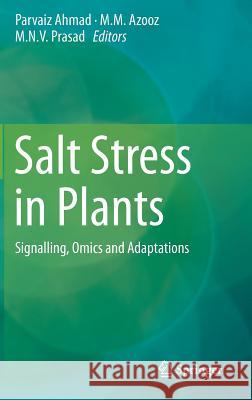
Salt Stress in Plants: Signalling, Omics and Adaptations Ahmad, Parvaiz 9781461461074 Springer - książkaWidoczna okładka, to zdjęcie poglądowe, a rzeczywista szata graficzna może różnić się od prezentowanej.

Salt Stress in Plants: Signalling, Omics and Adaptations

ISBN-13: 9781461461074 / Angielski / Twarda / 2013 / 509 str.

Parvaiz Ahmad; M. M. Azooz; Mnv Prasad
cena 806,99 zł
(netto: 768,56 VAT:  5%)

Najniższa cena z 30 dni: 771,08 zł
Termin realizacji zamówienia:
ok. 22 dni roboczych
Bez gwarancji dostawy przed świętami

Darmowa dostawa!

Environmental conditions and changes, irrespective of source, cause a variety of stresses, one of the most prevalent of which is salt stress. Excess amount of salt in the soil adversely affects plant growth and development, and impairs production. Nearly 20% of the world's cultivated area and nearly half of the world's irrigated lands are affected by salinity. Processes such as seed germination, seedling growth and vigour, vegetative growth, flowering and fruit set are adversely affected by high salt concentration, ultimately causing diminished economic yield and also quality of produce. Most plants cannot tolerate salt-stress. High salt concentrations decrease the osmotic potential of soil solution, creating a water stress in plants and severe ion toxicity. The interactions of salts with mineral nutrition may result in nutrient imbalances and deficiencies. The consequence of all these can ultimately lead to plant death as a result of growth arrest and molecular damage. To achieve salt-tolerance, the foremost task is either to prevent or alleviate the damage, or to re-establish homeostatic conditions in the new stressful environment. Barring a few exceptions, the conventional breeding techniques have been unsuccessful in transferring the salt-tolerance trait to the target species. A host of genes encoding different structural and regulatory proteins have been used over the past 5-6 years for the development of a range of abiotic stress-tolerant plants. It has been shown that using regulatory genes is a more effective approach for developing stress-tolerant plants. Thus, understanding the molecular basis will be helpful in developing selection strategies for improving salinity tolerance. This book will shed light on the effect of salt stress on plants development, proteomics, genomics, genetic engineering, and plant adaptations, among other topics. The book will cover around 25 chapters with contributors from all over the world. ​​

Kategorie:
Nauka, Biologia i przyroda
Kategorie BISAC:
Science > Biotechnology
Science > Botanika
Science > Life Sciences - Anatomy & Physiology
Wydawca:
Springer
Język:
Angielski
ISBN-13:
9781461461074
Rok wydania:
2013
Wydanie:
2013, Corr. 2nd
Ilość stron:
509
Waga:
1.15 kg
Wymiary:
23.37 x 15.75 x 3.3
Oprawa:
Twarda
Wolumenów:
01

Chapter 1: Recent Advances of Metabolomics to Reveal Plant Response During Salt Stress.- Chapter 2: MicroRNAs and Their Role in Salt Stress Response in Plants.- Chapter 3: Unravelling Salt Stress in Plants Through Proteomics.- Chapter 4: Genetic Approaches to Improve Salinity Tolerance in Plants.- Chapter 5: LEA Proteins in Salt Stress Tolerance.- Chapter 6: Enhancing Plant Productivity Under Salt Stress – Relevance of Poly-omics.- Chapter 7: Salt Stress and MAPK Signaling in Plants.- Chapter 8: ABA: Role in Plant Signaling Under Salt Stress.- Chapter 9: Calcium Signaling and Its Significance in Alleviating Salt Stress in Plants.- Chapter 10: Improving Salt Tolerance in Rice: Looking Beyond the Conventional.- Chapter 11: Approaches to Improving Salt Tolerance in Maize.- Chapter 12: The Role of Phytochromes in Stress Tolerance.- Chapter 13: Role of Arbuscular Mycorrhiza in Amelioration of Salinity.- Chapter 14: Breeding Salinity Tolerance in Citrus Using Rootstocks.- Chapter 15: Effects of Salt Stress on Photosynthesis Under Ambient and Elevated Atmospheric CO2 Concentration.- Chapter 16: Nitrogen-Use-Efficiency (NUE) in Plants Under NaCl Stress.- Chapter 17: The Responses of Salt-Affected Plants to Cadmium.- Chapter 18: Plant Tissue Culture: A Useful Measure for the Screening of Salt Tolerance in Plants.

Dr. Parvaiz Ahmad (Editor)


Dr. Parvaiz is Assistant professor in Botany at A.S. College, Srinagar, Jammu and Kashmir, India. He has completed his post-graduation in Botany in 2000 from Jamia Hamdard New Delhi India. After his Ph.D from Indian Institute of Technology (IIT) Delhi, India in 2007 he joined International Centre for Genetic Engineering and Biotechnology, New Delhi, India. His main research area is stress physiology and molecular biology. He has published more than 30 research papers in peer reviewed journals and 16 book chapters. He has also edited three volume 2 with Springer NY USA and 1 with Studium Press Pvt. India Ltd., New Delhi, India. He have received Junior Research Fellowship and Senior Research Fellowship by CSIR, New Delhi, India, during his Ph.D. Dr. Parvaiz has been awarded Young Scientist Award under Fast Track scheme in 2007, by Department of Science and Technology, Govt. of India, New Delhi, India. Dr. parvaiz is actively engaged in studying the molecular and physio-biochemical responses of different agricultural and horticultural plants under environmental stress.


Prof. Mohamed M. Azooz (Co-editor)

Pro.Dr. M.M. Azooz is a Professor of Plant Physiology in department of Botany, Faculty of Science, South Valley University, Qena, Egypt. He received the B.Sc in 1984 and M. Sc. in 1990 from Assiut University, Egypt; and Ph.D in 1997 from South Valley University, Qena, Egypt in collaboration with Tübingen University, Germany.  He has published more than 70 research articles in peer reviewed journals and 5 book chapters in international books. He has supervised many M.Sc. students and Ph.D. scholars till date and many are in progress. He is a member of editorial board and reviewer of many international journals. Prof. Azooz has been included in Marquis Who’s in the World (Biography, 28th Edition, 2011), and in the “Top 100 Scientists” list, International Biographical Centre, Cambridge-UK, 2011. Major focus of his research has been on the physiological, biochemical and molecular responses of plants against various biotic and abiotic stresses and the mechanisms of tolerance.


Prof. MNV Prasad (Co-editor)

Prof. MNV Prasad is a Professor in Department of Plant Sciences at the University of Hyderabad, India. He received the B.Sc. (1973) and M.Sc. (1975) degrees from Andhra University, India, and the Ph.D. degree (1979) in botany from the University of Lucknow, India. Prasad had published 138 articles in peer reviewed journals and 84 book chapters and conference proceedings in the broad area of environmental botany and heavy metal stress in plants. He is the author, co-author, editor, or co-editor for twelve books (John Wiley and Sons Inc. New  York; CRC Press, Boca Raton; Springer-Verlag Heidelberg; Narosa Publishing House, New Delhi; Kluwer Academic Publishers, Dordrecht; Marcel Dekker, New York, Fizmatlit Publishers. Moscow, Ministry of Environment and Forests, Govt. of India). He is the receipeint of  Pitamber Pant National Environment Fellowship  of  2007 awarded by the Ministry of Environment and Forests, Government of India. He has served as visiting professor/guest researcher in many universities in different parts of the world viz., Australia, Belgium, Canada, Finland, Kazakhstan, Poland, Portugal and Sweden.

Among abiotic stresses, soil salinity and sodality are major problems limiting plant growth and productivity. These problems are of great concern for countries whose economies rely on agriculture. Currently more than 100 countries are adversely affected by salinity and sodality and in many of these regions salinization is caused due to irrigation. . The production of crop is low in saline soil due to salt toxicity which interferes with nutrient uptake. The responses to salt stress comprise of wide range of changes at the molecular, biochemical and physiological levels. Plants withstand these stresses by modulating certain biochemical pathways. Tolerance mechanism of plants towards salinity is still a debated question. Biotechnological approaches have improved a lot in understanding the mechanisms of salt tolerance in plants. Omic approach is one of the recent tools that help us in understanding the physiology and biochemistry of the cells under salinity stress. Signalling is also an important way to understand the salinity tolerance. This volume has been compiled with the help a galaxy of researchers all over the world encompassing plant biologists and soil scientists.   This book will be useful for those who are interested in stress biology of plants and would provide information about the role of omics and signalling in plants under salinity.


Udostępnij

Facebook - konto krainaksiazek.pl


Opinie o Krainaksiazek.pl na Opineo.pl

Partner Mybenefit

Krainaksiazek.pl w programie rzetelna firma Krainaksiaze.pl - płatności przez paypal

Czytaj nas na:

Facebook - krainaksiazek.pl
  • książki na zamówienie
  • granty
  • książka na prezent
  • kontakt
  • pomoc
  • opinie
  • regulamin
  • polityka prywatności

Zobacz:

  • Księgarnia czeska

  • Wydawnictwo Książkowe Klimaty

1997-2025 DolnySlask.com Agencja Internetowa

© 1997-2022 krainaksiazek.pl
     
KONTAKT | REGULAMIN | POLITYKA PRYWATNOŚCI | USTAWIENIA PRYWATNOŚCI
Zobacz: Księgarnia Czeska | Wydawnictwo Książkowe Klimaty | Mapa strony | Lista autorów
KrainaKsiazek.PL - Księgarnia Internetowa

Polityka prywatnosci - link
Krainaksiazek.pl - płatnośc Przelewy24
Przechowalnia Przechowalnia






