• Wyszukiwanie zaawansowane
  • Kategorie
  • Kategorie BISAC
  • Książki na zamówienie
  • Promocje
  • Granty
  • Książka na prezent
  • Opinie
  • Pomoc
  • Załóż konto
  • Zaloguj się

SPSS for Starters and 2nd Levelers » książka


zaloguj się | załóż konto
Logo Krainaksiazek.pl

koszyk

konto

szukaj
topmenu
Księgarnia internetowa
Szukaj
Książki na zamówienie
Promocje
Granty
Książka na prezent
Moje konto
Pomoc
 
 
Wyszukiwanie zaawansowane
Pusty koszyk
Bezpłatna dostawa dla zamówień powyżej 20 złBezpłatna dostawa dla zamówień powyżej 20 zł

Kategorie główne

• Nauka
 [2946912]
• Literatura piękna
 [1852311]

  więcej...
• Turystyka
 [71421]
• Informatyka
 [150889]
• Komiksy
 [35717]
• Encyklopedie
 [23177]
• Dziecięca
 [617324]
• Hobby
 [138808]
• AudioBooki
 [1671]
• Literatura faktu
 [228371]
• Muzyka CD
 [400]
• Słowniki
 [2841]
• Inne
 [445428]
• Kalendarze
 [1545]
• Podręczniki
 [166819]
• Poradniki
 [480180]
• Religia
 [510412]
• Czasopisma
 [525]
• Sport
 [61271]
• Sztuka
 [242929]
• CD, DVD, Video
 [3371]
• Technologie
 [219258]
• Zdrowie
 [100961]
• Książkowe Klimaty
 [124]
• Zabawki
 [2341]
• Puzzle, gry
 [3766]
• Literatura w języku ukraińskim
 [255]
• Art. papiernicze i szkolne
 [7810]
Kategorie szczegółowe BISAC

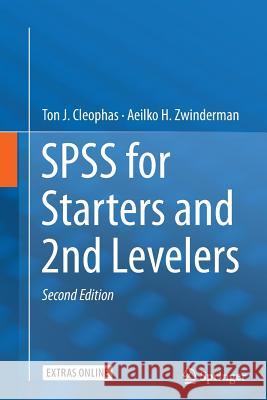
SPSS for Starters and 2nd Levelers

ISBN-13: 9783319342504 / Angielski / Miękka / 2016 / 375 str.
Ton J. Cleophas; Aeilko H. Zwinderman
SPSS for Starters and 2nd Levelers Ton J. Cleophas Aeilko H. Zwinderman 9783319342504 Springer - książkaWidoczna okładka, to zdjęcie poglądowe, a rzeczywista szata graficzna może różnić się od prezentowanej.

SPSS for Starters and 2nd Levelers

ISBN-13: 9783319342504 / Angielski / Miękka / 2016 / 375 str.

Ton J. Cleophas; Aeilko H. Zwinderman
cena 200,77
(netto: 191,21 VAT:  5%)

Najniższa cena z 30 dni: 192,74
Termin realizacji zamówienia:
ok. 22 dni roboczych
Dostawa w 2026 r.

Darmowa dostawa!

A unique point of this book is its low threshold, textually simple and at the same time full of self-assessment opportunities. Other unique points are the succinctness of the chapters with 3 to 6 pages, the presence of entire-commands-texts of the statistical methodologies reviewed and the fact that dull scientific texts imposing an unnecessary burden on busy and jaded professionals have been left out. For readers requesting more background, theoretical and mathematical information a note section with references is in each chapter.
The first edition in 2010 was the first publication of a complete overview of SPSS methodologies for medical and health statistics. Well over 100,000 copies of various chapters were sold within the first year of publication. Reasons for a rewrite were four.First, many important comments from readers urged for a rewrite. Second, SPSS has produced many updates and upgrades, with relevant novel and improved methodologies. Third, the authors felt that the chapter texts needed some improvements for better readability: chapters have now been classified according the outcome data helpful for choosing your analysis rapidly, a schematic overview of data, and explanatory graphs have been added. Fourth, current data are increasingly complex and many important methods for analysis were missing in the first edition.For that latter purpose some more advanced methods seemed unavoidable, like hierarchical loglinear methods, gamma and Tweedie regressions and random intercept analyses. In order for the contents of the book to remain covered by the title, the authors renamed the book: SPSS for Starters and 2nd Levelers.Special care was, nonetheless, taken to keep things as simple as possible, simple menu commands are given. The arithmetic is still of a no-more-than high-school level. Step-by-step analyses of different statistical methodologies are given with the help of 60 SPSS data files available through the internet. Because of the lack of time of this busy group of people, the authors have given every effort to produce a text as succinct as possible.


Kategorie:
Nauka, Medycyna
Kategorie BISAC:
Medical > Research
Computers > Data Science - General
Computers > Artificial Intelligence - Computer Vision & Pattern Recognition
Wydawca:
Springer
Język:
Angielski
ISBN-13:
9783319342504
Rok wydania:
2016
Wydanie:
Softcover Repri
Ilość stron:
375
Waga:
0.56 kg
Wymiary:
23.39 x 15.6 x 2.11
Oprawa:
Miękka
Wolumenów:
01
Dodatkowe informacje:
Wydanie ilustrowane

1: One-Sample Continuous Data (One-Sample T-Test, One-Sample Wilcoxon Signed Rank Test, 10 Patients).- 2: Paired Continuous Data (Paired T-Test, Wilcoxon Signed Rank Test, 10 Patients).- 3: Paired Continuous Data with Predictors (Generalized Linear Models, 50 Patients).- 4: Unpaired Continuous Data (Unpaired T-Test, Mann-Whitney, 20 Patients).- 5: Linear Regression (20 Patients).- 6: Multiple Linear Regression (20 Patients).- 7: Automatic Linear Regression (35 Patients).- 8: Linear Regression with Categorical Predictors (60 Patients).- 9: Repeated Measures Analysis of Variance, Friedman (10 Patients).- 10: Repeated Measures Analysis of Variance Plus Predictors (10 Patients).- 11: Doubly Repeated Measures Analysis of Variance (16 Patients).- 12:Repeated Measures Mixed-Modeling (20 Patients).- 13:  Unpaired Continuous Data with Three or More Groups (One Way Analysis of Variance, Kruskal-Wallis, 30 Patients).- 14: Automatic Nonparametric Testing (30 Patients).- 15: Trend Test for Continuous Data (30 Patients).- 16: Multistage Regression (35 Patients).- 17: Multivariate Analysis with Path Statistics (35 Patients).- 18: Multivariate Analysis of Variance (35 and 30 Patients).- 19: Missing Data Imputation (35 Patients).- 20: Meta-regression (20 and 9 Studies).- 21: Poisson Regression for Outcome Rates (50 Patients).- 22: Confounding (40 Patients).- 23: Interaction, Random Effect Analysis of Variance (40 Patients).- 24: General Loglinear Models for Identifying Subgroups with Large Health Risks (12 Populations).- 25: Curvilinear Estimation (20 Patients).- 26: Loess and Spline Modeling (90 Patients).- 27: Monte Carlo Tests for Continuous Data (10 and 20 Patients).- 28: Artificial Intelligence Using Distribution Free Data (90 Patients).- 29: Robust Testing (33 Patients).- 30: Nonnegative Outcomes Assessed with Gamma Distribution (110 Patients).- 31: Nonnegative Outcomes Assessed with Tweedie Distribution (110 Patients).- 32: Validating Quantitative Diagnostic Tests (17 Patients).- 33: Reliability Assessment of Quantitative Diagnostic Tests (17 Patients).- 34: One-Sample Binary Data (One-Sample Z-Test, Binomial Test, 55 Patients).- 35: Unpaired Binary Data (Chi-Square Test, 55 Patients).- 36: Logistic Regression with a Binary Predictor (55 Patients).- 37: Logistic Regression with a Continuous Predictor (55 Patients).- 38: Logistic Regression with Multiple Predictors (55 Patients).- 39: Logistic Regression with Categorical Predictors (60 Patients).- 40: Trend Tests for Binary Data (106 Patients).- 41: Paired Binary (McNemar Test) (139 General Practitioners).- 42: Paired Binary Data with Predictor (139 General Practitioners).- 43: Repeated Measures Binary Data (Cochran’s Q Test), (139 Patients).- 44: Multinomial Regression for Outcome Categories (55 Patients).- 45: Random Intercept for Categorical Outcome and Predictor Variables (55 Patients).- 46: Comparing the Performance of Diagnostic Tests (650 and 588 Patients).- 47: Poisson Regression for Binary Outcomes (52 Patients).- 48: Ordinal Regression for Data with Underpresented Outcome Categories (450 Patients).- 49: Probit Regression, Binary Data as Response Rates (14 Tests).- 50: Monte Carlo Tests for Binary Data (139 Physicians and 55 Patients).- 51: Loglinear Models, Logit Loglinear Models (445 Patients).- 52: Loglinear Models, Hierarchical Loglinear Models (445 Patients).- 53: Validating Qualitative Diagnostic Tests (575 Patients).- 54: Reliability Assessment of Qualitative Diagnostic Tests (17 Patients).- 55: Log Rank Testing (60 Patients).- 56: Cox Regression With/Without Time Dependent Variables (60 Patients).- 57: Segmented Cox Regression (60 Patients).- 58: Assessing Seasonality (24 Averages).- 59: Interval Censored Data Analysis for Assessing Mean Time to Cancer Relapse (51 Patients).- 60: Polynomial Analysis of Circadian Rhythms (1 Patient with Hypertension)

For medical and health workers this book is a must-have, because statistical methods in these fields are vital, and no equivalent work is available. For medical and health students this is equally true.

A unique point is its low threshold, textually simple and at the same time full of self-assessment opportunities. Other unique points are the succinctness of the chapters with 3 to 6 pages, the presence of entire-commands-texts of the statistical methodologies reviewed, and the fact that dull scientific texts imposing an unnecessary burden on busy and jaded professionals have been left out. For readers requesting more background, theoretical and mathematical information a note section with references is in each chapter.

The first edition in 2010 was the first publication of a complete overview of SPSS methodologies for medical and health statistics. Well over 100,000 copies of various chapters were sold within the first year of publication. Reasons for a rewrite were four.

First, many important comments from readers urged for a rewrite. Second, SPSS has produced many updates and upgrades, with relevant novel and improved methodologies. Third, the authors felt that the chapter texts needed some improvements for better readability: chapters have now been classified according the outcome data helpful for choosing your analysis rapidly, a schematic overview of data, and explanatory graphs have been added. Fourth, current data are increasingly

complex and many important methods for analysis were missing in the first edition.

For that latter purpose some more advanced methods seemed unavoidable, like hierarchical loglinear methods, gamma and Tweedie regressions, and random intercept analyses. In order for the contents of the book to remain covered by the title, the authors renamed the book: SPSS for Starters and 2nd Levelers.

Special care was, nonetheless, taken to keep things as simple as possible. Medical and health professionals tend to dislike software syntax. Therefore, virtually no syntax, but, rather,  simple menu commands are given. The arithmetic is still of a no-more-than high-school level. Step-by-step analyses of different statistical methodologies are given with the help of 60 SPSS data files available through the internet. Because of the lack of time of this busy group of people, the authors have given every effort to produce a text as succinct as possible.



Udostępnij

Facebook - konto krainaksiazek.pl


Opinie o Krainaksiazek.pl na Opineo.pl

Partner Mybenefit

Krainaksiazek.pl w programie rzetelna firma Krainaksiaze.pl - płatności przez paypal

Czytaj nas na:

Facebook - krainaksiazek.pl
  • książki na zamówienie
  • granty
  • książka na prezent
  • kontakt
  • pomoc
  • opinie
  • regulamin
  • polityka prywatności

Zobacz:

  • Księgarnia czeska

  • Wydawnictwo Książkowe Klimaty

1997-2025 DolnySlask.com Agencja Internetowa

© 1997-2022 krainaksiazek.pl
     
KONTAKT | REGULAMIN | POLITYKA PRYWATNOŚCI | USTAWIENIA PRYWATNOŚCI
Zobacz: Księgarnia Czeska | Wydawnictwo Książkowe Klimaty | Mapa strony | Lista autorów
KrainaKsiazek.PL - Księgarnia Internetowa

Polityka prywatnosci - link
Krainaksiazek.pl - płatnośc Przelewy24
Przechowalnia Przechowalnia





