• Wyszukiwanie zaawansowane
  • Kategorie
  • Kategorie BISAC
  • Książki na zamówienie
  • Promocje
  • Granty
  • Książka na prezent
  • Opinie
  • Pomoc
  • Załóż konto
  • Zaloguj się

Rules for Reasoning » książka


zaloguj się | załóż konto
Logo Krainaksiazek.pl

koszyk

konto

szukaj
topmenu
Księgarnia internetowa
Szukaj
Książki na zamówienie
Promocje
Granty
Książka na prezent
Moje konto
Pomoc
 
 
Wyszukiwanie zaawansowane
Pusty koszyk
Bezpłatna dostawa dla zamówień powyżej 20 złBezpłatna dostawa dla zamówień powyżej 20 zł

Kategorie główne

• Nauka
 [2946912]
• Literatura piękna
 [1852311]

  więcej...
• Turystyka
 [71421]
• Informatyka
 [150889]
• Komiksy
 [35717]
• Encyklopedie
 [23177]
• Dziecięca
 [617324]
• Hobby
 [138808]
• AudioBooki
 [1671]
• Literatura faktu
 [228371]
• Muzyka CD
 [400]
• Słowniki
 [2841]
• Inne
 [445428]
• Kalendarze
 [1545]
• Podręczniki
 [166819]
• Poradniki
 [480180]
• Religia
 [510412]
• Czasopisma
 [525]
• Sport
 [61271]
• Sztuka
 [242929]
• CD, DVD, Video
 [3371]
• Technologie
 [219258]
• Zdrowie
 [100961]
• Książkowe Klimaty
 [124]
• Zabawki
 [2341]
• Puzzle, gry
 [3766]
• Literatura w języku ukraińskim
 [255]
• Art. papiernicze i szkolne
 [7810]
Kategorie szczegółowe BISAC

Rules for Reasoning

ISBN-13: 9780805812572 / Angielski / Miękka / 1993 / 432 str.
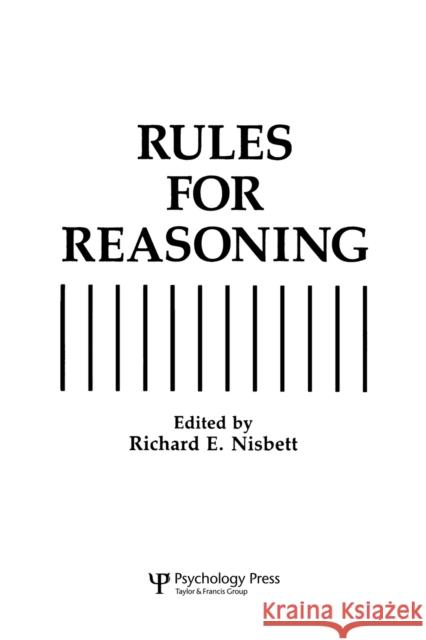
Richard E. Nisbett;Richard E. Nisbett; Richard E. Nisbett
Rules for Reasoning Richard E. Nisbett Richard E. Nisbett  Richard E.  Nisbett 9780805812572 Taylor & Francis - książkaWidoczna okładka, to zdjęcie poglądowe, a rzeczywista szata graficzna może różnić się od prezentowanej.

Rules for Reasoning

ISBN-13: 9780805812572 / Angielski / Miękka / 1993 / 432 str.

Richard E. Nisbett;Richard E. Nisbett; Richard E. Nisbett
cena 329,61
(netto: 313,91 VAT:  5%)

Najniższa cena z 30 dni: 317,30
Termin realizacji zamówienia:
ok. 22 dni roboczych
Dostawa w 2026 r.

Darmowa dostawa!
inne wydania

This book examines two questions: Do people make use of abstract rules such as logical and statistical rules when making inferences in everyday life? Can such abstract rules be changed by training? Contrary to the spirit of reductionist theories from behaviorism to connectionism, there is ample evidence that people do make use of abstract rules of inference -- including rules of logic, statistics, causal deduction, and cost-benefit analysis. Such rules, moreover, are easily alterable by instruction as it occurs in classrooms and in brief laboratory training sessions. The fact that purely formal training can alter them and that those taught in one content domain can escape to a quite different domain for which they are also highly applicable shows that the rules are highly abstract. The major implication for cognitive science is that people are capable of operating with abstract rules even for concrete, mundane tasks; therefore, any realistic model of human inferential capacity must reflect this fact. The major implication for education is that people can be far more broadly influenced by training than is generally supposed.At high levels of formality and abstraction, relatively brief training can alter the nature of problem-solving for an infinite number of content domains.


This book examines two questions: Do people make use of abstract rules such as logical and statistical rules when making inferences in everyday life? Can such abstract rules be changed by training? Contrary to the spirit of reductionist theories from behaviorism to connectionism, there is ample evidence that people do make use of abstract rules of inference -- including rules of logic, statistics, causal deduction, and cost-benefit analysis. Such rules, moreover, are easily alterable by instruction as it occurs in classrooms and in brief laboratory training sessions. The fact that purely formal training can alter them and that those taught in one content domain can "escape" to a quite different domain for which they are also highly applicable shows that the rules are highly abstract. The major implication for cognitive science is that people are capable of operating with abstract rules even for concrete, mundane tasks; therefore, any realistic model of human inferential capacity must reflect this fact. The major implication for education is that people can be far more broadly influenced by training than is generally supposed. At high levels of formality and abstraction, relatively brief training can alter the nature of problem-solving for an infinite number of content domains.

Kategorie:
Nauka, Psychologia
Kategorie BISAC:
Philosophy > Logic
Psychology > Cognitive Psychology & Cognition
Wydawca:
Taylor & Francis
Język:
Angielski
ISBN-13:
9780805812572
Rok wydania:
1993
Dostępne języki:
Ilość stron:
432
Waga:
0.57 kg
Wymiary:
22.86 x 15.24 x 2.24
Oprawa:
Miękka
Dodatkowe informacje:
Bibliografia

"...will appeal to a wide range of people, including cognitive and social psychologists, educational psychologists, educators at most school levels, and university instructors....brings the state of knowledge on reasoning into the 20th century and explodes a number of previously predominant myths, assumptions, and positions taken over the years within psychology....Any professional interested in how people reason will want to read this book. It is packed with information that will appeal to a broad audience and does an excellent job of taking basic science psychology research and applying it to an important domain, namely education."
—Contemporary Psychology

Contents: R.E. Nisbett, Reasoning, Abstraction, and the Prejudices of 20th Century Psychology. Part I:Establishing the Existence of Rules for Reasoning. R.E. Nisbett, D.H. Krantz, D. Jepson, Z. Kunda, The Use of Statistical Heuristics in Everyday Reasoning. P. Thagard, R.E. Nisbett, Variability and Confirmation. D. Jepson, D.H. Krantz, R.E. Nisbett, Inductive Reasoning: Competence or Skill? Part II:Teaching Statistical Rules. G.T. Fong, D.H. Krantz, R.E. Nisbett, The Effects of Statistical Training on Thinking About Everyday Problems. G.T. Fong, R.E. Nisbett, Immediate and Delayed Transfer of Training Effects in Statistical Reasoning. Part III:Rules for Conditional Reasoning. P. Cheng, K.J. Holyoak, R.E. Nisbett, L. Oliver, Pragmatic Versus Syntactic Approaches to Training Deductive Reasoning. Part IV:Rules for Causal Reasoning. P. Cheng, R.E. Nisbett, Pragmatic Constraints on Causal Deduction. M.W. Morris, R.E. Nisbett, Tools of the Trade: Deductive Schemas Taught in Psychology and Philosophy. Part V:Rules for Choice. R.P. Larrick, J.N. Morgan, R.E. Nisbett, Teaching the Use of Cost-Benefit Reasoning in Everyday Life. R.P. Larrick, R.E. Nisbett, J.N. Morgan, Who Uses the Normative Rules of Choice? Part VI:Implications for Education. R.E. Nisbett, G.T. Fong, D.R. Lehman, P. Cheng, Teaching Reasoning. D.R. Lehman, R.O. Lempert, R.E. Nisbett, The Effects of Graduate Training on Reasoning: Formal Discipline and Thinking About Everyday Life Events. D.R. Lehman, R.E. Nisbett, A Longitudinal Study of the Effects of Undergraduate Education on Reasoning. Part VII:Implications for Cognitive Science. E.E. Smith, C. Langston, R.E. Nisbett, The Case for Rules in Reasoning.

Richard E. Nisbett, Richard E. Nisbett, Richard E. Nisbett


Udostępnij

Facebook - konto krainaksiazek.pl


Opinie o Krainaksiazek.pl na Opineo.pl

Partner Mybenefit

Krainaksiazek.pl w programie rzetelna firma Krainaksiaze.pl - płatności przez paypal

Czytaj nas na:

Facebook - krainaksiazek.pl
  • książki na zamówienie
  • granty
  • książka na prezent
  • kontakt
  • pomoc
  • opinie
  • regulamin
  • polityka prywatności

Zobacz:

  • Księgarnia czeska

  • Wydawnictwo Książkowe Klimaty

1997-2025 DolnySlask.com Agencja Internetowa

© 1997-2022 krainaksiazek.pl
     
KONTAKT | REGULAMIN | POLITYKA PRYWATNOŚCI | USTAWIENIA PRYWATNOŚCI
Zobacz: Księgarnia Czeska | Wydawnictwo Książkowe Klimaty | Mapa strony | Lista autorów
KrainaKsiazek.PL - Księgarnia Internetowa

Polityka prywatnosci - link
Krainaksiazek.pl - płatnośc Przelewy24
Przechowalnia Przechowalnia




