• Wyszukiwanie zaawansowane
  • Kategorie
  • Kategorie BISAC
  • Książki na zamówienie
  • Promocje
  • Granty
  • Książka na prezent
  • Opinie
  • Pomoc
  • Załóż konto
  • Zaloguj się

Routine Data Processing in Earthquake Seismology: With Sample Data, Exercises and Software » książka


zaloguj się | załóż konto
Logo Krainaksiazek.pl

koszyk

konto

szukaj
topmenu
Księgarnia internetowa
Szukaj
Książki na zamówienie
Promocje
Granty
Książka na prezent
Moje konto
Pomoc
 
 
Wyszukiwanie zaawansowane
Pusty koszyk
Bezpłatna dostawa dla zamówień powyżej 20 złBezpłatna dostawa dla zamówień powyżej 20 zł

Kategorie główne

• Nauka
 [2946600]
• Literatura piękna
 [1856966]

  więcej...
• Turystyka
 [72221]
• Informatyka
 [151456]
• Komiksy
 [35826]
• Encyklopedie
 [23190]
• Dziecięca
 [619653]
• Hobby
 [140543]
• AudioBooki
 [1577]
• Literatura faktu
 [228355]
• Muzyka CD
 [410]
• Słowniki
 [2874]
• Inne
 [445822]
• Kalendarze
 [1744]
• Podręczniki
 [167141]
• Poradniki
 [482898]
• Religia
 [510455]
• Czasopisma
 [526]
• Sport
 [61590]
• Sztuka
 [243598]
• CD, DVD, Video
 [3423]
• Technologie
 [219201]
• Zdrowie
 [101638]
• Książkowe Klimaty
 [124]
• Zabawki
 [2473]
• Puzzle, gry
 [3898]
• Literatura w języku ukraińskim
 [254]
• Art. papiernicze i szkolne
 [8170]
Kategorie szczegółowe BISAC

Routine Data Processing in Earthquake Seismology: With Sample Data, Exercises and Software

ISBN-13: 9789048186969 / Angielski / Twarda / 2010 / 360 str.
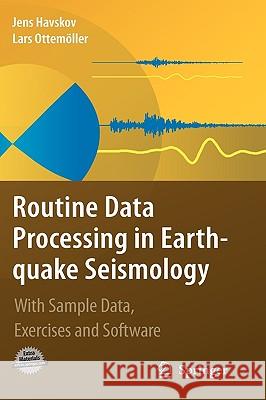
Jens Havskov; Lars Ottemoller
Routine Data Processing in Earthquake Seismology: With Sample Data, Exercises and Software Havskov, Jens 9789048186969 Springer - książkaWidoczna okładka, to zdjęcie poglądowe, a rzeczywista szata graficzna może różnić się od prezentowanej.

Routine Data Processing in Earthquake Seismology: With Sample Data, Exercises and Software

ISBN-13: 9789048186969 / Angielski / Twarda / 2010 / 360 str.

Jens Havskov; Lars Ottemoller
cena 423,65 zł
(netto: 403,48 VAT:  5%)

Najniższa cena z 30 dni: 404,80 zł
Termin realizacji zamówienia:
ok. 22 dni roboczych
Bez gwarancji dostawy przed świętami

Darmowa dostawa!
inne wydania

The purpose of this book is to get a practical understanding of the most common processing techniques in earthquake seismology. The book deals with manual methods and computer assisted methods. Each topic will be introduced with the basic theory followed by practical examples and exercises. There are manual exercises entirely based on the printed material of the book, as well as computer exercises based on public domain software. Most exercises are computer based. The software used, as well as all test data are available from http: //extras.springer.com. This book is intended for everyone processing earthquake data, both in the observatory routine and in connection with research. Using the exercises, the book can also be used as a basis for university courses in earthquake processing. Since the main emphasis is on processing, the theory will only be dealt with to the extent needed to understand the processing steps, however references will be given to where more extensive explanations can be found. Includes
Exercises
Test data
Public domain software (SEISAN)
available from http: //extras.springer.com"


Kategorie:
Nauka, Geografia
Kategorie BISAC:
Science > Geofizyka
Science > Earth Sciences - Geology
Technology & Engineering > Civil - Soil & Rock
Wydawca:
Springer
Język:
Angielski
ISBN-13:
9789048186969
Rok wydania:
2010
Wydanie:
2010
Ilość stron:
360
Waga:
0.68 kg
Wymiary:
23.39 x 15.6 x 2.06
Oprawa:
Twarda
Wolumenów:
01
Dodatkowe informacje:
Bibliografia
Wydanie ilustrowane

From the reviews:

"A book useful for training students in basic analysis skills ... . The book has a clear target audience: the routine analysts who manually process seismic network data. ... The approach could be characterized as suitably utilitarian. A strength of the book is the assumption that operators will use one of the existing seismic data analysis systems. The authors have a fairly wide knowledge of present systems and data recording formats and present some useful critiques of them." (George Helffrich, Geological Magazine, February, 2011)

"The book presents a very good overview of the routine data processing in earthquake seismology. It should find its place at every seismological data center, serving as a general guide, a reminder of the issues that are not part of the data center's everyday routine and an overview for the data center's beginners or for visitors." (Pawel Wiejacz, Pure and Applied Geophysics, Vol. 168, 2011)

Preface. 1. Introduction. 1.1. Earthquakes. 1.2. Recording seismic events and picking phases. 1.3. Locating earthquakes. 1.4. Magnitude. 1.5. Fault plane solution. 1.6. Further data analysis. 1.7. Software. 2. Earth structure and seismic phases. 2.1. Earth structure. 2.2. Seismic rays. 2.3. Seismic phases. 2.4. Travel times. 2.5. Seismic phases at different distances. 2.6. Determination of structure. 2.7. Exercises. 3. Instruments and waveform data. 3.1. Seismic sensors. 3.2. Seismic recorders. 3.3. Correction for instrument response. 3.4. Waveform formats. 3.5. Seismic noise. 3.6. Exercises. 4. Signal processing. 4.1. Filtering. 4.2. Spectral analysis and instrument correction. 4.3. Reading seismic phases. 4.4. Correlation. 4.5. Particle motion and component rotation. 4.6. Resampling. 4.7. Software. 4.8. Exercises. 5. Location. 5.1. Single station location. 5.2. Multiple station location. 5.3. Computer implementation. 5.4. Error quantification and statistics. 5.5 Relative lovation methods. 5.6. Practical considerations in earthquake locations. 5.7. Software. 5.8. Exercises. 6. Magnitude. 6.1. Amplitude and period measurements. 6.2. Local magnitude ML . 6.3. Coda magnitude Mc. 6.4. Body wave magnitude mb. 6.5. Broad band body wave magnitude mB. 6.6. Surface wave magnitude Ms. 6.7. Broad band surface wave magnitude MS. 6.8. Lg – wave magnitude. 6.9. Moment magnitude MW. 6.10. Energy magnitude Me. 6.11. Comparison of magnitude scales. 6.12. Summary. 6.13. Average magnitude and station corrections. 6.14. Adjusting magnitude scales to local or regional conditions. 6.15. Exercises. 7. Focal mechanism and seismogram modeling. 7.1. Fault geometry. 7.2. Source radiation. 7.3. Fault plane solution in practice. 7.4. Obtaining polarity. 7.5. Fault plane solutionusing local data and polarity. 7.6. Composite fault plane solution. 7.7. Fault plane solution using global data. 7.8. Fault plane solution using amplitudes. 7.9 Moment tensor. 7.10. Moment tensor inversion. 7.11. Seismogram modeling. 7.12. Software. 7.13. Exercises. 8. Spectral analysis. 8.1. Attenuation. 8.2. Seismic source model. 8.3. Geometrical spreading. 8.4. Self similarity and seismic source spectra. 8.5. Determination of Q. 8.6. Soil amplification. 8.7. Exercises. 9. Array processing. 9.1. Basic array parameters. 9.2. Beam forming. 9.3. Frequency – wavenumber analysis (fk). 9.4. Array response. 9.5. Processing software. 9.6. Using array measurements for identifying phases. 9.7. Exercises. 10. Operation. 10.1. Data and data storage. 10.2. Routine processing. 10.3. Data exchange. 10.4. Earthquake statistics. 10.5. Software. 10.6. Exercises. References. Software references. Index.

The purpose of this book is to get a practical understanding of the most common processing techniques in earthquake seismology. The book deals with manual methods and computer assisted methods. Each topic will be introduced with the basic theory followed by practical examples and exercises. There are manual exercises entirely based on the printed material of the book, as well as computer exercises based on public domain software. Most exercises are computer based. The software used, as well as all test data are available from http://extras.springer.com.

This book is intended for everyone processing earthquake data, both in the observatory routine and in connection with research. Using the exercises, the book can also be used as a basis for university courses in earthquake processing.

Since the main emphasis is on processing, the theory will only be dealt with to the extent needed to understand the processing steps, however references will be given to where more extensive explanations can be found.

Includes:
• Exercises
• Test data 
• Public domain software (SEISAN)
available from http://extras.springer.com


Udostępnij

Facebook - konto krainaksiazek.pl


Opinie o Krainaksiazek.pl na Opineo.pl

Partner Mybenefit

Krainaksiazek.pl w programie rzetelna firma Krainaksiaze.pl - płatności przez paypal

Czytaj nas na:

Facebook - krainaksiazek.pl
  • książki na zamówienie
  • granty
  • książka na prezent
  • kontakt
  • pomoc
  • opinie
  • regulamin
  • polityka prywatności

Zobacz:

  • Księgarnia czeska

  • Wydawnictwo Książkowe Klimaty

1997-2025 DolnySlask.com Agencja Internetowa

© 1997-2022 krainaksiazek.pl
     
KONTAKT | REGULAMIN | POLITYKA PRYWATNOŚCI | USTAWIENIA PRYWATNOŚCI
Zobacz: Księgarnia Czeska | Wydawnictwo Książkowe Klimaty | Mapa strony | Lista autorów
KrainaKsiazek.PL - Księgarnia Internetowa

Polityka prywatnosci - link
Krainaksiazek.pl - płatnośc Przelewy24
Przechowalnia Przechowalnia






