• Wyszukiwanie zaawansowane
  • Kategorie
  • Kategorie BISAC
  • Książki na zamówienie
  • Promocje
  • Granty
  • Książka na prezent
  • Opinie
  • Pomoc
  • Załóż konto
  • Zaloguj się

Rough Sets: Theoretical Aspects of Reasoning about Data » książka


zaloguj się | załóż konto
Logo Krainaksiazek.pl

koszyk

konto

szukaj
topmenu
Księgarnia internetowa
Szukaj
Książki na zamówienie
Promocje
Granty
Książka na prezent
Moje konto
Pomoc
 
 
Wyszukiwanie zaawansowane
Pusty koszyk
Bezpłatna dostawa dla zamówień powyżej 20 złBezpłatna dostawa dla zamówień powyżej 20 zł

Kategorie główne

• Nauka
 [2946912]
• Literatura piękna
 [1852311]

  więcej...
• Turystyka
 [71421]
• Informatyka
 [150889]
• Komiksy
 [35717]
• Encyklopedie
 [23177]
• Dziecięca
 [617324]
• Hobby
 [138808]
• AudioBooki
 [1671]
• Literatura faktu
 [228371]
• Muzyka CD
 [400]
• Słowniki
 [2841]
• Inne
 [445428]
• Kalendarze
 [1545]
• Podręczniki
 [166819]
• Poradniki
 [480180]
• Religia
 [510412]
• Czasopisma
 [525]
• Sport
 [61271]
• Sztuka
 [242929]
• CD, DVD, Video
 [3371]
• Technologie
 [219258]
• Zdrowie
 [100961]
• Książkowe Klimaty
 [124]
• Zabawki
 [2341]
• Puzzle, gry
 [3766]
• Literatura w języku ukraińskim
 [255]
• Art. papiernicze i szkolne
 [7810]
Kategorie szczegółowe BISAC

Rough Sets: Theoretical Aspects of Reasoning about Data

ISBN-13: 9780792314721 / Angielski / Twarda / 1991 / 231 str.
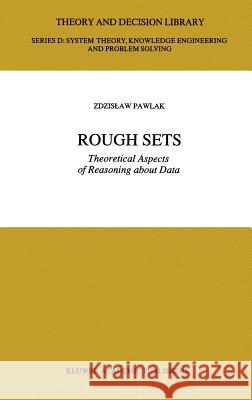
Zdzisaw Pawlak; Z. Pawlak
Rough Sets: Theoretical Aspects of Reasoning about Data Pawlak, Z. 9780792314721 Springer - książkaWidoczna okładka, to zdjęcie poglądowe, a rzeczywista szata graficzna może różnić się od prezentowanej.

Rough Sets: Theoretical Aspects of Reasoning about Data

ISBN-13: 9780792314721 / Angielski / Twarda / 1991 / 231 str.

Zdzisaw Pawlak; Z. Pawlak
cena 1529,72
(netto: 1456,88 VAT:  5%)

Najniższa cena z 30 dni: 1465,09
Termin realizacji zamówienia:
ok. 22 dni roboczych
Bez gwarancji dostawy przed świętami

Darmowa dostawa!

To-date computers are supposed to store and exploit knowledge. At least that is one of the aims of research fields such as Artificial Intelligence and Information Systems. However, the problem is to understand what knowledge means, to find ways of representing knowledge, and to specify automated machineries that can extract useful information from stored knowledge. Knowledge is something people have in their mind, and which they can express through natural language. Knowl edge is acquired not only from books, but also from observations made during experiments; in other words, from data. Changing data into knowledge is not a straightforward task. A set of data is generally disorganized, contains useless details, although it can be incomplete. Knowledge is just the opposite: organized (e.g. laying bare dependencies, or classifications), but expressed by means of a poorer language, i.e. pervaded by imprecision or even vagueness, and assuming a level of granularity. One may say that knowledge is summarized and organized data - at least the kind of knowledge that computers can store."


Kategorie:
Informatyka, Bazy danych
Kategorie BISAC:
Computers > Artificial Intelligence - General
Mathematics > Logic
Business & Economics > Operations Research
Wydawca:
Springer
Seria wydawnicza:
Mathematics and Its Applications. Soviet Series
Język:
Angielski
ISBN-13:
9780792314721
Rok wydania:
1991
Wydanie:
1991
Ilość stron:
231
Waga:
0.54 kg
Wymiary:
24.28 x 16.36 x 2.34
Oprawa:
Twarda
Wolumenów:
01

I. Theoretical Foundations.- 1. Knowledge.- 1.1. Introduction.- 1.2. Knowledge and Classification.- 1.3. Knowledge Base.- 1.4. Equivalence, Generalization and Specialization of Knowledge.- Summary.- Exercises.- References.- 2. Imprecise Categories, Approximations and Rough Sets.- 2.1. Introduction.- 2.2. Rough Sets.- 2.3. Approximations of Set.- 2.4. Properties of Approximations.- 2.5. Approximations and Membership Relation.- 2.6. Numerical Characterization of Imprecision.- 2.7. Topological Characterization of Imprecision.- 2.8. Approximation of Classifications.- 2.9. Rough Equality of Sets.- 2.10. Rough Inclusion of Sets.- Summary.- Exercises.- References.- 3. Reduction of Knowledge.- 3.1. Introduction.- 3.2. Reduct and Core of Knowledge.- 3.3. Relative Reduct and Relative Core of Knowledge.- 3.4. Reduction of Categories.- 3.5. Relative Reduct and Core of Categories.- Summary.- Exercises.- References.- 4. Dependencies in Knowledge Base.- 4.1. Introduction.- 4.2. Dependency of Knowledge.- 4.3. Partial Dependency of Knowledge.- Summary.- Exercises.- References.- 5. Knowledge Representation.- 5.1. Introduction.- 5.2. Examples.- 5.3. Formal Definition.- 5.4. Significance of Attributes.- 5.5. Discernibility Matrix.- Summary.- Exercises.- References.- 6. Decision Tables.- 6.1. Introduction.- 6.2. Formal Definition and Some Properties.- 6.3. Simplification of Decision Tables.- Summary.- Exercises.- References.- 7. Reasoning about Knowledge.- 7.1. Introduction.- 7.2. Language of Decision Logic.- 7.3. Semantics of Decision Logic Language.- 7.4. Deduction in Decision Logic.- 7.5. Normal Forms.- 7.6. Decision Rules and Decision Algorithms.- 7.7. Truth and Indiscernibility.- 7.8. Dependency of Attributes.- 7.9. Reduction of Consistent Algorithms.- 7.10. Reduction of Inconsistent Algorithms.- 7.11. Reduction of Decision Rules.- 7.12. Minimization of Decision Algorithms.- Summary.- Exercises.- References.- II. Applications.- 8. Decision Making.- 8.1. Introduction.- 8.2. Optician’s Decisions Table.- 8.3. Simplification of Decision Table.- 8.4. Decision Algorithm.- 8.5. The Case of Incomplete Information.- Summary.- Exercises.- References.- 9. Data Analysis.- 9.1. Introduction.- 9.2. Decision Table as Protocol of Observations.- 9.3. Derivation of Control Algorithms from Observation.- 9.4. Another Approach.- 9.5. The Case of Inconsistent Data.- Summary.- Exercises.- References.- 10. Dissimilarity Analysis.- 10.1. Introduction.- 10.2. The Middle East Situation.- 10.3. Beauty Contest.- 10.4. Pattern Recognition.- 10.5. Buying a Car.- Summary.- Exercises.- References.- 11. Switching Circuits.- 11.1. Introduction.- 11.2. Minimization of Partially Defined Switching Functions.- 11.3. Multiple-Output Switching Functions.- Summary.- Exercises.- References.- 12. Machine Learning.- 12.1. Introduction.- 12.2. Learning From Examples.- 12.3. The Case of an Imperfect Teacher.- 12.4. Inductive Learning.- Summary.- Exercises.- References.


Udostępnij

Facebook - konto krainaksiazek.pl


Opinie o Krainaksiazek.pl na Opineo.pl

Partner Mybenefit

Krainaksiazek.pl w programie rzetelna firma Krainaksiaze.pl - płatności przez paypal

Czytaj nas na:

Facebook - krainaksiazek.pl
  • książki na zamówienie
  • granty
  • książka na prezent
  • kontakt
  • pomoc
  • opinie
  • regulamin
  • polityka prywatności

Zobacz:

  • Księgarnia czeska

  • Wydawnictwo Książkowe Klimaty

1997-2025 DolnySlask.com Agencja Internetowa

© 1997-2022 krainaksiazek.pl
     
KONTAKT | REGULAMIN | POLITYKA PRYWATNOŚCI | USTAWIENIA PRYWATNOŚCI
Zobacz: Księgarnia Czeska | Wydawnictwo Książkowe Klimaty | Mapa strony | Lista autorów
KrainaKsiazek.PL - Księgarnia Internetowa

Polityka prywatnosci - link
Krainaksiazek.pl - płatnośc Przelewy24
Przechowalnia Przechowalnia






