• Wyszukiwanie zaawansowane
  • Kategorie
  • Kategorie BISAC
  • Książki na zamówienie
  • Promocje
  • Granty
  • Książka na prezent
  • Opinie
  • Pomoc
  • Załóż konto
  • Zaloguj się

Risk and Uncertainty Reduction by Using Algebraic Inequalities » książka

zaloguj się | załóż konto
Logo Krainaksiazek.pl

koszyk

konto

szukaj
topmenu
Księgarnia internetowa
Szukaj
Książki na zamówienie
Promocje
Granty
Książka na prezent
Moje konto
Pomoc
 
 
Wyszukiwanie zaawansowane
Pusty koszyk
Bezpłatna dostawa dla zamówień powyżej 20 złBezpłatna dostawa dla zamówień powyżej 20 zł

Kategorie główne

• Nauka
 [2939893]
• Literatura piękna
 [1808953]

  więcej...
• Turystyka
 [70366]
• Informatyka
 [150555]
• Komiksy
 [35137]
• Encyklopedie
 [23160]
• Dziecięca
 [608786]
• Hobby
 [136447]
• AudioBooki
 [1631]
• Literatura faktu
 [225099]
• Muzyka CD
 [360]
• Słowniki
 [2914]
• Inne
 [442115]
• Kalendarze
 [1068]
• Podręczniki
 [166599]
• Poradniki
 [468390]
• Religia
 [506548]
• Czasopisma
 [506]
• Sport
 [61109]
• Sztuka
 [241608]
• CD, DVD, Video
 [3308]
• Technologie
 [218981]
• Zdrowie
 [98614]
• Książkowe Klimaty
 [124]
• Zabawki
 [2174]
• Puzzle, gry
 [3275]
• Literatura w języku ukraińskim
 [260]
• Art. papiernicze i szkolne
 [7376]
Kategorie szczegółowe BISAC

Risk and Uncertainty Reduction by Using Algebraic Inequalities

ISBN-13: 9780367898007 / Angielski / Twarda / 2020 / 190 str.
Michael T. Todinov
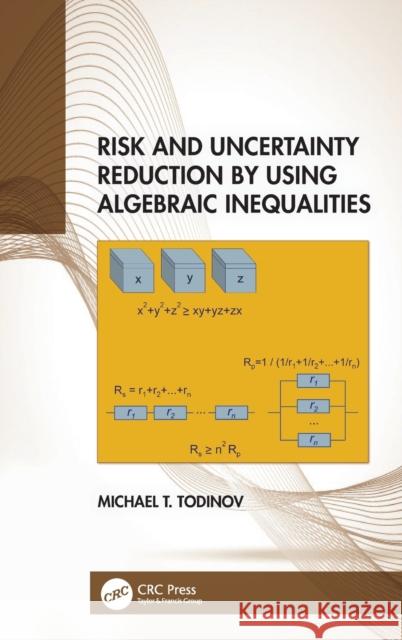
Risk and Uncertainty Reduction by Using Algebraic Inequalities Michael T. Todinov 9780367898007 CRC Press - książkaWidoczna okładka, to zdjęcie poglądowe, a rzeczywista szata graficzna może różnić się od prezentowanej.

Risk and Uncertainty Reduction by Using Algebraic Inequalities

ISBN-13: 9780367898007 / Angielski / Twarda / 2020 / 190 str.

Michael T. Todinov
cena 563,24
(netto: 536,42 VAT:  5%)

Najniższa cena z 30 dni: 528,93
Termin realizacji zamówienia:
ok. 22 dni roboczych.

Darmowa dostawa!
inne wydania

This book provides the reader with a domain-independent method for reducing risk through maximizing reliability, reducing epistemic uncertainty, reducing aleatory uncertainty, ranking the reliabilities of systems and processes, minimizing the risk of faulty assemblies, and ranking decision-making alternatives in the presence of deep uncertainty.


Kategorie:
Technologie
Kategorie BISAC:
Technology & Engineering > Manufacturing
Mathematics > Mathematical Analysis
Mathematics > Prawdopodobieństwo i statystyka
Wydawca:
CRC Press
Język:
Angielski
ISBN-13:
9780367898007
Rok wydania:
2020
Ilość stron:
190
Waga:
0.38 kg
Wymiary:
23.62 x 15.49 x 1.78
Oprawa:
Twarda
Wolumenów:
01
Dodatkowe informacje:
Bibliografia
Wydanie ilustrowane

1. FUNDAMENTAL CONCEPTS RELATED TO RISK AND UNCERTAINTY REDUCTION BY USING ALGEBRAIC INEQUALITIES 1.1 Domain-independent approach to risk reduction1.2 A powerful domain-independent method for risk and uncertainty reduction based on algebraic inequalities 1.3 Risk and uncertainty 2. PROPERTIES OF ALGEBRAIC INEQUALITIES AND STANDARD ALGEBRAIC INEQUALITIES 2.1 Basic rules related to algebraic inequalities2.2 Basic properties of inequalities2.3 One-dimensional triangle inequality2.4 The quadratic inequality2.5 Jensen's inequality2.6 Root-mean square – Arithmetic mean – Geometric mean – Harmonic mean (RMS-AM-GM-HM) inequality 2.7 Weighted Arithmetic mean-Geometric (AM-GM) mean inequality2.8 Hölder's inequality2.9 Cauchy-Schwarz inequality2.10 Rearrangement inequality2.11 Chebyshev's sum inequality2.12 Muirhead's inequality2.13 Markov's inequality2.14 Chebyshev's inequality2.15 Minkowski inequality 3. BASIC TECHNIQUES FOR PROVING ALGEBRAIC INEQUALITIES 3.1 The need for proving algebraic inequalities3.2 Proving inequalities by a direct algebraic manipulation and analysis3.3 Proving inequalities by presenting them as a sum of non-negative terms3.4 Proving inequalities by proving simpler intermediate inequalities3.5 Proving inequalities by a substitution3.6 Proving inequalities by exploiting the symmetry3.7 Proving inequalities by exploiting homogeneity3.8 Proving inequalities by a mathematical induction3.9 Proving inequalities by using the properties of convex/concave functions3.10 Proving inequalities by using the properties of sub-additive and super-additive functions3.11 Proving inequalities by transforming them to known inequalities3.12 Proving inequalities by a segmentation3.13 Proving algebraic inequalities by combining several techniques3.14 Using derivatives to prove inequalities 4. USING OPTIMISATION METHODS FOR DETERMINING TIGHT UPPER AND LOWER BOUNDS. TESTING A CONJECTURED INEQUALITY BY A SIMULATION. EXERCISES 4.1 Using constrained optimisation for determining tight upper bounds4.2 Tight bounds for multivariable functions whose partial derivatives do not change sign in a specified domain4.3 Conventions adopted in presenting the simulation algorithms4.4 Testing a conjectured algebraic inequality by a Monte-Carlo simulation4.5 Exercises4.6 Solutions to the exercises 5. RANKING THE RELIABILITIES OF SYSTEMS AND PROCESSES BY USING INEQUALITIES5.1 Improving reliability and reducing risk by proving an abstract inequality derived from the real physical system or process5.2 Using inequalities for ranking systems whose component reliabilities are unknown5.3 Using inequalities for ranking systems with the same topology and different components arrangements 5.4 Using inequalities to rank systems with different topologies built with the same type of components 6. USING INEQUALITIES FOR REDUCING EPISTEMIC UNCERTAINTY AND RANKING DECISION ALTERNATIVES 6.1 Selection from sources with unknown proportions of high-reliability components6.2 Monte Carlo simulations 6.3 Extending the results by using the Muirhead's inequality 7. CREATING A MEANINGFUL INTERPRETATION OF EXISTING ABSTRACT INEQUALITIES AND LINKING IT TO REAL APPLICATIONS 7.1 Meaningful interpretations of an abstract algebraic inequality with several applications to real physical systems7.2 Avoiding underestimation of the risk and overestimation of average profit by a meaningful interpretation of the Chebyshev's sum inequality 7.3 A meaningful interpretation of an abstract algebraic inequality with an application to selecting components of the same variety7.4 Maximising the chances of a beneficial random selection by a meaningful interpretation of a general inequality7.5 The principle of non-contradiction 8. INEQUALITIES MINIMISING THE RISK OF A FAULTY ASSEMBLY AND OPERATION 8.1 Using inequalities for minimising the deviation of reliability-critical parameters8.2 Minimising the deviation of the volume of manufactured cylindrical workpieces with cylindrical shape 8.3 Minimising the deviation of the volume of manufactured workpieces in the shape of a rectangular prism8.4 Minimising the deviation of the resonant frequency from the required level, for parallel resonant LC-circuits8.5 Maximising reliability by using the rearrangement inequality 8.6 Using the rearrangement inequality to minimise the risk of a faulty assembly 9. DETERMINING TIGHT BOUNDS FOR THE UNCERTAINTY IN RISK-CRITICAL PARAMETERS AND PROPERTIES BY USING INEQUALITIES 9.1 Upper-bound variance inequality for properties from different sources9.2 Identifying the source whose removal causes the largest reduction of the worst-case variation9.3 Increasing the robustness of electronic devices by using the variance-upper-bound inequality9.4 Determining tight bounds for the fraction of items with a particular property9.5 Using the properties of convex functions for determining the upper bound of the equivalent resistance for resistors with uncertain values9.6 Determining a tight upper bound for the risk of a faulty assembly by using the Chebyshev's inequality9.7 Deriving a tight upper bound for the risk of a faulty assembly by using the Chebyshev's inequality and Jensen's inequality 10. USING ALGEBRAIC INEQUALITIES TO SUPPORT RISK-CRITICAL REASONING 10.1 Using the inequality of the negatively correlated events to support risk-critical reasoning10.2 Avoiding risk underestimation by using the Jensen's inequality 10.3 Reducing uncertainty and risk associated with the prediction of the magnitudes ranking related to random outcomes 11. REFERENCES

Michael T. Todinov, PhD, has a background in mechanical engineering, applied mathematics and computer science. Prof.Todinov pioneered reliability analysis based on the cost of failure, repairable flow networks andnetworks with disturbed flows, domain-independent methods for reliability improvement and risk reduction and reducing risk and uncertainty by using algebraic inequalities.


Udostępnij

Facebook - konto krainaksiazek.pl


Opinie o Krainaksiazek.pl na Opineo.pl

Partner Mybenefit

Krainaksiazek.pl w programie rzetelna firma Krainaksiaze.pl - płatności przez paypal

Czytaj nas na:

Facebook - krainaksiazek.pl
  • książki na zamówienie
  • granty
  • książka na prezent
  • kontakt
  • pomoc
  • opinie
  • regulamin
  • polityka prywatności

Zobacz:

  • Księgarnia czeska

  • Wydawnictwo Książkowe Klimaty

1997-2026 DolnySlask.com Agencja Internetowa

© 1997-2022 krainaksiazek.pl
     
KONTAKT | REGULAMIN | POLITYKA PRYWATNOŚCI | USTAWIENIA PRYWATNOŚCI
Zobacz: Księgarnia Czeska | Wydawnictwo Książkowe Klimaty | Mapa strony | Lista autorów
KrainaKsiazek.PL - Księgarnia Internetowa

Polityka prywatnosci - link
Krainaksiazek.pl - płatnośc Przelewy24
Przechowalnia Przechowalnia







