• Wyszukiwanie zaawansowane
  • Kategorie
  • Kategorie BISAC
  • Książki na zamówienie
  • Promocje
  • Granty
  • Książka na prezent
  • Opinie
  • Pomoc
  • Załóż konto
  • Zaloguj się

Risk, Disaster and Crisis Reduction: Mobilizing, Collecting and Sharing Information » książka


zaloguj się | załóż konto
Logo Krainaksiazek.pl

koszyk

konto

szukaj
topmenu
Księgarnia internetowa
Szukaj
Książki na zamówienie
Promocje
Granty
Książka na prezent
Moje konto
Pomoc
 
 
Wyszukiwanie zaawansowane
Pusty koszyk
Bezpłatna dostawa dla zamówień powyżej 20 złBezpłatna dostawa dla zamówień powyżej 20 zł

Kategorie główne

• Nauka
 [2946912]
• Literatura piękna
 [1852311]

  więcej...
• Turystyka
 [71421]
• Informatyka
 [150889]
• Komiksy
 [35717]
• Encyklopedie
 [23177]
• Dziecięca
 [617324]
• Hobby
 [138808]
• AudioBooki
 [1671]
• Literatura faktu
 [228371]
• Muzyka CD
 [400]
• Słowniki
 [2841]
• Inne
 [445428]
• Kalendarze
 [1545]
• Podręczniki
 [166819]
• Poradniki
 [480180]
• Religia
 [510412]
• Czasopisma
 [525]
• Sport
 [61271]
• Sztuka
 [242929]
• CD, DVD, Video
 [3371]
• Technologie
 [219258]
• Zdrowie
 [100961]
• Książkowe Klimaty
 [124]
• Zabawki
 [2341]
• Puzzle, gry
 [3766]
• Literatura w języku ukraińskim
 [255]
• Art. papiernicze i szkolne
 [7810]
Kategorie szczegółowe BISAC

Risk, Disaster and Crisis Reduction: Mobilizing, Collecting and Sharing Information

ISBN-13: 9783319085418 / Angielski / Twarda / 2014 / 184 str.
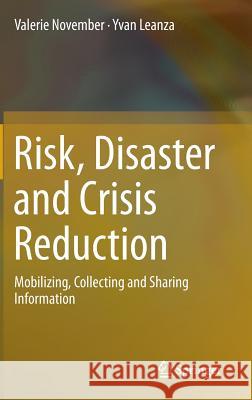
Valerie November; Yvan Leanza
Risk, Disaster and Crisis Reduction: Mobilizing, Collecting and Sharing Information November, Valerie 9783319085418 Springer - książkaWidoczna okładka, to zdjęcie poglądowe, a rzeczywista szata graficzna może różnić się od prezentowanej.

Risk, Disaster and Crisis Reduction: Mobilizing, Collecting and Sharing Information

ISBN-13: 9783319085418 / Angielski / Twarda / 2014 / 184 str.

Valerie November; Yvan Leanza
cena 403,47
(netto: 384,26 VAT:  5%)

Najniższa cena z 30 dni: 385,52
Termin realizacji zamówienia:
ok. 22 dni roboczych
Bez gwarancji dostawy przed świętami

Darmowa dostawa!

In the field of risks and crises, both the access to relevant information and its circulation are seen as crucial factors. Based on a new integrated theoretical model focusing on the stakeholder, the book proposes analysis of information reformulation and circulation in risk environments and crisis situations.Simply circulating the information does not mean that it will be picked up by those who could benefit from it. This has been amply demonstrated by the various crises and catastrophes that have shaken the planet in recent years. In order to be able to deal with risk situations and crises, it must be possible for information - when it circulates - to be understood and interpreted by a wide range of stakeholders, working in fields such as health and natural or environmental risks. By observing closely, in three very different situations, the way in which information is gathered, processed, distributed and used, this book examines the countless reformulations, redefinitions and even reorientations to which all information is subjected. This multiple reformatting, at least according to the hypothesis put forward in this book, is an important element in ensuring that the information produced circulates and reaches those for whom it is intended. The intention is then to analyze the way in which information circulates in situations of risk and crisis. In order to do it, the authors propose a new theoretical model based on different approaches. This model is anchored in the trend of research that has been oriented towards a wider understanding of risks and their territorial and social consequences. These ideas question the approach to risk which focuses primarily on technical aspects and probability. The model also draws from approaches to risk that focus on the stakeholders involved in the debates and the need for an integrated vision of risks. Risks are thus considered heterogeneous, plural and transcalar. The information flow about risks was studied first in the SHOC Room of the World Health Organization (WHO) in Geneva, a central place through which passes all information destined to managing world-wide epidemic risks. Then the research team monitored the constitution and the reception of a field library about risks management and reduction sent to Madagascar, an island systematically hit by cyclones. This following process has permitted the analysis of information dissemination during a crisis situation. The third field work was done in Cameroun to observe the use and transmission of information in two NGO specializing in sanitary risks prevention using traditional and biomedical conceptualization of health and illness. The book ends with a practical tool to assess and help the information circulation in risk and crisis situations.


Kategorie:
Nauka, Medycyna
Kategorie BISAC:
Nature > Natural Disasters
Medical > Preventive Medicine
Social Science > Methodology
Wydawca:
Springer
Język:
Angielski
ISBN-13:
9783319085418
Rok wydania:
2014
Wydanie:
2015
Ilość stron:
184
Waga:
0.45 kg
Wymiary:
23.39 x 15.6 x 1.27
Oprawa:
Twarda
Wolumenów:
01

Preface.- Risk and Information: for a new Conceptual Framework.- A Contemporary Look at Risks: Risks are Plural and Transcalar.- Information as a Process.- Definitions, Classifications and Models.- Reviewing Risk Categories.- Integrated Risk Management.- Temporal Risk Models.- Contextualising the Stages of Risk and the Various Types of Expertise.- The Information Flow.- Proposing a new Conceptual Framework.- The Translation Process.- The Holds.- The Trajectories.- The Research.- Case Studies.- Methodology.- Field Research.- Disseminating Information and Risk Management in Madagascar.- Risk Management in Madagascar.- The Institutional Structures of Crisis Management.- The Focal Point in Madagascar: the BNGRC.- The Roles and Responsibilities of the Actors.- The Terminology and the Categories of Alert Used.- Prevention, Alleviation, Preparation, Intervention.- Vulnerability.- The Warning.- Permeable Categories.- Definitions and Approaches to Risks.- The Circulation of Risk Information in Madagascar.- The Information Circulation Profiles.- Vertical Communication.- Horizontal Communication.- Actor Profiles.- The Socio-Technical Intermediaries.- Batteries.- Fuel.- Books, Forms and Reports.- Figures.- Conclusion.- Continuity between Categories and Reference Points for Action.- Structure Linking the Levels of Information.- Connexity and Contiguity.- Using and Communicating Information Practices Adopted by Tow Organisations in Cameroon.- Introduction.- The National Context with Regard to Health and Environmental Problems.- Objectives of the Research carried out in Cameroon.- Presentation of two NGOs, Local Contexts and Populations.- Research Methods.- The Doctors Working with Prosenat.- Definition of Risk and of Prevention.- Sources of Information and Professional Training Routes.- Communicating Knowledge.- Circulation of Information.- The Prosenat Traditional Therapists.- Definition of Risk and of Prevention.- Training and Sources of Information.- Communicating Knowledge.- Circulation of Information.- The Members of Wesde.- The Definition of Risk and Prevention.- Training and Sources of Information.- Communicating Knowledge.- Sources of Knowledge and Stages of its Transmission by Wesde.- Synthesis and Reflections.- Professional Definitions of Risk and Prevention.- A Restricting Factor: the Funding Structure for the Transmission of Knowledge.- Professional Training Routes: Gaps in the Transmission of Knowledge.- The Consequences of the Lack of Recognition for Traditional Medicine by the State.- Translation and Transmission of the Information.- Conclusions.- Conclusion.

Valerie November, Ph.D., is CNRS Research Professor and is working at the Techniques, Territories and Society Lab (LATTS), Ecole des Ponts ParisTech. Between 2006 and 2011, she worked as Swiss National Science Foundation Professor at Ecole Polytechnique Federale of Lausanne (EPFL). Her research focuses on risk management in many different fields (natural, environmental, technological, urban), with an approach that mixes human geography and sociology of science and techniques. She published “Habiter les territoires à risques” (2011) and the catalogue of the art-science-society exhibition called “Risk inSight” that she commissioned (2012).

After many migratory movements between Switzerland and Canada, Yvan Leanza, Ph.D., is a full professor in the School of Psychology, Laval University (Québec City) where he teaches cross-cultural psychology and intervention, and leads the “Psychology and Cultures” lab. His research focuses on working with interpreters and relations to the (culturally different) other in healthcare settings and on sleep in a cross-cultural perspective. He is a founding member and the director of Alterstice - International Journal of Intercultural Research. He has edited or authored books on migrant and minority integration processes, and on the relation to the (culturally different) other in pediatrics. He is one of the authors of the only systematic review of interpreting qualitative studies (published in Patient Education and Counselling 91, 2013) and of a chapter on working with interpreters in mental health settings (in Kirmayer, L. et al., 2014, Cultural Consultation, New-York: Springer).

In the field of risks and crises, both the access to relevant information and its circulation are seen as crucial factors. Based on a new integrated theoretical model focusing on the stakeholder, the book proposes analysis of information reformulation and circulation in risk environments and crisis situations.

Simply circulating the information does not mean that it will be picked up by those who could benefit from it. This has been amply demonstrated by the various crises and catastrophes that have shaken the planet in recent years. In order to be able to deal with risk situations and crises, it must be possible for information – when it circulates – to be understood and interpreted by a wide range of stakeholders, working in fields such as health and natural or environmental risks. By observing closely, in three very different situations, the way in which information is gathered, processed, distributed and used, this book examines the countless reformulations, redefinitions and even reorientations to which all information is subjected. This multiple reformatting, at least according to the hypothesis put forward in this book, is an important element in ensuring that the information produced circulates and reaches those for whom it is intended. The intention is then to analyze the way in which information circulates in situations of risk and crisis. In order to do it, the authors propose a new theoretical model based on different approaches. This model is anchored in the trend of research that has been oriented towards a wider understanding of risks and their territorial and social consequences. These ideas question the approach to risk which focuses primarily on technical aspects and probability. The model also draws from approaches to risk that focus on the stakeholders involved in the debates and the need for an integrated vision of risks. Risks are thus considered heterogeneous, plural and transcalar. The information flow about risks was studied first in the SHOC Room of the World Health Organization (WHO) in Geneva, a central place through which passes all information destined to managing world-wide epidemic risks. Then the research team monitored the constitution and the reception of a field library about risks management and reduction sent to Madagascar, an island systematically hit by cyclones. This following process has permitted the analysis of information dissemination during a crisis situation. The third field work was done in Cameroun to observe the use and transmission of information in two NGO specializing in sanitary risks prevention using traditional and biomedical conceptualization of health and illness. The book ends with a practical tool to assess and help the information circulation in risk and crisis situations.



Udostępnij

Facebook - konto krainaksiazek.pl


Opinie o Krainaksiazek.pl na Opineo.pl

Partner Mybenefit

Krainaksiazek.pl w programie rzetelna firma Krainaksiaze.pl - płatności przez paypal

Czytaj nas na:

Facebook - krainaksiazek.pl
  • książki na zamówienie
  • granty
  • książka na prezent
  • kontakt
  • pomoc
  • opinie
  • regulamin
  • polityka prywatności

Zobacz:

  • Księgarnia czeska

  • Wydawnictwo Książkowe Klimaty

1997-2025 DolnySlask.com Agencja Internetowa

© 1997-2022 krainaksiazek.pl
     
KONTAKT | REGULAMIN | POLITYKA PRYWATNOŚCI | USTAWIENIA PRYWATNOŚCI
Zobacz: Księgarnia Czeska | Wydawnictwo Książkowe Klimaty | Mapa strony | Lista autorów
KrainaKsiazek.PL - Księgarnia Internetowa

Polityka prywatnosci - link
Krainaksiazek.pl - płatnośc Przelewy24
Przechowalnia Przechowalnia





