• Wyszukiwanie zaawansowane
  • Kategorie
  • Kategorie BISAC
  • Książki na zamówienie
  • Promocje
  • Granty
  • Książka na prezent
  • Opinie
  • Pomoc
  • Załóż konto
  • Zaloguj się

Revitalising Language in Provence: A Critical Approach » książka

zaloguj się | załóż konto
Logo Krainaksiazek.pl

koszyk

konto

szukaj
topmenu
Księgarnia internetowa
Szukaj
Książki na zamówienie
Promocje
Granty
Książka na prezent
Moje konto
Pomoc
 
 
Wyszukiwanie zaawansowane
Pusty koszyk
Bezpłatna dostawa dla zamówień powyżej 20 złBezpłatna dostawa dla zamówień powyżej 20 zł

Kategorie główne

• Nauka
 [2949965]
• Literatura piękna
 [1857847]

  więcej...
• Turystyka
 [70818]
• Informatyka
 [151303]
• Komiksy
 [35733]
• Encyklopedie
 [23180]
• Dziecięca
 [617748]
• Hobby
 [139972]
• AudioBooki
 [1650]
• Literatura faktu
 [228361]
• Muzyka CD
 [398]
• Słowniki
 [2862]
• Inne
 [444732]
• Kalendarze
 [1620]
• Podręczniki
 [167233]
• Poradniki
 [482388]
• Religia
 [509867]
• Czasopisma
 [533]
• Sport
 [61361]
• Sztuka
 [243125]
• CD, DVD, Video
 [3451]
• Technologie
 [219309]
• Zdrowie
 [101347]
• Książkowe Klimaty
 [123]
• Zabawki
 [2362]
• Puzzle, gry
 [3791]
• Literatura w języku ukraińskim
 [253]
• Art. papiernicze i szkolne
 [7933]
Kategorie szczegółowe BISAC

Revitalising Language in Provence: A Critical Approach

ISBN-13: 9781119243533 / Angielski / Miękka / 2017 / 198 str.
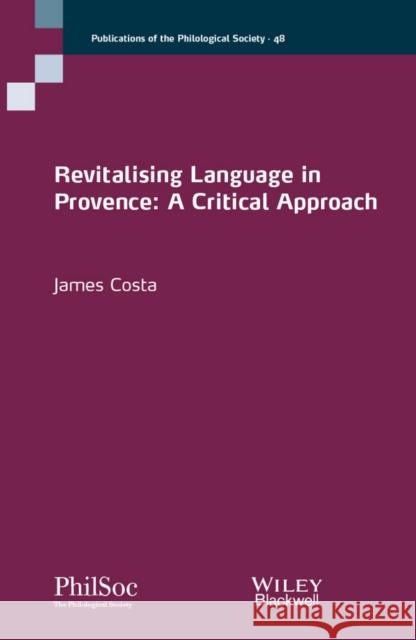
James Costa
Revitalising Language in Provence: A Critical Approach Costa, James 9781119243533 John Wiley & Sons - książkaWidoczna okładka, to zdjęcie poglądowe, a rzeczywista szata graficzna może różnić się od prezentowanej.

Revitalising Language in Provence: A Critical Approach

ISBN-13: 9781119243533 / Angielski / Miękka / 2017 / 198 str.

James Costa
cena 118,04
(netto: 112,42 VAT:  5%)

Najniższa cena z 30 dni: 116,83
Termin realizacji zamówienia:
ok. 30 dni roboczych
Bez gwarancji dostawy przed świętami

Darmowa dostawa!

Revitalising Language in Provence: A Critical Approach questions the concept of language revitalization and challenges the field's main tenets through a detailed analysis Southern France's ProvenCal movement, one of Europe's longest standing language revitalisation projects.

  • Presents a wealth of new research data relating to revitalising language movement
  • Offers an innovative new way of problematizing language revitalisation
  • Questions the very concept of language revitalisation and challenges the field's main tenets
  • Reveals what language revitalisation movements really stand for, what they use language for, and who the people spearheading these movements are

Revitalising Language in Provence: A Critical Approach questions the concept of language revitalisation and challenges the field s main tenets through a detailed analysis Southern France s Provençal movement, one of Europe s longest standing language revitalisation projects.


Kategorie:
Nauka, Językoznawstwo
Kategorie BISAC:
Language Arts & Disciplines > Linguistics - Sociolinguistics
Wydawca:
John Wiley & Sons
Seria wydawnicza:
Publications of the Philological Society
Język:
Angielski
ISBN-13:
9781119243533
Rok wydania:
2017
Ilość stron:
198
Waga:
0.32 kg
Wymiary:
22.86 x 14.73 x 1.52
Oprawa:
Miękka
Wolumenów:
01
Dodatkowe informacje:
Bibliografia
Wydanie ilustrowane

Acknowledgements

Preface

1. Researching language revitalisation from a critical sociolinguistic perspective

1.1. Saving authentic languages vs. inventing new ones

1.2. Language revitalisation

1.3. Language revitalisation in Academic Work

1.4. Revitalising Occitan in Southern France: Occitania and Provence

1.5. Positioning

1.6. Critical sociolinguistics

1.7. Volume outline

Revitalising

2. Language revitalisation: a genealogy

2.1. Introduction: investigating language revitalisation

2.2. The Precursors: antiquarians and French Revolutionaries

2.3. North American scholarship: anthropology and sociolinguistics

2.4. Descriptive linguistics and language endangerment

2.5. Language revitalisation and linguistics

2.6. Language documentation and description established

3. Defining language revitalisation

3.1. Introduction

3.2. Defi ning revitalisation

3.3. Establishing a discourse of diagnosis and remedy

3.4. Critical approaches to endangerment and revitalisation

3.5. Conclusion

4. Revitalisation as recategorisation

4.1. Introduction

4.2. Rethinking revitalisation as a social movement

4.3. Revitalisation as a conscious effort to implement social change

4.4. Revitalisation and culture change in later debates

4.5. The study of language revitalisation movements

4.5.1. Proposition 1: language revitalisation, as a social movement, is about groupness

4.5.2. Proposition 2: language revitalisation as the consequence of social contact

4.5.3. Proposition 3: language revitalisation is fundamentallya struggle over classifi cations

4.5.4. Language revitalisation is ultimately not about language or even about past linguistic hierarchies

4.6. Conclusion

Conflict in the Occitan South of France

5. Does context stink?

5.1. Introduction

5.2. The Predicament of contextualising: does context stink?

5.3. Language revitalisation in the South of France: who are we talking about?

5.3.1. Experts: legitimising knowledge and revitalisation

5.3.2. Language advocates: disseminating the revitalization narrative

5.3.3. Traditional and new speakers

5.4. Conclusion

6. What the Occitan Language movement is up against: the French Nationalist and Linguistic Project

6.1. Introduction

6.2. Narratives of Frenchness

6.3. Erasing linguistic Otherness in the Sixteenth century

6.4. Patois and the construction of citizenship

6.5. Dialectology and the linguistic making of France

6.6. The French nationalist project and the marginalisation of the South

6.7. Conclusion: a new world ready for language revivals to happen

7. Reviving Occitan

7.1. Introduction

7.2. The first ‘Occitan’ revivals?

7.3. The contemporary language movement in Southern France: from the Felibrige to the Institut d’Estudis Occitans

7.4. The primacy of place, or the identifi cation of language and territory

7.5. History: imagining the past and calling the future into being

7.6. Conclusion

8. Internal struggles

8.1. Introduction: language revitalisation as a terrain for language ideological debates

8.2. Nineteenth century linguistic ideological debates: who can speak on behalf of the South?

8.2.1. History as a shaping discipline

8.2.2. Early orthographic debates

8.2.3. Representing the South

8.3. Contemporary struggles: Provençal as a language in its own right or as an Occitan dialect

8.3.1. Ideological roots of contemporary linguistic arguments

8.3.2. Diversity and the endangerment discourse of the 1980s and 1990s: setting the old song to a new tune

8.3.3. A rose by any other name would not smell as sweet: the collectif prouvènço, a new player in provençal language politics

8.3.4. Occitan globalisation and the shaming of the Occitan middle class

8.4. Conclusion

Legitimacy

9. Legitimate language and traditional speakers

9.1. Introduction: fi nding the ‘traditional speaker’

9.2. ‘Language’ according to traditional speakers in provence

9.3. Terminological confusion in orange

9.3.1. Categorising speech and language: ‘patois’ and ‘mistralien’

9.3.2. Language and place

9.4. Conclusion

10. Children as ambiguous participants in language revitalisation

10.1. Introduction: the dubious child

10.2. Children as children: tokens of growth and of a future for the community

10.3. Children as pupils

10.4. Bilingual education pupils as ‘new speakers’

10.4.1. New speakers and legitimate language on the Provençal linguistic market

10.4.2. New speakers for academics: a descriptive category?

10.4.3. Legitimacy among bilingual school pupils in Provence

10.4.4. Encountering the native speaker: reframing language into old vs. new provençal

10.5. Conclusion

11. Conclusion: wrestling with classifi cations in a world of signs

References

Index

James Costa is Associate Professor of Sociolinguistics and Linguistic Anthropology at the Université Sorbonne Nouvelle in Paris, France.

Few question the importance of the survival of languages in today’s world. Yet why is it that many “language revitalisation” movements have a wider social agenda? And why do people choose language—and not, say, religion, ethnicity, or politics—to express claims and positions in the world? A stark rise in language revitalisation movements in recent years has necessitated a clearer understanding of the field—a need filled by  Revitalising Language in Provence: A Critical Approach. Through a detailed analysis Southern France’s Provençal movement, one of Europe’s longest standing language revitalisation projects, noted sociolinguistic James Costa reveals that “language revitalisation” is often more than it appears to be—and how “saving a language” may not be the primary objective of many such movements. Costa shows that language revitalisation constitutes an attempt to renegotiate the very terms of historical contact between groups which are themselves generated through that very process. Opening chapters explore how revitalization has emerged as a theoretical and empirical object of scholarly discussion with Costa challenging the field’s main tenets. The next sections focus on language revitalization as a form of conflict, and Costa shows how the revitalisation movement often sees itself in a minority role pitted against a dominant group. He argues that the aim of revitalisation movements is to renegotiate the unequal terms of this contact—a task enabled only through “groupness” work. Questions are then answered about how language revitalisation generates groupness, and how one is to distinguish between legitimate language and speaker—the underlying question of all such movements.  Revitalising Language in Provence: A Critical Approach offers illuminating insights into not just keeping language alive, but how people come together to act and articulate opinions on how society should be ordered—and who should take part in ordering it—in the contemporary world.


Udostępnij

Facebook - konto krainaksiazek.pl


Opinie o Krainaksiazek.pl na Opineo.pl

Partner Mybenefit

Krainaksiazek.pl w programie rzetelna firma Krainaksiaze.pl - płatności przez paypal

Czytaj nas na:

Facebook - krainaksiazek.pl
  • książki na zamówienie
  • granty
  • książka na prezent
  • kontakt
  • pomoc
  • opinie
  • regulamin
  • polityka prywatności

Zobacz:

  • Księgarnia czeska

  • Wydawnictwo Książkowe Klimaty

1997-2025 DolnySlask.com Agencja Internetowa

© 1997-2022 krainaksiazek.pl
     
KONTAKT | REGULAMIN | POLITYKA PRYWATNOŚCI | USTAWIENIA PRYWATNOŚCI
Zobacz: Księgarnia Czeska | Wydawnictwo Książkowe Klimaty | Mapa strony | Lista autorów
KrainaKsiazek.PL - Księgarnia Internetowa

Polityka prywatnosci - link
Krainaksiazek.pl - płatnośc Przelewy24
Przechowalnia Przechowalnia






