• Wyszukiwanie zaawansowane
  • Kategorie
  • Kategorie BISAC
  • Książki na zamówienie
  • Promocje
  • Granty
  • Książka na prezent
  • Opinie
  • Pomoc
  • Załóż konto
  • Zaloguj się

Revealing Media Bias in News Articles: NLP Techniques for Automated Frame Analysis » książka


zaloguj się | załóż konto
Logo Krainaksiazek.pl

koszyk

konto

szukaj
topmenu
Księgarnia internetowa
Szukaj
Książki na zamówienie
Promocje
Granty
Książka na prezent
Moje konto
Pomoc
 
 
Wyszukiwanie zaawansowane
Pusty koszyk
Bezpłatna dostawa dla zamówień powyżej 20 złBezpłatna dostawa dla zamówień powyżej 20 zł

Kategorie główne

• Nauka
 [2944077]
• Literatura piękna
 [1814251]

  więcej...
• Turystyka
 [70679]
• Informatyka
 [151074]
• Komiksy
 [35590]
• Encyklopedie
 [23169]
• Dziecięca
 [611005]
• Hobby
 [136031]
• AudioBooki
 [1718]
• Literatura faktu
 [225599]
• Muzyka CD
 [379]
• Słowniki
 [2916]
• Inne
 [443741]
• Kalendarze
 [1187]
• Podręczniki
 [166463]
• Poradniki
 [469211]
• Religia
 [506887]
• Czasopisma
 [481]
• Sport
 [61343]
• Sztuka
 [242115]
• CD, DVD, Video
 [3348]
• Technologie
 [219293]
• Zdrowie
 [98602]
• Książkowe Klimaty
 [124]
• Zabawki
 [2385]
• Puzzle, gry
 [3504]
• Literatura w języku ukraińskim
 [260]
• Art. papiernicze i szkolne
 [7151]
Kategorie szczegółowe BISAC

Revealing Media Bias in News Articles: NLP Techniques for Automated Frame Analysis

ISBN-13: 9783031176920 / Angielski / Twarda / 2023 / 238 str.
Felix Hamborg
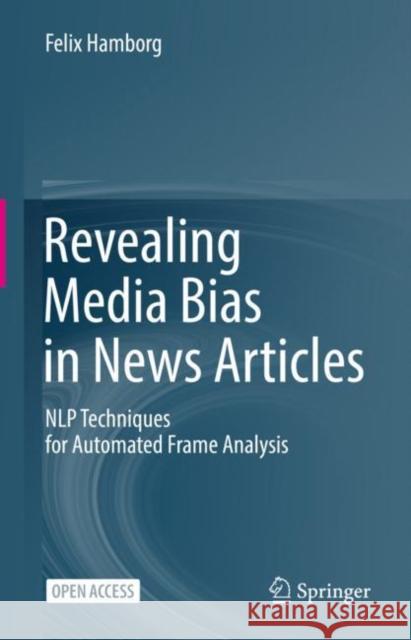
Revealing Media Bias in News Articles: NLP Techniques for Automated Frame Analysis Felix Hamborg 9783031176920 Springer - książkaWidoczna okładka, to zdjęcie poglądowe, a rzeczywista szata graficzna może różnić się od prezentowanej.

Revealing Media Bias in News Articles: NLP Techniques for Automated Frame Analysis

ISBN-13: 9783031176920 / Angielski / Twarda / 2023 / 238 str.

Felix Hamborg
cena 201,24
(netto: 191,66 VAT:  5%)

Najniższa cena z 30 dni: 192,74
Termin realizacji zamówienia:
ok. 22 dni roboczych.

Darmowa dostawa!
inne wydania

This open access book presents an interdisciplinary approach to reveal biases in English news articles reporting on a given political event. The approach named person-oriented framing analysis identifies the coverage’s different perspectives on the event by assessing how articles portray the persons involved in the event. In contrast to prior automated approaches, the identified frames are more meaningful and substantially present in person-oriented news coverage.The book is structured in seven chapters: Chapter 1 presents a few of the severe problems caused by slanted news coverage and identifies the research gap that motivated the research described in this thesis. Chapter 2 discusses manual analysis concepts and exemplary studies from the social sciences and automated approaches, mostly from computer science and computational linguistics, to analyze and reveal media bias. This way, it identifies the strengths and weaknesses of current approaches for identifying and revealing media bias. Chapter 3 discusses the solution design space to address the identified research gap and introduces person-oriented framing analysis (PFA), a new approach to identify substantial frames and to reveal slanted news coverage. Chapters 4 and 5 detail target concept analysis and frame identification, the first and second component of PFA. Chapter 5 also introduces the first large-scale dataset and a novel model for target-dependent sentiment classification (TSC) in the news domain. Eventually, Chapter 6 introduces Newsalyze, a prototype system to reveal biases to non-expert news consumers by using the PFA approach. In the end, Chapter 7 summarizes the thesis and discusses the strengths and weaknesses of the thesis to derive ideas for future research on media bias.This book mainly targets researchers and graduate students from computer science, computational linguistics, political science, and further social sciences who want to get an overview of the relevant state of the art in the other related disciplines and understand and tackle the issue of bias from a more effective, interdisciplinary viewpoint.


This open access book presents an interdisciplinary approach to reveal biases in English news articles reporting on a given political event. The approach named person-oriented framing analysis identifies the coverage’s different perspectives on the event by assessing how articles portray the persons involved in the event. In contrast to prior automated approaches, the identified frames are more meaningful and substantially present in person-oriented news coverage. The book is structured in seven chapters: Chapter 1 presents a few of the severe problems caused by slanted news coverage and identifies the research gap that motivated the research described in this thesis. Chapter 2 discusses manual analysis concepts and exemplary studies from the social sciences and automated approaches, mostly from computer science and computational linguistics, to analyze and reveal media bias. This way, it identifies the strengths and weaknesses of current approaches for identifying and revealing media bias. Chapter 3 discusses the solution design space to address the identified research gap and introduces person-oriented framing analysis (PFA), a new approach to identify substantial frames and to reveal slanted news coverage. Chapters 4 and 5 detail target concept analysis and frame identification, the first and second component of PFA. Chapter 5 also introduces the first large-scale dataset and a novel model for target-dependent sentiment classification (TSC) in the news domain. Eventually, Chapter 6 introduces Newsalyze, a prototype system to reveal biases to non-expert news consumers by using the PFA approach. In the end, Chapter 7 summarizes the thesis and discusses the strengths and weaknesses of the thesis to derive ideas for future research on media bias.This book mainly targets researchers and graduate students from computer science, computational linguistics, political science, and further social sciences who want to get an overview of the relevant state of the art in the other related disciplines and understand and tackle the issue of bias from a more effective, interdisciplinary viewpoint.

Kategorie:
Informatyka, Bazy danych
Kategorie BISAC:
Computers > Speech & Audio Processing
Computers > Artificial Intelligence - General
Social Science > Media Studies
Wydawca:
Springer
Język:
Angielski
ISBN-13:
9783031176920
Rok wydania:
2023
Dostępne języki:
Ilość stron:
238
Oprawa:
Twarda
Dodatkowe informacje:
Wydanie ilustrowane

1. Introduction.- 2. Media Bias Analysis.- 3. Person-Oriented Framing Analysis.- 4. Target Concept Analysis.- 5. Frame Analysis.- 6. Prototype.- 7. Conclusion. 

Felix Hamborg is a research group leader at the Heidelberg Academy of Sciences and Humanities and a visiting researcher at the Humboldt University of Berlin, Germany. His research focuses on the automated identification of media bias in news articles and combines approaches from deep learning, natural language processing, information visualization, and political science. He completed his PhD at the University of Konstanz and was awarded several Best Paper / Outstanding Paper awards at renowned conferences like JCDL, CIKM, or the iConference. 

This open access book presents an interdisciplinary approach to reveal biases in English news articles reporting on a given political event. The approach named person-oriented framing analysis identifies the coverage’s different perspectives on the event by assessing how articles portray the persons involved in the event. In contrast to prior automated approaches, the identified frames are more meaningful and substantially present in person-oriented news coverage.

The book is structured in seven chapters: Chapter 1 presents a few of the severe problems caused by slanted news coverage and identifies the research gap that motivated the research described in this thesis. Chapter 2 discusses manual analysis concepts and exemplary studies from the social sciences and automated approaches, mostly from computer science and computational linguistics, to analyze and reveal media bias. This way, it identifies the strengths and weaknesses of current approaches for identifying and revealing media bias. Chapter 3 discusses the solution design space to address the identified research gap and introduces person-oriented framing analysis (PFA), a new approach to identify substantial frames and to reveal slanted news coverage. Chapters 4 and 5 detail target concept analysis and frame identification, the first and second component of PFA. Chapter 5 also introduces the first large-scale dataset and a novel model for target-dependent sentiment classification (TSC) in the news domain. Eventually, Chapter 6 introduces Newsalyze, a prototype system to reveal biases to non-expert news consumers by using the PFA approach. In the end, Chapter 7 summarizes the thesis and discusses the strengths and weaknesses of the thesis to derive ideas for future research on media bias.

This book mainly targets researchers and graduate students from computer science, computational linguistics, political science, and further social sciences who want to get an overview of the relevant state of the art in the other related disciplines and understand and tackle the issue of bias from a more effective, interdisciplinary viewpoint.




Udostępnij

Facebook - konto krainaksiazek.pl


Opinie o Krainaksiazek.pl na Opineo.pl

Partner Mybenefit

Krainaksiazek.pl w programie rzetelna firma Krainaksiaze.pl - płatności przez paypal

Czytaj nas na:

Facebook - krainaksiazek.pl
  • książki na zamówienie
  • granty
  • książka na prezent
  • kontakt
  • pomoc
  • opinie
  • regulamin
  • polityka prywatności

Zobacz:

  • Księgarnia czeska

  • Wydawnictwo Książkowe Klimaty

1997-2026 DolnySlask.com Agencja Internetowa

© 1997-2022 krainaksiazek.pl
     
KONTAKT | REGULAMIN | POLITYKA PRYWATNOŚCI | USTAWIENIA PRYWATNOŚCI
Zobacz: Księgarnia Czeska | Wydawnictwo Książkowe Klimaty | Mapa strony | Lista autorów
KrainaKsiazek.PL - Księgarnia Internetowa

Polityka prywatnosci - link
Krainaksiazek.pl - płatnośc Przelewy24
Przechowalnia Przechowalnia




