• Wyszukiwanie zaawansowane
  • Kategorie
  • Kategorie BISAC
  • Książki na zamówienie
  • Promocje
  • Granty
  • Książka na prezent
  • Opinie
  • Pomoc
  • Załóż konto
  • Zaloguj się

Reuse-Based Methodologies and Tools in the Design of Analog and Mixed-Signal Integrated Circuits » książka


zaloguj się | załóż konto
Logo Krainaksiazek.pl

koszyk

konto

szukaj
topmenu
Księgarnia internetowa
Szukaj
Książki na zamówienie
Promocje
Granty
Książka na prezent
Moje konto
Pomoc
 
 
Wyszukiwanie zaawansowane
Pusty koszyk
Bezpłatna dostawa dla zamówień powyżej 20 złBezpłatna dostawa dla zamówień powyżej 20 zł

Kategorie główne

• Nauka
 [2952079]
• Literatura piękna
 [1850969]

  więcej...
• Turystyka
 [71058]
• Informatyka
 [151066]
• Komiksy
 [35579]
• Encyklopedie
 [23181]
• Dziecięca
 [620496]
• Hobby
 [139036]
• AudioBooki
 [1646]
• Literatura faktu
 [228729]
• Muzyka CD
 [379]
• Słowniki
 [2932]
• Inne
 [445708]
• Kalendarze
 [1409]
• Podręczniki
 [164793]
• Poradniki
 [480107]
• Religia
 [510956]
• Czasopisma
 [511]
• Sport
 [61267]
• Sztuka
 [243299]
• CD, DVD, Video
 [3411]
• Technologie
 [219640]
• Zdrowie
 [100984]
• Książkowe Klimaty
 [124]
• Zabawki
 [2281]
• Puzzle, gry
 [3363]
• Literatura w języku ukraińskim
 [258]
• Art. papiernicze i szkolne
 [8020]
Kategorie szczegółowe BISAC

Reuse-Based Methodologies and Tools in the Design of Analog and Mixed-Signal Integrated Circuits

ISBN-13: 9789048172894 / Angielski / Miękka / 2010 / 390 str.
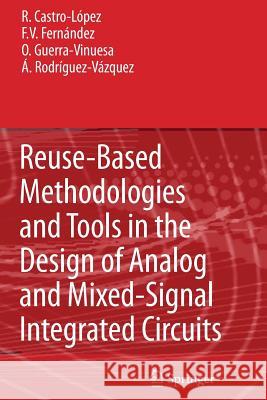
Rafael Castro Lopez; Francisco V. Fernandez; Oscar Guerra-Vinuesa
Reuse-Based Methodologies and Tools in the Design of Analog and Mixed-Signal Integrated Circuits Rafael Castr Francisco V. Fernandez Oscar Guerra-Vinuesa 9789048172894 Springer - książkaWidoczna okładka, to zdjęcie poglądowe, a rzeczywista szata graficzna może różnić się od prezentowanej.

Reuse-Based Methodologies and Tools in the Design of Analog and Mixed-Signal Integrated Circuits

ISBN-13: 9789048172894 / Angielski / Miękka / 2010 / 390 str.

Rafael Castro Lopez; Francisco V. Fernandez; Oscar Guerra-Vinuesa
cena 603,81
(netto: 575,06 VAT:  5%)

Najniższa cena z 30 dni: 578,30
Termin realizacji zamówienia:
ok. 22 dni roboczych.

Darmowa dostawa!

Despite the spectacular breakthroughs of the semiconductor industry, the ability to design integrated circuits under stringent time-to-market requirements is lagging behind integration capacity, so far keeping pace with still valid Moore s Law. The resulting gap is threatening with slowing down such a phenomenal growth. The design community believes that it is only by means of powerful CAD tools, design methodologies and even a design paradigm shift, that this design gap can be bridged. In this sense, reuse-based design is seen as a promising solution, and concepts such as IP Block, Virtual Component, and Design Reuse have become commonplace thanks to the significant advances in the digital arena. Unfortunately, the very nature of analog and mixed-signal (AMS) design more subtle, hierarchically loose, and handicraft-demanding has hindered a similar level of consensus and development. Aiming at the core of the problem, Reuse Based Methodologies and Tools in the Design of Analog and Mixed-Signal Integrated Circuits presents a framework for the reuse-based design of AMS circuits. The framework is founded on three key elements: (1) a CAD-supported hierarchical design flow that facilitates the incorporation of AMS reusable blocks, reduces the overall design time, and expedites the management of increasing AMS design complexity; (2) a complete, clear definition of the AMS reusable block, structured into three separate facets or views: the behavioral, structural, and layout facets, the first two for top-down electrical synthesis and bottom-up verification, the latter used during bottom-up physical synthesis; (3) the design for reusability set of tools, methods, and guidelines that, relying on intensive parameterization as well as on design knowledge capture and encapsulation, allows to produce fully reusable AMS blocks. Reuse Based Methodologies and Tools in the Design of Analog and Mixed-Signal Integrated Circuits features a very detailed, tutorial, and in-depth coverage of all issues and must-have properties of reusable AMS blocks, as well as a thorough description of the methods and tools necessary to implement them. For the first time, this has been done hierarchically, covering one by one the different stages of the design flow, allowing us to examine how the reusable block yields its benefits, both in design time and correct performance."


Kategorie:
Technologie
Kategorie BISAC:
Computers > Design, Graphics & Media - CAD-CAM
Technology & Engineering > Electronics - Microelectronics
Technology & Engineering > Electrical
Wydawca:
Springer
Język:
Angielski
ISBN-13:
9789048172894
Rok wydania:
2010
Ilość stron:
390
Waga:
0.56 kg
Wymiary:
23.39 x 15.6 x 2.13
Oprawa:
Miękka
Wolumenów:
01

PREFACE. CHAPTER 1 – INTRODUCTION. 1 Problem Overview: The Design Gap. 1.1 Evolution of the semiconductor industry. 1.2 The design gap. 1.2.1 Time-to-market. 1.2.2 Design complexity. 1.3 Analog design automation. 2 Problem definition. 2.1 Hierarchy, abstraction, and views. 2.2 The AMS design flow. 3 Summary. CHAPTER 2 - A REUSE-BASED DESIGN FRAMEWORK FOR ANALOG ICs. 1 Design automation. 1.1 Preliminary definitions. 1.2 The two sides of automation. 1.2.1 Knowledge-based synthesis . 1.2.2 Optimization-based synthesis. 1.2.3 Quality metrics for analog synthesis . 1.3 Knowledge versus optimization-based synthesis. 2. Circuit reuse. 2.1 Preliminary definitions. 2.2. Digital design reuse. 2.3 Analog design reuse. 2.4 Other approaches to analog reuse. 3 The reuse-based design framework. 3.1 The analog reusable block. 3.2 The design reuse flow. 3.2.1 Adopted synthesis approaches. 3.2.2 The top-down path. 3.2.3 The bottom-up path. 3.2.4 The role of the analog reusable block. 3.3 The design for reusability methodology. 4 Summary. CHAPTER 3 - THE ANALOG REUSABLE BLOCK: BEHAVIORAL FACET. 1 Introduction: Why behavioral descriptions? 1.1 Analog behavioral modeling taxonomy. 2 Facing design reuse. 2.1 The design reuse flow: top-down electrical synthesis. 2.2 The design reuse flow: bottom-up verification. 2.3 Characteristics of the behavioral facet of the AMS reusable block. 3 Case study: a quadrature DA transmit interface. 3.1 System description. 3.2 Reusable macromodels. 4 Summary. CHAPTER 4 - THE ANALOG REUSABLE BLOCK: STRUCTURAL FACET. 1 Introduction. 1.1 Adopted sizing approach. 2 Design knowledge encapsulation. 2.1 Netlist-related elements . 2.1.1 Design variables. 2.1.2 Constraints. 2.2 Testbench setups. 2.2.1Performance feature elements . 2.2.2 Peripheral setup elements. 2.2.3 Component model and process data elements. 2.2.4 Design variables, dependent variables, and constraints . 3 Practical aspects of structural view reuse. 4 Summary. CHAPTER 5 - THE ANALOG REUSABLE BLOCK: LAYOUT FACET. 1 Introduction. 2 Layout retargeting . 2.1 Device mismatch. 2.2 Loading effects. 2.3 Coupling effects. 2.4 Reliability. 2.5 Area occupation. 3 Layout migration. 4 Analog layout strategies. 4.1 Optimization-driven approaches. 4.2 Knowledge-driven approaches. 5 Automated layout generation for design reuse. 6 Layout template: definition and properties. 7 Creating the layout template. 7.1 Device-level layout generation: primitives. 7.1.1 Reuse: migration issues. 7.1.2 Reuse: retargeting issues. 7.1.3 PDLP coding. 7.2 Device-level layout generation: blocks. 7.2.1 Reuse: migration issues. 7.2.2 Reuse: retargeting issues. 7.2.3 PDLB coding. 7.3 Layout template generation. 7.3.1 Reuse: migration issues. 7.3.2 Reuse: retargeting issues. 7.3.3 Layout template coding . 8 Practical implementation of layout-reusable analog blocks. 8.1 Layout languages. 8.2 Implementation examples. 9 Summary. CHAPTER 6 - DESIGN EXAMPLES AND SILICON PROTOTYPE. 1 Introduction. 2 The demonstration vehicle . 2.1 Application area and rationale for architecture selection. 2.2 System specifications and specifications of the analog back-end. 2.3 Hierarchy of the analog back-end. 2.4 Analysis of the analog back-end. 2.4.1 The CT-LP filter. 2.4.2 The PGA. 3 Reusable blocks. 3.1 Reusable blocks: opamps. 3.2 Reusable blocks: analog back-end. 4 Design examples. 4.1 Design example (I): design retargeting and migration of the opamp. 4.1.1 Opamp retargeting in process A (0.35mm). 4.1.2 Opamp migration to process B (0.5mm). 4.2 Design example (II): GSM retargeting o

Prof. Ángel Rodríguez-Vázquez has authored and edited numerous books for Springer and Kluwer


Udostępnij

Facebook - konto krainaksiazek.pl


Opinie o Krainaksiazek.pl na Opineo.pl

Partner Mybenefit

Krainaksiazek.pl w programie rzetelna firma Krainaksiaze.pl - płatności przez paypal

Czytaj nas na:

Facebook - krainaksiazek.pl
  • książki na zamówienie
  • granty
  • książka na prezent
  • kontakt
  • pomoc
  • opinie
  • regulamin
  • polityka prywatności

Zobacz:

  • Księgarnia czeska

  • Wydawnictwo Książkowe Klimaty

1997-2026 DolnySlask.com Agencja Internetowa

© 1997-2022 krainaksiazek.pl
     
KONTAKT | REGULAMIN | POLITYKA PRYWATNOŚCI | USTAWIENIA PRYWATNOŚCI
Zobacz: Księgarnia Czeska | Wydawnictwo Książkowe Klimaty | Mapa strony | Lista autorów
KrainaKsiazek.PL - Księgarnia Internetowa

Polityka prywatnosci - link
Krainaksiazek.pl - płatnośc Przelewy24
Przechowalnia Przechowalnia





