• Wyszukiwanie zaawansowane
  • Kategorie
  • Kategorie BISAC
  • Książki na zamówienie
  • Promocje
  • Granty
  • Książka na prezent
  • Opinie
  • Pomoc
  • Załóż konto
  • Zaloguj się

Reticulate Evolution: Symbiogenesis, Lateral Gene Transfer, Hybridization and Infectious Heredity » książka


zaloguj się | załóż konto
Logo Krainaksiazek.pl

koszyk

konto

szukaj
topmenu
Księgarnia internetowa
Szukaj
Książki na zamówienie
Promocje
Granty
Książka na prezent
Moje konto
Pomoc
 
 
Wyszukiwanie zaawansowane
Pusty koszyk
Bezpłatna dostawa dla zamówień powyżej 20 złBezpłatna dostawa dla zamówień powyżej 20 zł

Kategorie główne

• Nauka
 [2946600]
• Literatura piękna
 [1856966]

  więcej...
• Turystyka
 [72221]
• Informatyka
 [151456]
• Komiksy
 [35826]
• Encyklopedie
 [23190]
• Dziecięca
 [619653]
• Hobby
 [140543]
• AudioBooki
 [1577]
• Literatura faktu
 [228355]
• Muzyka CD
 [410]
• Słowniki
 [2874]
• Inne
 [445822]
• Kalendarze
 [1744]
• Podręczniki
 [167141]
• Poradniki
 [482898]
• Religia
 [510455]
• Czasopisma
 [526]
• Sport
 [61590]
• Sztuka
 [243598]
• CD, DVD, Video
 [3423]
• Technologie
 [219201]
• Zdrowie
 [101638]
• Książkowe Klimaty
 [124]
• Zabawki
 [2473]
• Puzzle, gry
 [3898]
• Literatura w języku ukraińskim
 [254]
• Art. papiernicze i szkolne
 [8170]
Kategorie szczegółowe BISAC

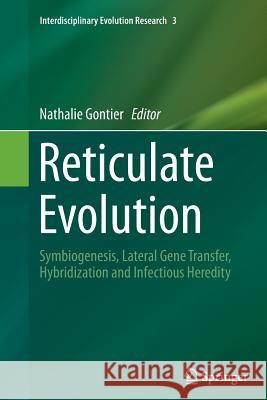
Reticulate Evolution: Symbiogenesis, Lateral Gene Transfer, Hybridization and Infectious Heredity

ISBN-13: 9783319354552 / Angielski / Miękka / 2016 / 337 str.
Nathalie Gontier
Reticulate Evolution: Symbiogenesis, Lateral Gene Transfer, Hybridization and Infectious Heredity Gontier, Nathalie 9783319354552 Springer - książkaWidoczna okładka, to zdjęcie poglądowe, a rzeczywista szata graficzna może różnić się od prezentowanej.

Reticulate Evolution: Symbiogenesis, Lateral Gene Transfer, Hybridization and Infectious Heredity

ISBN-13: 9783319354552 / Angielski / Miękka / 2016 / 337 str.

Nathalie Gontier
cena 765,61 zł
(netto: 729,15 VAT:  5%)

Najniższa cena z 30 dni: 759,08 zł
Termin realizacji zamówienia:
ok. 10-14 dni roboczych
Bez gwarancji dostawy przed świętami

Darmowa dostawa!

Written for non-experts, this volume introduces the mechanisms that underlie reticulate evolution. Chapters are either accompanied with glossaries that explain new terminology or timelines that position pioneering scholars and their major discoveries in their historical contexts. The contributing authors outline the history and original context of discovery of symbiosis, symbiogenesis, lateral gene transfer, hybridization or divergence with gene flow and infectious heredity. By applying key insights from the areas of molecular (phylo)genetics, microbiology, virology, ecology, systematics, immunology, epidemiology and computational science, they demonstrate how reticulate evolution impacts successful survival, fitness and speciation.Reticulate evolution brings forth a challenge to the standard Neo-Darwinian framework, which defines life as the outcome of bifurcation and ramification patterns brought forth by the vertical mechanism of natural selection. Reticulate evolution puts forward a pattern in the tree of life that is characterized by horizontal mergings and lineage crossings induced by symbiosis, symbiogenesis, lateral gene transfer, hybridization or divergence with gene flow and infective heredity, making the "tree of life" look more like a "web of life." On an epistemological level, the various means by which hereditary material can be transferred horizontally challenges our classic notions of units and levels of evolution, fitness, modes of transmission, linearity, communities and biological individuality.The case studies presented examine topics including the origin of the eukaryotic cell and its organelles through symbiogenesis; the origin of algae through primary and secondary symbiosis and dinoflagellates through tertiary symbiosis; the superorganism and holobiont as units of evolution; how endosymbiosis induces speciation in multicellular life forms; transferrable and non-transferrable plasmids and how they symbiotically interact with their host; the means by which pro- and eukaryotic organisms transfer genes laterally (bacterial transformation, transduction and conjugation as well as transposons and other mobile genetic elements); hybridization and divergence with gene flow in sexually-reproducing individuals; current (human) microbiome and viriome studies that impact our knowledge concerning the evolution of organismal health and acquired immunity; and how symbiosis and symbiogenesis can be modelled in computational evolution.


Kategorie:
Nauka
Kategorie BISAC:
Science > Life Sciences - Evolution
Medical > Genetyka kliniczna
Science > Life Sciences - Ecology
Wydawca:
Springer
Seria wydawnicza:
Interdisciplinary Evolution Research
Język:
Angielski
ISBN-13:
9783319354552
Rok wydania:
2016
Wydanie:
Softcover Repri
Numer serii:
000479515
Ilość stron:
337
Waga:
0.49 kg
Wymiary:
23.39 x 15.6 x 1.85
Oprawa:
Miękka
Wolumenów:
01
Dodatkowe informacje:
Wydanie ilustrowane

Reticulate Evolution Everywhere.- Can We Understand Evolution Without Symbiogenesis?.- Symbiosis: Evolution’s Co-Author.- Novel Endosymbioses as a Catalyst of Fast Speciation.- Historical and Epistemological Perspectives on What Lateral Gene Transfer Mechanisms Contribute to Our Understanding of Evolution.- Plasmids: Histories of a Concept.- Symbiosis Between Non-Transferable Plasmids and Prokaryote Cells.- Host-Symbiont-Pathogen-Host Interactions: Wolbachia, Vector-Transmitted Human Pathogens and the Importance of Quantitative Models of Multipartite Coevolution.- Evolution of The Human Microbiome and Impacts on Human Health, Infectious Disease and Hominid Evolution.- Divergence-With-Gene-Flow: What Humans and Other Mammals Got Up To.- A Multiset Model of Multi-Species Evolution to Solve Big Deceptive Problems.

Nathalie Gontier is a philosopher of science and an anthropologist. Her main research interests lie in evolutionary epistemology and non-Darwinian evolutionary theories, how the latter differ from the Modern Synthesis and how they can be implemented into the linguistic sciences and the overall sociocultural domain. As the founding director of the Lisbon Applied Evolutionary Epistemology Lab, she is affiliated to the Centre for Philosophy of Science at the Faculty of Science of the University of Lisbon, and financed by the Portuguese Fund for Science and Technology. Previous appointments were held at the Dutch Free University of Brussels (Belgium), the Konrad Lorenz Institute (Austria), and the American Museum of Natural History (USA). Her research has been sponsored by the American John Templeton Foundation, the European Marie Curie Actions and the Belgian Fund for Scientific Research Flanders. She is the founder and editor-in-chief of the Springer book series Interdisciplinary Evolution Research.

Written for non-experts, this volume introduces the mechanisms that underlie reticulate evolution. Chapters are either accompanied with glossaries that explain new terminology or timelines that position pioneering scholars and their major discoveries in their historical contexts. The contributing authors outline the history and original context of discovery of symbiosis, symbiogenesis, lateral gene transfer, hybridization or divergence with gene flow, and infectious heredity. By applying key insights from the areas of molecular (phylo)genetics, microbiology, virology, ecology, systematics, immunology, epidemiology and computational science, they demonstrate how reticulate evolution impacts successful survival, fitness and speciation.

Reticulate evolution brings forth a challenge to the standard Neo-Darwinian framework, which defines life as the outcome of bifurcation and ramification patterns brought forth by the vertical mechanism of natural selection. Reticulate evolution puts forward a pattern in the tree of life that is characterized by horizontal mergings and lineage crossings induced by symbiosis, symbiogenesis, lateral gene transfer, hybridization or divergence with gene flow, and infective heredity, making the “tree of life” look more like a “web of life.” On an epistemological level, the various means by which hereditary material can be transferred horizontally challenges our classic notions of units and levels of evolution, fitness, modes of transmission, linearity, communities, and biological individuality.


The case studies presented examine topics including the origin of the eukaryotic cell and its organelles through symbiogenesis; the origin of algae through primary and secondary symbiosis and dinoflagellates through tertiary symbiosis; the superorganism and holobiont as units of evolution; how endosymbiosis induces speciation in multicellular life forms; transferrable and non-transferrable plasmids and how they symbiotically interact with their host; the means by which pro- and eukaryotic organisms transfer genes laterally (bacterial transformation, transduction and conjugation as well as transposons and other mobile genetic elements); hybridization and divergence with gene flow in sexually-reproducing individuals; current (human) microbiome and viriome studies that impact our knowledge concerning the evolution of organismal health and acquired immunity; and how symbiosis and symbiogenesis can be modelled in computational evolution.




Udostępnij

Facebook - konto krainaksiazek.pl


Opinie o Krainaksiazek.pl na Opineo.pl

Partner Mybenefit

Krainaksiazek.pl w programie rzetelna firma Krainaksiaze.pl - płatności przez paypal

Czytaj nas na:

Facebook - krainaksiazek.pl
  • książki na zamówienie
  • granty
  • książka na prezent
  • kontakt
  • pomoc
  • opinie
  • regulamin
  • polityka prywatności

Zobacz:

  • Księgarnia czeska

  • Wydawnictwo Książkowe Klimaty

1997-2025 DolnySlask.com Agencja Internetowa

© 1997-2022 krainaksiazek.pl
     
KONTAKT | REGULAMIN | POLITYKA PRYWATNOŚCI | USTAWIENIA PRYWATNOŚCI
Zobacz: Księgarnia Czeska | Wydawnictwo Książkowe Klimaty | Mapa strony | Lista autorów
KrainaKsiazek.PL - Księgarnia Internetowa

Polityka prywatnosci - link
Krainaksiazek.pl - płatnośc Przelewy24
Przechowalnia Przechowalnia



