1. Introduction: Taxation in Times of Uncertainty in Latin America
Jorge Atria, Constantin Groll, and Maria Fernanda Valdés
Part I: Historical Dimension of Taxation
2. Debtor Coalitions and Weak Tax Institutions in Latin America: Insights from Argentina and Brazil
Ryan Saylor
3. State Capacity and Development: Federalism and Tax in Brazil
Aaron Schneider
Part II: Transnational Dimension of Taxation
4. Global Uncertainty in the Evolution of Latin American Income Taxes
Andrés Biehl and José Tomás Labarca
5. International Insertion, Volatility and Fiscal Resources in Countries Specialized in Extractive Industries: Between A Rock and A Hard Place?
Juan Carlos Gómez Sabaini, Osvaldo Kacef, and Dalmiro Morá
n
Part III: Relational Dimension of Taxation
6. Gender Bias of Regressive Taxation in Latin America: Overview and Exploration of the Argentinean Case
Corina Rodríguez Enríquez and Nicolás Águila
7. Business Groups, Tax Efficiency, and Regressivity in Colombia
Nestor Castañeda
8. Tax Incentives in Latin America: The Case of Guatemala
Mauricio Garita
9. Latin American Taxation from A New Perspective: Contributions from the Relational, Historical and Transnational Dimensions
Jorge Atria, Constantin Groll, and María Fernanda Valdés
Jorge Atria is Researcher at Pontificia Universidad Católica de Chile and Adjunct Researcher at Centre for Social Conflict and Cohesion Studies (COES), Chile.
Constantin Groll is Researcher at Freie Universität Berlin, Germany.
Maria Fernanda Valdés is a program coordinator for the Friedrich Ebert Stiftung in Bogotá, Colombia.
Jorge Atria is Researcher at Pontificia Universidad Católica de Chile and Adjunct Researcher at Centre for Social Conflict and Cohesion Studies (COES), Chile.
Constantin Groll is Researcher at Freie Universität Berlin, Germany.
Maria Fernanda Valdés is a program coordinator for the Friedrich Ebert Stiftung in Bogotá, Colombia.
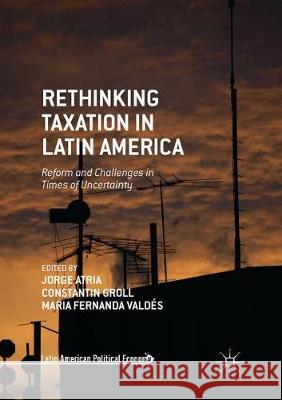
This study of taxation in Latin America takes a novel approach to the subject, using a framework that posits three dimensions for studying taxes—historical, relational, and transnational. The book argues that: first, taxation should be understood as a relational concept and tax systems as a function of a strategic nexus between the state and society; second, that any analysis of tax systems across Latin America needs to take historical legacies of national tax systems into account; and finally, that transnational phenomena have significant implications for tax regime dynamics in Latin America. The essays included provide diverse and representative insights for a new understanding of taxation in Latin America and highlight the bottlenecks to the development of sustainable tax systems in the region, exploring new links between academic research and policy-making.