• Wyszukiwanie zaawansowane
  • Kategorie
  • Kategorie BISAC
  • Książki na zamówienie
  • Promocje
  • Granty
  • Książka na prezent
  • Opinie
  • Pomoc
  • Załóż konto
  • Zaloguj się

Religious Experience in Trauma: Koreans' Collective Complex of Inferiority and the Korean Protestant Church » książka


zaloguj się | załóż konto
Logo Krainaksiazek.pl

koszyk

konto

szukaj
topmenu
Księgarnia internetowa
Szukaj
Książki na zamówienie
Promocje
Granty
Książka na prezent
Moje konto
Pomoc
 
 
Wyszukiwanie zaawansowane
Pusty koszyk
Bezpłatna dostawa dla zamówień powyżej 20 złBezpłatna dostawa dla zamówień powyżej 20 zł

Kategorie główne

• Nauka
 [2946912]
• Literatura piękna
 [1852311]

  więcej...
• Turystyka
 [71421]
• Informatyka
 [150889]
• Komiksy
 [35717]
• Encyklopedie
 [23177]
• Dziecięca
 [617324]
• Hobby
 [138808]
• AudioBooki
 [1671]
• Literatura faktu
 [228371]
• Muzyka CD
 [400]
• Słowniki
 [2841]
• Inne
 [445428]
• Kalendarze
 [1545]
• Podręczniki
 [166819]
• Poradniki
 [480180]
• Religia
 [510412]
• Czasopisma
 [525]
• Sport
 [61271]
• Sztuka
 [242929]
• CD, DVD, Video
 [3371]
• Technologie
 [219258]
• Zdrowie
 [100961]
• Książkowe Klimaty
 [124]
• Zabawki
 [2341]
• Puzzle, gry
 [3766]
• Literatura w języku ukraińskim
 [255]
• Art. papiernicze i szkolne
 [7810]
Kategorie szczegółowe BISAC

Religious Experience in Trauma: Koreans' Collective Complex of Inferiority and the Korean Protestant Church

ISBN-13: 9783030535858 / Angielski / Miękka / 2021 / 212 str.
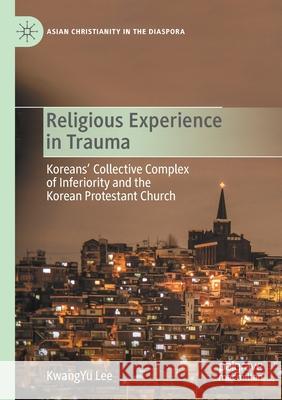
KwangYu Lee
Religious Experience in Trauma: Koreans' Collective Complex of Inferiority and the Korean Protestant Church Lee, Kwangyu 9783030535858 Springer International Publishing - książkaWidoczna okładka, to zdjęcie poglądowe, a rzeczywista szata graficzna może różnić się od prezentowanej.

Religious Experience in Trauma: Koreans' Collective Complex of Inferiority and the Korean Protestant Church

ISBN-13: 9783030535858 / Angielski / Miękka / 2021 / 212 str.

KwangYu Lee
cena 402,53
(netto: 383,36 VAT:  5%)

Najniższa cena z 30 dni: 385,52
Termin realizacji zamówienia:
ok. 22 dni roboczych
Bez gwarancji dostawy przed świętami

Darmowa dostawa!
inne wydania

This book offers a psychohistorical analysis of the rapid growth of the Korean Protestant Church. KwangYu Lee looks at some of the traumatic historical events of Korea in the 20th century, including the fall of the Joseon Dynasty (1392-1910), the Japanese Occupation (1910-1945), the Korean War (1950-1953), and the Korean Military Dictatorship (1961-1987), and explores the psychological impacts of these events on the collective unconsciousness of Koreans. He argues that Koreans’ collective (or cultural) complex of inferiority, which was caused and gradually exacerbated by these traumatic events, along with their psychological relationships with their two colonizers—the Japanese and Americans—prompted them to convert to Korean Protestantism en masse as a means to avoid their psychological pains and to fulfil their futile desire to become like Americans, their overtly idealized psychological-object.


Kategorie:
Religia
Kategorie BISAC:
Social Science > Sociology of Religion
Religion > Psychology of Religion
Religion > Christianity - General
Wydawca:
Springer International Publishing
Seria wydawnicza:
Asian Christianity in the Diaspora
Język:
Angielski
ISBN-13:
9783030535858
Rok wydania:
2021
Ilość stron:
212
Waga:
0.28 kg
Wymiary:
21.01 x 14.81 x 1.22
Oprawa:
Miękka
Wolumenów:
01
Dodatkowe informacje:
Wydanie ilustrowane

1. Introduction: The Korean Protestant Church at Present and the Necessity of a Psychohistorical Approach to Its History


 1.1    The Declining Korean Protestant Church   
    1.1.1    The Korean Protestant Church’s Individualism 
    1.1.2    The Korean Protestant Church’s Materialism  
    1.1.3    The Korean Protestant Church’s Exclusivism  
 1.2    The Necessity of a Psychohistorical Approach to the History of the Korean Protestant Church   
 1.3    Methodology: Jungian Psychohistory  
 1.4    The Scope and Discussion of the Research  
 References


2. : A Historical Sketch of the Growth of the Korean Protestant Church in the Twentieth Century

 2.1    The Miraculous Growth of Korean Christianity  
     2.1.1    The Fall of Joseon, Korea’s Last Dynasty, and Christianity (1882–1910)  
     2.1.2    The Japanese Colonial Era (1910–1945)  
     2.1.3    Since the Liberation of 1945
 2.2    The Three Main Reasons for the Rapid Growth  
    2.2.1    Protestantism: New Perspectives on Life  
    2.2.2    Rapid Social Changes: A Seedbed for Evangelism  
    2.2.3    Korean Protestantism: A Synthesis of Korean Shamanism and Western Protestantism  
 2.3    The Miraculous Growth of the Korean Protestant Church: Gradual or Sudden?  
 2.4    Conclusion  
References

3. : A Jungian Psychohistorical Theory: An Interpretive Tool

 
 3.1    Psychohistory: Its Origin and Evolution  
    3.1.1    The Emergence of Psychohistory  
    3.1.2    Erik H. Erikson and Young Man Luther  
    3.1.3    Psychohistory: From Individuals to Groups  
 3.2    Psychohistory’s Strengths, Weaknesses, and Contributions to Historical Studies  
    3.2.1    Freudian Psychology at the Heart of Psychohistory  
    3.2.2    Psychohistory’s Strengths: The Unconscious and a Psychotherapeutical Approach to History  
    3.2.3    Psychohistory’s Weaknesses: Psychologization, Reductionism, Arbitrariness, and Determinism  
    3.2.4    Psychohistory’s Contributions to Historical Studies  
 3.3    Jung’s Analytical Psychology: The Basics  
    3.3.1    The Collective Unconscious  
    3.3.2    Psychopathology  
    3.3.3    Dreams and Archetypes  
    3.3.4    Complex Theory  
 3.4    A Jungian Psychohistory: Cultural (Collective) Complex  
    3.4.1    The Cultural Unconscious  
    3.4.2    Cultural (Collective) Complex  
    3.4.3    Projection: The Central Element of Complex      
    3.4.4    Two Examples of the Jungian Psychohistorical Analysis: Frantz Fanon and Jacqueline Gerson  
3.5    Conclusion
 References 

4. The Traumatic Twentieth Century of Korea: Japanese Imperialism, the Korean War and the Korean Military Governments

 
 4.1    Japanese Imperialism and the Loss of Old Korea
 4.2    S. Korea’s Anticommunism and the Korean War: A Series of Massacres
    4.2.1    The Rhee Government’s Anticommunism
    4.2.2    The National Bodo League: An Example of the Rhee Government’s Massacres for the Birth of Anticommunism
    4.2.3    The U.S. Armed Forces and Their Military “Operational” Massacres
 4.3    The Korean Governments with the Politics of Terror and Anxiety
     4.3.1    Syngman Rhee and the National Security Law for Anticommunism
     4.3.2    Park Chung-Hee and the Korean Central Intelligence Agency (KCIA)
     4.3.3    Chun Doo-Hwan and His Brutal Discipline of S. Koreans
 4.4    Conclusion
 References

5. The Growth of the Korean Protestant Church from a Jungian Psychohistorical Perspective: Trauma, Cultural Complex, the Theology of Prosperity/Bliss and the Governmental Support

  5.1    The “Traumatized” Psychological States of S. Koreans
  5.2    S. Koreans’ Cultural Complex: Collective Inferiority
    5.2.1    Cultural (Collective) Complex of Inferiority: Its Meaning and Characteristics     
    5.2.2    The Psychological Origins of S. Koreans’ Cultural Complex of Inferiority
    5.2.3    The U.S. Military Government and S. Koreans’ Desire to Be Like Americans
    5.2.4    The Korean War and Its Aftermath: The Exacerbation of S. Koreans’ Cultural Complex of Inferiority

 5.3    The Growth of the Korean Protestant Church and the Cultural Complex
    5.3.1    Koreans’ General Understanding of Protestantism in Japan’s Colonial Era
    5.3.2    The Reciprocal Relationship Between Protestantism and the Korean Military Governments
    5.3.3    Syngman Rhee’s Favoritism Toward the Korean Protestant Church
    5.3.4    The Korean Protestant Church’s Support of the Korean Military Governments          5.3.5    The Theology of Prosperity/Bliss: Its Psychological Dynamics
 5.4    A Psychohistorical Analysis of the Korean Protestant Church’s Growth in the Past Century
 5.5    Conclusion
 References


6. Conclusion: The Korean Protestant Church with the Cultural Complex of Inferiority


 6.1    Summary
 6.2    Four Takeaways
 6.3    The Next Step for S. Koreans and the KPC?
 References

KwangYu Lee is an ordained minister of the Korean Methodist Church. Currently he works for Korean Community Church of New Jersey and is a guest lecturer for the Pastoral Care and Counseling Program in Korean of Blanton-Peale Institute & Counseling Center.


This book offers a psychohistorical analysis of the rapid growth of the Korean Protestant Church. KwangYu Lee looks at some of the traumatic historical events of Korea in the 20th century, including the fall of the Joseon Dynasty (1392-1910), the Japanese Occupation (1910-1945), the Korean War (1950-1953), and the Korean Military Dictatorship (1961-1987), and explores the psychological impacts of these events on the collective unconsciousness of Koreans. He argues that Koreans’ collective (or cultural) complex of inferiority, which was caused and gradually exacerbated by these traumatic events, along with their psychological relationships with their two colonizers—the Japanese and Americans—prompted them to convert to Korean Protestantism en masse as a means to avoid their psychological pains and to fulfil their futile desire to become like Americans, their overtly idealized psychological-object.




Udostępnij

Facebook - konto krainaksiazek.pl


Opinie o Krainaksiazek.pl na Opineo.pl

Partner Mybenefit

Krainaksiazek.pl w programie rzetelna firma Krainaksiaze.pl - płatności przez paypal

Czytaj nas na:

Facebook - krainaksiazek.pl
  • książki na zamówienie
  • granty
  • książka na prezent
  • kontakt
  • pomoc
  • opinie
  • regulamin
  • polityka prywatności

Zobacz:

  • Księgarnia czeska

  • Wydawnictwo Książkowe Klimaty

1997-2025 DolnySlask.com Agencja Internetowa

© 1997-2022 krainaksiazek.pl
     
KONTAKT | REGULAMIN | POLITYKA PRYWATNOŚCI | USTAWIENIA PRYWATNOŚCI
Zobacz: Księgarnia Czeska | Wydawnictwo Książkowe Klimaty | Mapa strony | Lista autorów
KrainaKsiazek.PL - Księgarnia Internetowa

Polityka prywatnosci - link
Krainaksiazek.pl - płatnośc Przelewy24
Przechowalnia Przechowalnia




