• Wyszukiwanie zaawansowane
  • Kategorie
  • Kategorie BISAC
  • Książki na zamówienie
  • Promocje
  • Granty
  • Książka na prezent
  • Opinie
  • Pomoc
  • Załóż konto
  • Zaloguj się

Reliability of Electronic Components: A Practical Guide to Electronic Systems Manufacturing » książka


zaloguj się | załóż konto
Logo Krainaksiazek.pl

koszyk

konto

szukaj
topmenu
Księgarnia internetowa
Szukaj
Książki na zamówienie
Promocje
Granty
Książka na prezent
Moje konto
Pomoc
 
 
Wyszukiwanie zaawansowane
Pusty koszyk
Bezpłatna dostawa dla zamówień powyżej 20 złBezpłatna dostawa dla zamówień powyżej 20 zł

Kategorie główne

• Nauka
 [2952079]
• Literatura piękna
 [1850969]

  więcej...
• Turystyka
 [71058]
• Informatyka
 [151066]
• Komiksy
 [35579]
• Encyklopedie
 [23181]
• Dziecięca
 [620496]
• Hobby
 [139036]
• AudioBooki
 [1646]
• Literatura faktu
 [228729]
• Muzyka CD
 [379]
• Słowniki
 [2932]
• Inne
 [445708]
• Kalendarze
 [1409]
• Podręczniki
 [164793]
• Poradniki
 [480107]
• Religia
 [510956]
• Czasopisma
 [511]
• Sport
 [61267]
• Sztuka
 [243299]
• CD, DVD, Video
 [3411]
• Technologie
 [219640]
• Zdrowie
 [100984]
• Książkowe Klimaty
 [124]
• Zabawki
 [2281]
• Puzzle, gry
 [3363]
• Literatura w języku ukraińskim
 [258]
• Art. papiernicze i szkolne
 [8020]
Kategorie szczegółowe BISAC

Reliability of Electronic Components: A Practical Guide to Electronic Systems Manufacturing

ISBN-13: 9783642636257 / Angielski / Miękka / 2012 / 509 str.
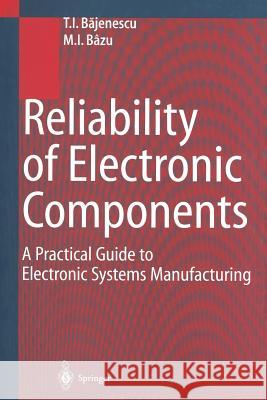
Titu I. Bajenescu; Marius I. Bazu
Reliability of Electronic Components: A Practical Guide to Electronic Systems Manufacturing Bajenescu, Titu I. 9783642636257 Springer - książkaWidoczna okładka, to zdjęcie poglądowe, a rzeczywista szata graficzna może różnić się od prezentowanej.

Reliability of Electronic Components: A Practical Guide to Electronic Systems Manufacturing

ISBN-13: 9783642636257 / Angielski / Miękka / 2012 / 509 str.

Titu I. Bajenescu; Marius I. Bazu
cena 484,18
(netto: 461,12 VAT:  5%)

Najniższa cena z 30 dni: 424,07
Termin realizacji zamówienia:
ok. 22 dni roboczych
Dostawa w 2026 r.

Darmowa dostawa!

The first detailed studies of electronic components reliability were undertaken to improve the performance of communications and navigational systems used by the American army. The techniques then developed were subsequently refined and applied to equipment used for many other applications where high reliability was of paramount importance - for example in civil airline electronic systems. The evolution of good and reliable products is the responsibility of technical and professional persons, engineers and designers. These individuals cannot succeed unless they are given adequate opportunity to apply their arts and mysteries so as to bring the end-product to the necessary level of satisfaction. Few managements, however, are yet aware of the far greater potential value of the reliability of their products or services. Yet customer satisfaction depends, in most cases, far more on the reliability of performance than on quality in the industrial sense. There was a time when reliable design could be prescribed simply as "picking good parts and using them right." Nowadays the complexity of systems, particularly electronic systems, and the demand for ultrahigh reliability in many applications mean that sophisticated methods based on numerical analysis and probability techniques have been brought to bear - particularly in the early stages of design - on determining the feasibility of systems.


Kategorie:
Technologie
Kategorie BISAC:
Technology & Engineering > Electronics - General
Technology & Engineering > Quality Control
Science > Fizyka
Wydawca:
Springer
Język:
Angielski
ISBN-13:
9783642636257
Rok wydania:
2012
Wydanie:
Softcover Repri
Ilość stron:
509
Waga:
0.84 kg
Wymiary:
23.5 x 15.5
Oprawa:
Miękka
Wolumenów:
01
Dodatkowe informacje:
Bibliografia
Glosariusz/słownik

1 Introduction.- 1.1 Definition of reliability.- 1.2 Historical development perspective.- 1.3 Quality and reliability.- 1.4 Economics and optimisation.- 1.5 Probability; basic laws.- 1.5.1 Probability distributions.- 1.5.2 Basic reliability distribution theory.- 1.6 Specific terms.- 1.6.1 The generalised definition of l and MTBF.- 1.7 Failures types.- 1.7.1 Failures classification.- 1.8 Reliability estimates.- 1.9 “Bath—tub” failure curve.- 1.10 Reliability of electronic systems.- 1.10.1 Can the batch reliability be increased?.- 1.10.2 What is the utility of screening tests?.- 1.10.3 Derating technique.- 1.10.4 About the testability of electronic and telecommunication systems.- 1.10.5 Accelerated ageing methods for equipped boards.- 1.10.6 Operational failures.- 1.10.7 FMEA/FMECA method.- 1.10.8 Fault tree analysis (FTA).- 1.10.8.1 Monte Carlo techniques.- 1.10.9 Practical recommendations.- 1.10.10 Component reliability and market economy.- 1.11 Some examples.- References.- 2 State of the Art in Reliability.- 2.1 Cultural features.- 2.1.1 Quality and reliability assurance.- 2.1.2 Total quality management (TQM).- 2.1.3 Building-in reliability (BIR).- 2.1.4 Concurrent engineering (CE).- 2.1.5 Acquisition reform.- 2.2 Reliability building.- 2.2.1 Design for reliability.- 2.2.2 Process reliability.- 2.2.2.1 Technological synergies.- 2.2.3 Screening and burn-in.- 2.2.3.1 Burn-in.- 2.2.3.2 Economic aspects of burn-in.- 2.2.3.3 Other screening tests.- 2.2.3.4 Monitoring the screening.- 2.3 Reliability evaluation.- 2.3.1 Environmental reliability testing.- 2.3.1.1 Synergy of environmental factors.- 2.3.1.2 Temperature cycling.- 2.3.1.3 Behavior in a radiation field.- 2.3.2 Life testing with noncontinous inspection.- 2.3.3 Accelerated testing.- 2.3.3.1 Activation energy depends on the stress level.- 2.3.4 Physics of failure.- 2.3.4.1 Drift, drift failures and drift behaviour.- 2.3.5 Prediction methods.- 2.3.5.1 Prediction methods based on failure physics.- 2.3.5.2 Laboratory versus operational reliability.- 2.4 Standardisation.- 2.4.1 Quality systems.- 2.4.2 Dependability.- References.- 3 Reliability of Passive Electronic Parts.- 3.1 How parts fail.- 3.2 Resistors.- 3.2.1 Some important parameters.- 3.2.2 Characteristics.- 3.2.3 Reasons for inconstant resistors [3.8]...[3.10].- 3.2.3.1 Carbon film resistors (Fig. 3.4).- 3.2.3.2 Metal film resistors.- 3.2.3.3 Composite resistors (on inorganic basis).- 3.2.4 Some design rules.- 3.2.5 Some typical defects of resistors.- 3.2.5.1 Carbon film resistors.- 3.2.5.2 Metal film resistors.- 3.2.5.3 Film resistors.- 3.2.5.4 Fixed wirewound resistors.- 3.2.5.5 Variable wirewound resistors.- 3.2.5.6 Noise behaviour.- 3.3 Reliability of capacitors.- 3.3.1 Introduction.- 3.3.2 Aluminium electrolytic capacitors.- 3.3.2.1 Characteristics.- 3.3.2.2 Results of reliability research studies.- 3.3.2.3 Reliability data.- 3.3.2.4 Main failures types.- 3.3.2.5 Causes of failures.- 3.3.3 Tantalum capacitors.- 3.3.3.1 Introduction.- 3.3.3.2 Structure and properties.- 3.3.3.3 Reliability considerations.- 3.3.3.4 DC/C0 variation with temperature.- 3.3.3.5 The failure rate and the product CU.- 3.3.3.6 Loss factor.- 3.3.3.7 Impedance at 100 Hz.- 3.3.3.8 Investigating the stability of 35 V tantalum capacitor.- 3.3.3.9 The failure rate model.- 3.3.4 Reliability comparison.- 3.3.5 Another reliability comparison.- 3.3.6 Polyester film / foil capacitors.- 3.3.6.1 Introduction.- 3.3.6.2 Life testing.- 3.3.6.3 1 as a function of temperature and load.- 3.3.6.4 Reliability conclusions.- 3.3.7 Wound capacitors.- 3.3.8 Reliability and screening methods [3.37] [3.38].- 3.4 Zinc oxide (ZnO) varistors [3.39]...[3.45].- 3.4.1 Pulse behaviour of ZnO varistors.- 3.4.2 Reliability results.- 3.5 Connectors.- 3.5.1 Specifications profile.- 3.5.2 Elements of a test plan.- References.- 4 Reliability of Diodes.- 4.1 Introduction.- 4.2 Semiconductor diodes.- 4.2.1 Structure and properties.- 4.2.2 Reliability tests and results.- 4.2.3 Failure mechanisms.- a. Mechanical failure mechanisms.- b. Electrical failure mechanisms.- 4.2.4 New technologies.- 4.2.5 Correlation between technology and reliability.- 4.2.6 Intermittent short-circuits.- 4.3 Z diodes.- 4.3.1 Characteristics.- 4.3.2 Reliability investigations and results.- 4.3.3 Failure mechanisms.- 4.3.3.1 Failure mechanisms of Z diodes.- 4.3.3.2 Design for reliability.- 4.3.3.3 Some general remarks.- 4.3.3.4 Catastrophic failures.- 4.3.3.5 Degradation failures.- 4.4 Trans-Zorb diodes.- 4.4.1 Introduction.- 4.4.2 Structure and characteristics.- 4.5 Impatt (IMPact Avalanche and Transit-Time) diodes.- 4.5.1 Reliability test results for HP silicon single drift Impatt diodes.- 4.5.2 Reliability test results for HP silicon double drift Impatt diodes.- 4.5.3 Factors affecting the reliability and safe operation.- References.- 5 Reliability of Silicon Transistors.- 5.1 Introduction.- 5.2 Technologies and power limitations.- 5.2.1 Bipolar transistors.- 5.2.2 Unipolar transistors.- 5.3 Electrical characteristics.- 5.3.1 Recommendations.- 5.3.2 Safety Limits.- 5.3.3 The du/dt phenomenon.- 5.4 Reliability characteristics.- 5.5 Thermal fatigue.- 5.6 Causes of failures.- 5.6.1 Failure mechanisms.- 5.6.2 Failure modes.- 5.6.3 A check-up for the users.- 5.6.4 Bipolar transistor peripherics.- 5.7 The package problem.- 5.8 Accelerated tests.- 5.8.1 The Arrhenius model.- 5.8.2 Thermal cycling.- 5.9 How to improve the reliability.- 5.10 Some recommendations.- References.- 6 Reliability of Thyristors.- 6.1 Introduction.- 6.2 Design and reliability.- 6.2.1 Failure mechanisms.- 6.2.2 Plastic and hermetic package problems.- 6.2.3 Humidity problem.- 6.2.4 Evaluating the reliability.- 6.2.5 Thyristor failure rates.- 6.3 Derating.- 6.4 Reliability screens by General Electric.- 6.5 New technology in preparation: SITH.- References.- 7 Reliability of Integrated Circuits.- 7.1 Introduction.- 7.2 Reliability evaluation.- 7.2.1 Some reliability problems.- 7.2.2 Evaluation of integrated circuit reliability.- 7.2.3 Accelerated thermal test.- 7.2.4 Humidity environment.- 7.2.5 Dynamic life testing.- 7.3 Failure analysis.- 7.3.1 Failure mechanisms.- 7.3.1.1 Gate oxide breakdown.- 7.3.1.2 Surface charges.- 7.3.1.3 Hot carrier effects.- 7.3.1.4 Metal diffusion.- 7.3.1.5 Electromigration.- 7.3.1.6 Fatigue.- 7.3.1.7 Aluminium-gold system.- 7.3.1.8 Brittle fracture.- 7.3.1.9 Electrostatic Discharge (ESD).- 7.3.2 Early failures.- 7.3.3 Modeling IC reliability.- 7.4 Screening and burn-in.- 7.4.1 The necessity of screening.- 7.4.2 Efficiency and necessity of burn-in.- 7.4.3 Failures at screening and burn-in.- 7.5 Comparison between the IC families TTL Standard and TTL-LS.- 7.6 Application Specific Integrated Circuits (ASIC).- References.- 8 Reliability of Hybrids.- 8.1 Introduction.- 8.2 Thin-film hybrid circuits.- 8.2.1 Reliability characteristics of resistors.- 8.2.2 Reliability of throughout-contacts.- 8.3 Thick-film hybrids.- 8.3.1 Failure types.- 8.3.2 Reliability of resistors and capacitors.- 8.3.3 Reliability of “beam-leads”.- 8.4 Thick-film versus thin-film hybrids.- 8.5 Reliability of hybrid ICs.- 8.6 Causes of failures.- 8.7 Influence of radiation.- 8.8 Prospect outlook of the hybrid technology.- 8.9 Die attach and bonding techniques.- 8.9.1 Introduction.- 8.9.2 Hybrid package styles.- 8.10 Failure mechanisms.- References.- 9 Reliability of Memories.- 9.1 Introduction.- 9.2 Process-related reliability aspects.- 9.3 Possible memories classifications.- 9.4 Silicon On Insulator (SOI) technologies.- 9.4.1 Silicon on sapphire (SOS) technology.- 9.5 Failure frequency of small geometry memories.- 9.6 Causes of hardware failures.- 9.6.1 Read only memories (ROMs).- 9.6.2 Small geometry devices.- 9.7 Characterisation testing.- 9.7.1 Timing and its influence on characterisation and test.- 9.7.2 Test and characterisation of refresh.- 9.7.2.1 Screening tests and test strategies.- 9.7.3 Test—programmes and —categories.- 9.7.3.1 Test categories.- 9.7.3.2 RAM failure modes.- 9.7.3.3 Radiation environment in space; hardening approaches.- 9.8 Design trends in microprocessor domain.- 9.9 Failure mechanisms of microprocessors.- References.- 10 Reliability of Optoelectronics.- 10.1 Introduction.- 10.2 LED reliability.- 10.3 Optocouplers.- 10.3.1 Introduction.- 10.3.2 Optocouplers ageing problem.- 10.3.3 CTR degradation and its cause.- 10.3.4 Reliability of optocouplers.- 10.3.5 Some basic rules for circuit designers.- 10.4 Liquid crystal displays.- 10.4.1 Quality and reliability of LCDs.- References.- 11 Noise and Reliability.- 11.2 Excess noise and reliability.- 11.3 Popcorn noise.- 11.4 Flicker noise.- 11.4.1 Measuring noise.- 11.4.2 Low noise, long life.- 11.5 Noise figure.- 11.6 Improvements in signal quality of digital networks.- References.- 12 Plastic Package and Reliability.- 12.1 Historical development.- 12.2 Package problems.- 12.2.1 Package functions.- 12.3 Some reliabilistic aspects of the plastic encapsulation.- 12.4 Reliability tests.- 12.4.1 Passive tests.- 12.4.2 Active tests.- 12.4.3 Life tests.- 12.4.4 Reliability of intermittent functioning plastic encapsulated ICs.- 12.5 Reliability predictions.- 12.6 Failure analysis.- 12.7 Technological improvements.- 12.7.1 Reliability testing of PCB equipped with PEM.- 12.7.2 Chip-Scale packaging.- 12.8 Can we use plastic encapsulated microcircuits (PEM) in high reliability applications?.- References.- 13 Test and Testability of Logic Ics.- 13.1 Introduction.- 13.2 Test and test systems.- 13.2.1 Indirect tests.- 13.3 Input control tests of electronic components.- 13.3.1 Electrical tests.- 13.3.2 Some economic considerations.- 13.3.3 What is the cost of the tests absence?.- 13.4 LIC selection and connected problems.- 13.4.1 Operational tests of memories.- 13.4.2 Microprocessor test methods.- 13.4.2.1 Selftesting.- 13.4.2.2 Comparison method.- 13.4.2.3 Real time algorithmic method.- 13.4.2.4 Registered patterns method.- 13.4.2.5 Random test of microprocessors.- 13.5 Testability of LICs.- 13.5.1 Constraints.- 13.5.2 Testability of sequential circuits.- 13.5.3 Independent and neutral test laboratories.- 13.6 On the testability of electronic and telecommunications systems.- References.- 14 Failure Analysis.- 14.1 Introduction [14.1]...[14.25].- 14.2 The purpose of failure analysis.- 14.2.1 Where are discovered the failures?.- 14.2.2 Types of failures.- 14.3 Methods of analysis.- 14.3.1 Electrical analysis.- 14.3.2 X-ray analysis.- 14.3.3 Hermeticity testing methods.- 14.3.4 Conditioning tests.- 14.3.5 Chemical means.- 14.3.6 Mechanical means.- 14.3.7 Microscope analysis.- 14.3.8 Plasma etcher.- 14.3.9 Electron microscope.- 14.3.10 Special means.- 14.4 Failure causes.- 14.5 Some examples.- References.- 15 Appendix.- 15.1 Software-package RAMTOOL++ [15.1].- 15.1.1 Core and basic module R3 Trecker.- 15.1.2 RM analyst.- 15.1.3 Mechanicus (Maintainability analysis).- 15.1.4 Logistics.- 15.1.5 RM FFT-module.- 15.1.6 PPoF-module.- 15.2 Failure rates for components used in telecommunications.- 15.3 Failure types for electronic components [15.2].- 15.4 Detailed failure modes for some components.- 15.5 Storage reliability data [15.3].- 15.6 Failure criteria. Some examples.- 15.7 Typical costs for the screening of plastic encapsulated ICs.- 15.8 Results of 1000 h HTB life tests for CMOS microprocessors.- 15.9 Results of 1000 h HTB life tests for linear circuits.- 15.10 Average values of the failure rates for some IC families.- 15.11 Activation energy values for various technologies.- 15.12 Failures at burn-in.- References.- General Bibliography.- Reliability Glossary.- List of Abbreviations.- Polyglot Dictionary of Reliability Terms.

The objective of this book is to better understand why components fail, addressing the needs of engineers who will apply reliability principles in design, manufacture, testing, and field service. It so contributes to new approaches and the development of electronic and telecommunications component reliability. As a reference source, it summarizes the knowledge on failure modes, degradation and mechanisms, including a survey of accelerated testing, achieving better reliability, total quality topics, screening tests and prediction methods. A detailed index, a glossary, acronym lists, reliability dictionaries and a rich specific bibliography round the benefit offered by the book. The technical level suites to senior and graduate students, as well as to experts and managers in industries.


Udostępnij

Facebook - konto krainaksiazek.pl


Opinie o Krainaksiazek.pl na Opineo.pl

Partner Mybenefit

Krainaksiazek.pl w programie rzetelna firma Krainaksiaze.pl - płatności przez paypal

Czytaj nas na:

Facebook - krainaksiazek.pl
  • książki na zamówienie
  • granty
  • książka na prezent
  • kontakt
  • pomoc
  • opinie
  • regulamin
  • polityka prywatności

Zobacz:

  • Księgarnia czeska

  • Wydawnictwo Książkowe Klimaty

1997-2025 DolnySlask.com Agencja Internetowa

© 1997-2022 krainaksiazek.pl
     
KONTAKT | REGULAMIN | POLITYKA PRYWATNOŚCI | USTAWIENIA PRYWATNOŚCI
Zobacz: Księgarnia Czeska | Wydawnictwo Książkowe Klimaty | Mapa strony | Lista autorów
KrainaKsiazek.PL - Księgarnia Internetowa

Polityka prywatnosci - link
Krainaksiazek.pl - płatnośc Przelewy24
Przechowalnia Przechowalnia





