• Wyszukiwanie zaawansowane
  • Kategorie
  • Kategorie BISAC
  • Książki na zamówienie
  • Promocje
  • Granty
  • Książka na prezent
  • Opinie
  • Pomoc
  • Załóż konto
  • Zaloguj się

Reinforcement Learning From Scratch: Understanding Current Approaches - with Examples in Java and Greenfoot » książka


zaloguj się | załóż konto
Logo Krainaksiazek.pl

koszyk

konto

szukaj
topmenu
Księgarnia internetowa
Szukaj
Książki na zamówienie
Promocje
Granty
Książka na prezent
Moje konto
Pomoc
 
 
Wyszukiwanie zaawansowane
Pusty koszyk
Bezpłatna dostawa dla zamówień powyżej 20 złBezpłatna dostawa dla zamówień powyżej 20 zł

Kategorie główne

• Nauka
 [2949965]
• Literatura piękna
 [1857847]

  więcej...
• Turystyka
 [70818]
• Informatyka
 [151303]
• Komiksy
 [35733]
• Encyklopedie
 [23180]
• Dziecięca
 [617748]
• Hobby
 [139972]
• AudioBooki
 [1650]
• Literatura faktu
 [228361]
• Muzyka CD
 [398]
• Słowniki
 [2862]
• Inne
 [444732]
• Kalendarze
 [1620]
• Podręczniki
 [167233]
• Poradniki
 [482388]
• Religia
 [509867]
• Czasopisma
 [533]
• Sport
 [61361]
• Sztuka
 [243125]
• CD, DVD, Video
 [3451]
• Technologie
 [219309]
• Zdrowie
 [101347]
• Książkowe Klimaty
 [123]
• Zabawki
 [2362]
• Puzzle, gry
 [3791]
• Literatura w języku ukraińskim
 [253]
• Art. papiernicze i szkolne
 [7933]
Kategorie szczegółowe BISAC

Reinforcement Learning From Scratch: Understanding Current Approaches - with Examples in Java and Greenfoot

ISBN-13: 9783031090295 / Angielski / Twarda / 2022 / 184 str.
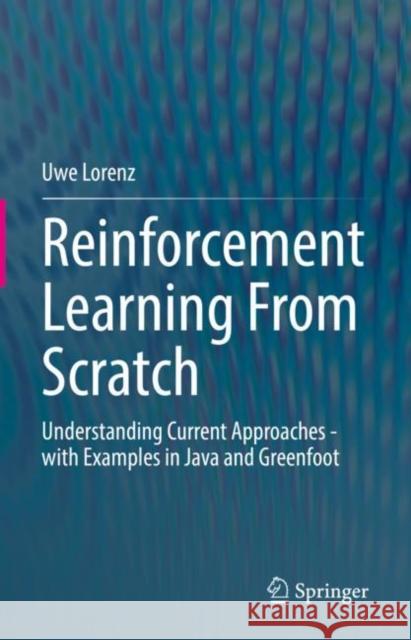
Uwe Lorenz
Reinforcement Learning From Scratch: Understanding Current Approaches - with Examples in Java and Greenfoot Uwe Lorenz 9783031090295 Springer - książkaWidoczna okładka, to zdjęcie poglądowe, a rzeczywista szata graficzna może różnić się od prezentowanej.

Reinforcement Learning From Scratch: Understanding Current Approaches - with Examples in Java and Greenfoot

ISBN-13: 9783031090295 / Angielski / Twarda / 2022 / 184 str.

Uwe Lorenz
cena 322,77
(netto: 307,40 VAT:  5%)

Najniższa cena z 30 dni: 308,41
Termin realizacji zamówienia:
ok. 22 dni roboczych
Bez gwarancji dostawy przed świętami

Darmowa dostawa!
inne wydania

In ancient games such as chess or go, the most brilliant players can improve by studying the strategies produced by a machine. Robotic systems practice their own movements. In arcade games, agents capable of learning reach superhuman levels within a few hours. How do these spectacular reinforcement learning algorithms work?With easy-to-understand explanations and clear examples in Java and Greenfoot, you can acquire the principles of reinforcement learning and apply them in your own intelligent agents. Greenfoot (M.Kölling, King's College London) and the hamster model (D. Bohles, University of Oldenburg) are simple but also powerful didactic tools that were developed to convey basic programming concepts.The result is an accessible introduction into machine learning that  concentrates on reinforcement learning. Taking the reader through the steps of developing intelligent agents, from the very basics to advanced aspects, touching on a variety of machine learning algorithms along the way, one is allowed to play along, experiment, and add their own ideas and experiments.

In ancient games such as chess or go, the most brilliant players can improve by studying the strategies produced by a machine. Robotic systems practice their own movements. In arcade games, agents capable of learning reach superhuman levels within a few hours. How do these spectacular reinforcement learning algorithms work? With easy-to-understand explanations and clear examples in Java and Greenfoot, you can acquire the principles of reinforcement learning and apply them in your own intelligent agents. Greenfoot (M.Kölling, King's College London) and the hamster model (D. Bohles, University of Oldenburg) are simple but also powerful didactic tools that were developed to convey basic programming concepts. The result is an accessible introduction into machine learning that  concentrates on reinforcement learning. Taking the reader through the steps of developing intelligent agents, from the very basics to advanced aspects, touching on a variety of machine learning algorithms along the way, one is allowed to play along, experiment, and add their own ideas and experiments.  

Kategorie:
Informatyka, Bazy danych
Kategorie BISAC:
Computers > Artificial Intelligence - General
Computers > Languages - Java
Computers > Data Science - Data Analytics
Wydawca:
Springer
Język:
Angielski
ISBN-13:
9783031090295
Rok wydania:
2022
Dostępne języki:
Ilość stron:
184
Waga:
0.45 kg
Wymiary:
23.39 x 15.6 x 1.27
Oprawa:
Twarda
Dodatkowe informacje:
Wydanie ilustrowane

Foreword of Michael Koelling (King’s College London)

​Preface

Introduction

Chapter 1: Reinforcement learning as subfield of machine learning

1.1 Machine Learning as automated processing of feedback from the environment

1.2 Machine Learning methods

1.3 Reinforcement Learning with Java

Bibliography

Chapter 2: Basic concepts of reinforcement learning

2.1 Agents

2.2 Control of the agent

2.3 Evaluation of states and actions (Q-function, Bellman equation)

Bibliography

Chapter 3: Optimal decision-making in a known environment

3.1 Value Iteration

3.1.1 Target-oriented state evaluation (“backward induction”)

3.1.2 Policy-based state valuation (reward prediction)

3.2 Iterative policy search

3.2.1 Direct policy improvement

3.2.2 Mutual improvement of policy and value-function

3.3 Optimal policy in a board game scenario

3.4 Summary

Bibliography

Chapter 4: decision making and learning in an unknown environment

4.1 Exploration vs. exploitation

4.2 Retroactive processing of experience ("model-free reinforcement learning")

4.2.1 Goal-oriented learning ("value-based")

4.2.2 Policy search

4.2.3 Combined methods (Actor-Critic)

4.3 Exploration with predictive simulations ("Model-Based Reinforcement Learning")

4.3.1 Dyna-Q

4.3.2 Monte-Carlo rollout

4.3.3 Artificial curiosity

4.3.4 Monte Carlo Tree Search (MCTS).

4.3.5 Remarks on the Concept of Intelligence

4.4 Systematic of learning methods

Bibliography

Chapter 5: Artificial Neural Networks as estimators for state values and the action selection

5.1 Artificial neural networks

5.1.1     Pattern recognition with the perceptron

5.1.2     The adaptability of artificial neural networks

5.1.3     Backpropagation Learning

5.1.4     Regression with multilayer perceptrons

5.2 State evaluation with generalizing approximations

5.3         Neural estimators for action selection

5.3.1     Policy gradient with neural networks

5.3.2     Proximal Policy Optimization

5.3.3     Evolutionary strategy with a neural policy

Bibliography

Chapter 6: Guiding ideas in Artificial Intelligence over time

6.1 Changing basic ideas

6.2 On the relationship between humans and Artificial Intelligence

Bibliography


After studying computer science and philosophy with a focus on artificial intelligence and machine learning at the Humboldt University Berlin and for a few years as a project engineer, Uwe Lorenz currently works as a high school teacher for computer science and mathematics and at the Free University of Berlin in the Computing Education Research Group, - since his first contact with computers at the end of the 1980s he couldn't let go of the topic of artificial intelligence.


In ancient games such as chess or go, the most brilliant players can improve by studying the strategies produced by a machine. Robotic systems practice their own movements. In arcade games, agents capable of learning reach superhuman levels within a few hours. How do these spectacular reinforcement learning algorithms work? 

With easy-to-understand explanations and clear examples in Java and Greenfoot, you can acquire the principles of reinforcement learning and apply them in your own intelligent agents. Greenfoot (M.Kölling, King's College London) and the hamster model (D. Bohles, University of Oldenburg) are simple but also powerful didactic tools that were developed to convey basic programming concepts. 

The result is an accessible introduction into machine learning that  concentrates on reinforcement learning. Taking the reader through the steps of developing intelligent agents, from the very basics to advanced aspects, touching on a variety of machine learning algorithms along the way, one is allowed to play along, experiment, and add their own ideas and experiments.  



This book is a translation of an original German edition. The translation was done with the help of artificial intelligence (machine translation by the service DeepL.com). A subsequent human revision was done primarily in terms of content, so that the book will read stylistically differently from a conventional translation.


Udostępnij

Facebook - konto krainaksiazek.pl


Opinie o Krainaksiazek.pl na Opineo.pl

Partner Mybenefit

Krainaksiazek.pl w programie rzetelna firma Krainaksiaze.pl - płatności przez paypal

Czytaj nas na:

Facebook - krainaksiazek.pl
  • książki na zamówienie
  • granty
  • książka na prezent
  • kontakt
  • pomoc
  • opinie
  • regulamin
  • polityka prywatności

Zobacz:

  • Księgarnia czeska

  • Wydawnictwo Książkowe Klimaty

1997-2025 DolnySlask.com Agencja Internetowa

© 1997-2022 krainaksiazek.pl
     
KONTAKT | REGULAMIN | POLITYKA PRYWATNOŚCI | USTAWIENIA PRYWATNOŚCI
Zobacz: Księgarnia Czeska | Wydawnictwo Książkowe Klimaty | Mapa strony | Lista autorów
KrainaKsiazek.PL - Księgarnia Internetowa

Polityka prywatnosci - link
Krainaksiazek.pl - płatnośc Przelewy24
Przechowalnia Przechowalnia




