• Wyszukiwanie zaawansowane
  • Kategorie
  • Kategorie BISAC
  • Książki na zamówienie
  • Promocje
  • Granty
  • Książka na prezent
  • Opinie
  • Pomoc
  • Załóż konto
  • Zaloguj się

Regulating Chemical Risks: European and Global Challenges » książka


zaloguj się | załóż konto
Logo Krainaksiazek.pl

koszyk

konto

szukaj
topmenu
Księgarnia internetowa
Szukaj
Książki na zamówienie
Promocje
Granty
Książka na prezent
Moje konto
Pomoc
 
 
Wyszukiwanie zaawansowane
Pusty koszyk
Bezpłatna dostawa dla zamówień powyżej 20 złBezpłatna dostawa dla zamówień powyżej 20 zł

Kategorie główne

• Nauka
 [2946912]
• Literatura piękna
 [1852311]

  więcej...
• Turystyka
 [71421]
• Informatyka
 [150889]
• Komiksy
 [35717]
• Encyklopedie
 [23177]
• Dziecięca
 [617324]
• Hobby
 [138808]
• AudioBooki
 [1671]
• Literatura faktu
 [228371]
• Muzyka CD
 [400]
• Słowniki
 [2841]
• Inne
 [445428]
• Kalendarze
 [1545]
• Podręczniki
 [166819]
• Poradniki
 [480180]
• Religia
 [510412]
• Czasopisma
 [525]
• Sport
 [61271]
• Sztuka
 [242929]
• CD, DVD, Video
 [3371]
• Technologie
 [219258]
• Zdrowie
 [100961]
• Książkowe Klimaty
 [124]
• Zabawki
 [2341]
• Puzzle, gry
 [3766]
• Literatura w języku ukraińskim
 [255]
• Art. papiernicze i szkolne
 [7810]
Kategorie szczegółowe BISAC

Regulating Chemical Risks: European and Global Challenges

ISBN-13: 9789048194278 / Angielski / Twarda / 2010 / 350 str.
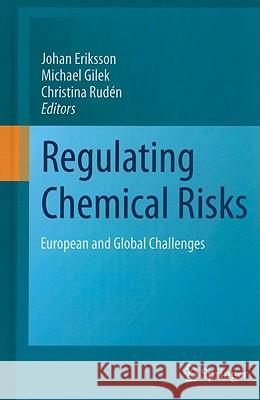
Johan Eriksson; Michael Gilek; Christina Ruden
Regulating Chemical Risks: European and Global Challenges Eriksson, Johan 9789048194278 Not Avail - książkaWidoczna okładka, to zdjęcie poglądowe, a rzeczywista szata graficzna może różnić się od prezentowanej.

Regulating Chemical Risks: European and Global Challenges

ISBN-13: 9789048194278 / Angielski / Twarda / 2010 / 350 str.

Johan Eriksson; Michael Gilek; Christina Ruden
cena 605,23
(netto: 576,41 VAT:  5%)

Najniższa cena z 30 dni: 578,30
Termin realizacji zamówienia:
ok. 22 dni roboczych
Bez gwarancji dostawy przed świętami

Darmowa dostawa!

This volume presents research on current trends in chemical regulations a fa- growing, complex, and increasingly internationalized field. The book grew out from a multidisciplinary research project entitled Regulating Chemical Risks in the Baltic Sea Area: Science, Politics, and the Media, led by Michael Gilek at Sodertorn University, Sweden. This research project involved scholars and experts from natural as well as social sciences, based at Sodertorn University, Swedish Royal Institute of Technology (KTH), Karolinska Institutet, and Umea University. The project group organized a multidisciplinary research conference on chemical risk regulations, held in Stockholm, August 15 17, 2007. Most of the contributions published in this book were, in draft form, first presented at this conference. The conference, like the ensuing edited volume, expanded the geographical focus beyond the Baltic Sea area to include wider European, and to some extent also global trends. Many thanks to all project colleagues and conference participants We are very grateful for the generous financial support received from The Foundation for Baltic and East European Studies (Ostersjostiftelsen), The Swedish Research Council Formas, and from Sodertorn University. Without this support the present book would not have been possible. Special thanks to all of our fellow contributors, all of whom have submitted to- cal papers based on high-quality research. Many thanks also to Tobias Evers, who assisted us with technical editing. Finally, we are grateful for the professionalism shown by our editors at Springer."


Kategorie:
Nauka, Prawo i administracja
Kategorie BISAC:
Law > International
Medical > Farmakologia
Law > Environmental
Wydawca:
Not Avail
Język:
Angielski
ISBN-13:
9789048194278
Rok wydania:
2010
Ilość stron:
350
Waga:
0.78 kg
Wymiary:
23.5 x 15.5
Oprawa:
Twarda
Wolumenów:
01
Dodatkowe informacje:
Bibliografia
Wydanie ilustrowane

From the reviews:

"This multiauthored monograph stems from research and a conference on regulating chemical risk in the Baltic area. ... This work is useful as a supplementary reference for students in the sciences, journalism, and environmental law. Summing Up: Recommended. Upper-division undergraduates through professionals, general audiences." (R. E. Buntrock, Choice, Vol. 48 (9), May, 2011)

Preface.- List of Contributors.- 1. Introduction.- PART I: Chemical Risk Assessment and Risk Communication.- 2. Risk Governance: Contemporary and Future Challenges.- 2.1 Challenges Posed by Seriousness, Complexity, Uncertainty, and Ambiguity.- 2.1.1 Seriousness.- 2.1.2 Complexity.- 2.1.3 Scientific Uncertainty.- 2.1.4 Interpretative and Normative Ambiguity.- 2.2 Conceptual Design of an Integrated Risk Governance Model.- 2.2.1 Pre-assessment.- 2.2.2 Risk Appraisal.- 2.2.3 Tolerance and Acceptability Judgement.- 2.2.4 Risk Management.- 2.2.5 Risk Communication.- 2.3 Conclusions.- References.- 3. Communicating Chemical Risks: Beyond the Risk Society.- 3.1 Introduction.- 3.2 Early Approaches to Researching Science and the Media.- 3.3 Which Risks Attract Attention, Why and Under What Conditions?- 3.4 Risk Society.- 3.5 The Brent Spar.- 3.6 The Prestige Oil Disaster.- 3.7 Conclusion: Beyond the Risk Society.- References.- 4. Framing Chemical Risks in Sweden and Poland: Journalists’ Narratives and Media Texts.- 4.1 Introduction.- 4.2 Purpose.- 4.3 The Swedish and Polish Cases.- 4.4 Methods and Materials.- 4.5 Results.- 4.6 Chemicals in the Swedish Press.- 4.7 Chemicals in the Polish Press.- 4.8 Swedish Journalists’ Narratives About Chemicals.- 4.9 Polish journalists’ Narratives About Chemicals.- 4.10 Conclusions and Reflections.- References.- 5. REACH: What Has Been Achieved and What Needs To Be Done?- 5.1 Introduction.- 5.2 Risk Management Criteria.- 5.3 Data Requirements in REACH.- 5.4 What Needs To Be Done.- References.- 6. Improving the Value Standard of Toxicity Test Data in REACH.- 6.1 Introduction.- 6.2 Suboptimal Testing Conditions.- 6.2.1 Background.- 6.2.2 Environmental Factors of Importance for Uptake and Effects.- 6.3 Population Modelling.- 6.3.1 Available Tools.- 6.3.2 Standard Test Data To Be Used for Regulatory Modelling.- 6.4 Suggestions for Improvements of REACH.- 6.5 Concluding Remarks.- References.- 7. Testing in Aquatic Ecotoxicology: What are theScientific Conditions for the ‘3R’ Concept?- 7.1 Introduction.- 7.2 Why Fsh Tests at All?- 7.3 Alternative ‘3R’ Based Approaches in Ecotoxicology.- 7.3.1 Reduction: Acute Threshold Approach.- 7.3.2 Replacement: In Vitro Cell Based Methods.- 7.3.3 Replacement: Fish Egg/Embryo Systems.- 7.4 Current Trends in Ecotoxicological Testing.- 7.5 Conclusion: Has the ‘3R’ Concept a Future in Ecotoxicology?- References.- 8. Chemical Risk Assessment in Toxicological Perspective.- 8.1 Data requirements for Hazard Assessment.- 8.1.1 Hazard Identification and Dose Response.- 8.1.2 Exposure Assessment.- 8.2 Risk Management.- 8.2.1 The General Approach.- 8.2.2 The Tools for Hazard Identification.- 8.2.3 Risk Assessment for Threshold Compounds.- 8.2.4 Risk Assessment for Non-threshold Genotoxic Carcinogens.- 8.3 Classification and Labelling of Carcinogens.- 8.4 Conclusion.- References.- 9. Occupational Exposure Limits in Comparative Perspective: Unity and Diversity Within the European Union.- 9.1 Introduction.- 9.2 European Community Involvement.- 9.3 Aiming for Unity.- 9.4 National Diversity.- 9.5 Scrutinising Diversity.- 9.6 Unity and Diversity.-References.- 10. Scientific Uncertainty and Science-Policy Interactions in the Risk Assessment of Hazardous Chemicals.- 10.1 Identifying Substances of High Concern.- 10.2 Uncertainty in Risk Assessments of Potential PBT/vPvB Substances.- 10.2.1 Uncertainties Identified in the Exposure Assessment.- 10.2.2 Uncertainties Identified in the Hazard Assessment.- 10.2.3 Uncertainties Identified in the Overall PBT Conclusions.- 10.3 Discussion.- 10.4 Conclusions and Recommendations.- References.- 11. Assessing Chemical Risks: Evaluating Products Rather than Substances, and the Case of Anti-fouling Paints.- 11.1 Introduction.- 11.2 Background: Anti-fouling Paints.- 11.2.1 History of Anti-fouling Paints Globally.- 11.2.2 History of Regulations in Sweden.- 11.2.3 The Situation of Today on Anti-fouling Paints in Sweden.- 11.3 The Biocidal

This important contribution to the scientific understanding of chemical risk regulation offers a coherent, comprehensive and updated multidisciplinary analysis, written by leading experts in toxicology, ecotoxicology, risk analysis, media and communication, law, and political science.   The text focuses in particular on the new European REACH regime and its nature, causes and consequences. It examines the regime in the context of the interplay between science and policy, the role of the media, human health, and the environment. Other regulatory systems at both domestic and international levels are also studied, including the UN’s Globally Harmonised System (GHS) for chemical labelling, as well as developments in the U.S. In addition, readers will find analyses of a number of new and still largely uncharted regulatory systems, along with in-depth assessments of their complexity and transnational nature.


Udostępnij

Facebook - konto krainaksiazek.pl


Opinie o Krainaksiazek.pl na Opineo.pl

Partner Mybenefit

Krainaksiazek.pl w programie rzetelna firma Krainaksiaze.pl - płatności przez paypal

Czytaj nas na:

Facebook - krainaksiazek.pl
  • książki na zamówienie
  • granty
  • książka na prezent
  • kontakt
  • pomoc
  • opinie
  • regulamin
  • polityka prywatności

Zobacz:

  • Księgarnia czeska

  • Wydawnictwo Książkowe Klimaty

1997-2025 DolnySlask.com Agencja Internetowa

© 1997-2022 krainaksiazek.pl
     
KONTAKT | REGULAMIN | POLITYKA PRYWATNOŚCI | USTAWIENIA PRYWATNOŚCI
Zobacz: Księgarnia Czeska | Wydawnictwo Książkowe Klimaty | Mapa strony | Lista autorów
KrainaKsiazek.PL - Księgarnia Internetowa

Polityka prywatnosci - link
Krainaksiazek.pl - płatnośc Przelewy24
Przechowalnia Przechowalnia





