• Wyszukiwanie zaawansowane
  • Kategorie
  • Kategorie BISAC
  • Książki na zamówienie
  • Promocje
  • Granty
  • Książka na prezent
  • Opinie
  • Pomoc
  • Załóż konto
  • Zaloguj się

Recycling and Resource Recovery Engineering: Principles of Waste Processing » książka


zaloguj się | załóż konto
Logo Krainaksiazek.pl

koszyk

konto

szukaj
topmenu
Księgarnia internetowa
Szukaj
Książki na zamówienie
Promocje
Granty
Książka na prezent
Moje konto
Pomoc
 
 
Wyszukiwanie zaawansowane
Pusty koszyk
Bezpłatna dostawa dla zamówień powyżej 20 złBezpłatna dostawa dla zamówień powyżej 20 zł

Kategorie główne

• Nauka
 [2949965]
• Literatura piękna
 [1857847]

  więcej...
• Turystyka
 [70818]
• Informatyka
 [151303]
• Komiksy
 [35733]
• Encyklopedie
 [23180]
• Dziecięca
 [617748]
• Hobby
 [139972]
• AudioBooki
 [1650]
• Literatura faktu
 [228361]
• Muzyka CD
 [398]
• Słowniki
 [2862]
• Inne
 [444732]
• Kalendarze
 [1620]
• Podręczniki
 [167233]
• Poradniki
 [482388]
• Religia
 [509867]
• Czasopisma
 [533]
• Sport
 [61361]
• Sztuka
 [243125]
• CD, DVD, Video
 [3451]
• Technologie
 [219309]
• Zdrowie
 [101347]
• Książkowe Klimaty
 [123]
• Zabawki
 [2362]
• Puzzle, gry
 [3791]
• Literatura w języku ukraińskim
 [253]
• Art. papiernicze i szkolne
 [7933]
Kategorie szczegółowe BISAC

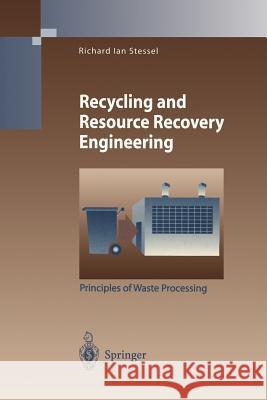
Recycling and Resource Recovery Engineering: Principles of Waste Processing

ISBN-13: 9783642802218 / Angielski / Miękka / 2011 / 263 str.
Richard I. Stessel
Recycling and Resource Recovery Engineering: Principles of Waste Processing Stessel, Richard I. 9783642802218 Springer - książkaWidoczna okładka, to zdjęcie poglądowe, a rzeczywista szata graficzna może różnić się od prezentowanej.

Recycling and Resource Recovery Engineering: Principles of Waste Processing

ISBN-13: 9783642802218 / Angielski / Miękka / 2011 / 263 str.

Richard I. Stessel
cena 403,47 zł
(netto: 384,26 VAT:  5%)

Najniższa cena z 30 dni: 385,52 zł
Termin realizacji zamówienia:
ok. 22 dni roboczych
Bez gwarancji dostawy przed świętami

Darmowa dostawa!

Solid waste is one of the newest fields to achieve recognition as a sub-discipline in environmental engineering. As such, one is hard-pressed to find thorough coverage of related topics in academic curricula. Many graduate programs in environmental engineering have one introductory course in waste control. A handful of texts, some excellent, exist to serve this need. Recent purported crises in solid waste management have forced the understanding that something beyond the traditional control methods may be appropriate. Resource recovery is the correct nomenclature for the longest standing alternative approach seeking to extract materials from the waste stream for eventual re-use in one or another beneficial fashion. Several books have evolved, covering various approaches. Design approaches therein have borrowed heavily from other disciplines, ceasing where solid waste differs from the feeds to be processed. These books were oriented towards knowledgeable practitioners. This work attempts to present waste processing as a study in unit operations appropriate to university study at the graduate level. The study of unit operations is typical in environmental engineering. These unit operations are different. A variety of student backgrounds are suitable. However, a familiarity with the basics of waste control, such as would be gained from one of the introductory courses mentioned above, is assumed, as is a sound quantitative background. It is hoped that this work fills an empty niche. Contents 1 Waste as a Resource . . . . . . . . . . . . . . . . . . .. . . 1 . . . . ."


Kategorie:
Technologie
Kategorie BISAC:
Science > Life Sciences - Ecology
Science > Environmental Science (see also Chemistry - Environmental)
Business & Economics > Economics - General
Wydawca:
Springer
Seria wydawnicza:
Environmental Science and Engineering / Environmental Engine
Język:
Angielski
ISBN-13:
9783642802218
Rok wydania:
2011
Wydanie:
Softcover Repri
Numer serii:
000449131
Ilość stron:
263
Waga:
0.43 kg
Wymiary:
23.5 x 15.5
Oprawa:
Miękka
Wolumenów:
01

1 Waste as a Resource.- 1.1 Political Background.- 1.1.1 Governmental Roles in Waste Management.- 1.1.2 Research.- 1.2 Resource Economics.- 1.2.1 Industry.- 1.2.2 Disposable Materials.- 1.3 Recycling.- 1.3.1 Disposable Materials Composition.- 1.3.2 Collection.- 1.4 Automated Processing.- 1.4.1 The Possibilities.- 1.4.2 Research.- 2 Waste Analysis.- 2.1 Waste Sampling.- 2.1.1 Statistics of Sampling.- 2.1.2 Mechanics of Sampling.- 2.2 Waste Composition.- 2.2.1 Procedures.- 2.2.2 Categorization.- 2.3 Determination of Waste Properties.- 2.3.1 Determination of Size Distributions.- 2.3.2 Size and Sample Reduction for Analysis.- 2.3.3 Moisture Content.- 2.3.4 Density.- 2.3.5 Terminal Velocity.- 2.4 Energy Recovery Assessments.- 2.4.1 Ash and Fines Analysis.- 2.4.2 Energy Content.- 2.4.3 Degradability.- 2.5 Hazardous Waste Aspects.- 2.6 The Waste Analysis Laboratory.- 3 System Design.- 3.1 Design of Recycling Systems.- 3.1.1 Collection Systems.- 3.1.2 Unloading the Vehicle at the T-MRF.- 3.1.3 Industry Configuration.- 3.2 Design of Process Trains.- 3.2.1 Process Train Design and Complexity.- 3.2.2 Laboratory Research.- 3.2.3 Unit Operation General Design Principles.- 3.2.4 MRF Configuration.- 3.3 Product Design for Recycling.- 3.3.1 Examples of Product Design.- 3.3.2 Product Design with the MRF in Mind.- 3.4 Efficiency of Unit Operations and Systems.- 3.5 Conveyance.- 3.5.1 Belt conveyors.- 3.5.2 Other Positive-Action Conveyors.- 3.5.3. Pneumatic Transport.- 3.6 Safety.- 4 Energy Recovery.- 4.1 Combustion Equipment.- 4.1.1 General Configurations of Combustors.- 4.1.2 Energy Recovery.- 4.1.3 Grates.- 4.2 Energy Recovery Analysis.- 4.2.1 Energy Content.- 4.2.2 Oxygen Requirements.- 4.2.3 Energy Recovery.- 4.2.4 Energy Losses.- 4.3 Emissions.- 4.3.1 Emissions of Concern.- 4.3.2 Emissions Monitoring.- 4.3.3 Physical Control Systems.- 4.3.4 Chemical Control.- 4.4 Residue Control.- 4.4.1 The Nature of Ash Streams.- 4.4.2 In-Plant Operations.- 4.4.3 Disposal.- 4.5 Refuse-Derived Fuel.- 5 Size Reduction.- 5.1 Volume Reduction.- 5.2 Particle Size Reduction.- 5.2.1 Shredders.- 5.2.2 Concepts in Particle Size Reduction.- 5.2.3 Energy Requirements.- 6 Fluid Separation.- 6.1 General Theory of Fluids Separation.- 6.2 Categories of Fluids Separators.- 6.2.1 Flotation Separators.- 6.2.2 Air Separation.- 6.3 Air Classification in Waste Processing.- 6.3.1 Zigzag Air Classifiers.- 6.3.2 Active Pulsed-Flow Air Classification.- 6.3.3 Air Cleaning: the Cyclone Separator.- 7 Screening.- 7.1 Flat Screens.- 7.1.1 Types of Flat Screen.- 7.1.2 Basic Screening Principles.- 7.2 Screening Theory.- 7.3 The Trommel and Related Theory.- 7.3.2 Particle Trajectory.- 7.3.2 Screen Rise.- 7.3.3 Bed Dimensions and Screening.- 7.4 Trommel Operation.- 7.4.1 Trommel Behavior.- 7.4.2 Trommel Implementation.- 8 Metals Recovery.- 8.1 Ferrous Metals Separation.- 8.1.1 Properties of Ferrous Metals.- 8.1.2 Principles of Magnetic Field-Ferrous Material Interactions.- 8.1.3 Extraction of Material from a Bed.- 8.1.4 Magnetic Separation Equipment.- 8.2 Non-Ferrous Metals Separation.- 8.2.1 Eddy-Current Separator Theory.- 8.2.2 Types of Eddy-Current Separator.- 9 Detect-and-Route Systems.- 9.1 Detect-and-Route System Configuration.- 9.2 Glass Separation.- 9.3 Plastics Separation.- 10 Digestion.- 10.1 Current Methods of Degradation.- 10.1.1 Composting.- 10.1.2 Land Disposal.- 10.2 Optimization of Degradation.- 10.3 Implications of Optimized Aerobic Landfill Degradation.- 10.3.1 Design of the In-Ground Digester (IGD).- 10.3.2 Heavy-Metal Control in the IGD.- 10.3.3 Control of Organic Contaminants in the IGD.- 10.3.4 Landfill Gas Implications.- 10.4 Processing of Degraded Waste.

This book covers mechanical processing of solid waste. It moves beyond a basic understanding of waste control to encompass waste processing as an industry expected to take its place alongside existing industrial raw materials suppliers. The author begins by describing the industry as it should develop, and then presents an advanced discussion of waste analysis, including a description of the features of a waste analysis laboratory. He goes on to describe universal design principles in waste processing, then discusses combustion, degradation, shredding, screening, air classification, metals separation, and automated materials detection. The focus throughout is on the analytic understanding of principles of operation necessary to undertake recycling and resource recovery with a cost-effective industrial approach. Richard I. Stessel has been doing research and design in resource recovery engineering for over 15 years. He is a registered Professional Engineer and board certified in Solid Waste Engineering by the American Academy of Environmental Engineer's Solid Waste Processing Division and chairs the Landfill and Composting Committee of the Air & Waste Management Association. Fachgebiet: Environmental Engineering Zielgruppe: Application


Udostępnij

Facebook - konto krainaksiazek.pl


Opinie o Krainaksiazek.pl na Opineo.pl

Partner Mybenefit

Krainaksiazek.pl w programie rzetelna firma Krainaksiaze.pl - płatności przez paypal

Czytaj nas na:

Facebook - krainaksiazek.pl
  • książki na zamówienie
  • granty
  • książka na prezent
  • kontakt
  • pomoc
  • opinie
  • regulamin
  • polityka prywatności

Zobacz:

  • Księgarnia czeska

  • Wydawnictwo Książkowe Klimaty

1997-2025 DolnySlask.com Agencja Internetowa

© 1997-2022 krainaksiazek.pl
     
KONTAKT | REGULAMIN | POLITYKA PRYWATNOŚCI | USTAWIENIA PRYWATNOŚCI
Zobacz: Księgarnia Czeska | Wydawnictwo Książkowe Klimaty | Mapa strony | Lista autorów
KrainaKsiazek.PL - Księgarnia Internetowa

Polityka prywatnosci - link
Krainaksiazek.pl - płatnośc Przelewy24
Przechowalnia Przechowalnia





