• Wyszukiwanie zaawansowane
  • Kategorie
  • Kategorie BISAC
  • Książki na zamówienie
  • Promocje
  • Granty
  • Książka na prezent
  • Opinie
  • Pomoc
  • Załóż konto
  • Zaloguj się

Recent Advances in Quantitative Methods in Cancer and Human Health Risk Assessment » książka


zaloguj się | załóż konto
Logo Krainaksiazek.pl

koszyk

konto

szukaj
topmenu
Księgarnia internetowa
Szukaj
Książki na zamówienie
Promocje
Granty
Książka na prezent
Moje konto
Pomoc
 
 
Wyszukiwanie zaawansowane
Pusty koszyk
Bezpłatna dostawa dla zamówień powyżej 20 złBezpłatna dostawa dla zamówień powyżej 20 zł

Kategorie główne

• Nauka
 [2946600]
• Literatura piękna
 [1856966]

  więcej...
• Turystyka
 [72221]
• Informatyka
 [151456]
• Komiksy
 [35826]
• Encyklopedie
 [23190]
• Dziecięca
 [619653]
• Hobby
 [140543]
• AudioBooki
 [1577]
• Literatura faktu
 [228355]
• Muzyka CD
 [410]
• Słowniki
 [2874]
• Inne
 [445822]
• Kalendarze
 [1744]
• Podręczniki
 [167141]
• Poradniki
 [482898]
• Religia
 [510455]
• Czasopisma
 [526]
• Sport
 [61590]
• Sztuka
 [243598]
• CD, DVD, Video
 [3423]
• Technologie
 [219201]
• Zdrowie
 [101638]
• Książkowe Klimaty
 [124]
• Zabawki
 [2473]
• Puzzle, gry
 [3898]
• Literatura w języku ukraińskim
 [254]
• Art. papiernicze i szkolne
 [8170]
Kategorie szczegółowe BISAC

Recent Advances in Quantitative Methods in Cancer and Human Health Risk Assessment

ISBN-13: 9780470857564 / Angielski / Twarda / 2005 / 512 str.
Lutz Edler; Christos Kitsos
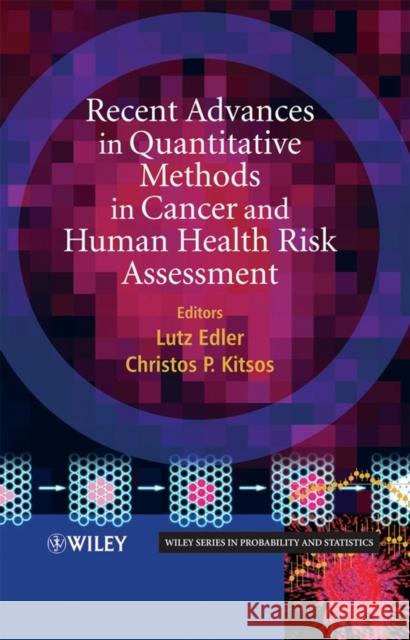
Recent Advances in Quantitative Methods in Cancer and Human Health Risk Assessment Lutz Edler Christos Kitsos 9780470857564 John Wiley & Sons - książkaWidoczna okładka, to zdjęcie poglądowe, a rzeczywista szata graficzna może różnić się od prezentowanej.

Recent Advances in Quantitative Methods in Cancer and Human Health Risk Assessment

ISBN-13: 9780470857564 / Angielski / Twarda / 2005 / 512 str.

Lutz Edler; Christos Kitsos
cena 656,96 zł
(netto: 625,68 VAT:  5%)

Najniższa cena z 30 dni: 650,24 zł
Termin realizacji zamówienia:
ok. 30 dni roboczych
Bez gwarancji dostawy przed świętami

Darmowa dostawa!

Human health risk assessment involves the measuring of risk of exposure to disease, with a view to improving disease prevention. Mathematical, biological, statistical, and computational methods play a key role in exposure assessment, hazard assessment and identification, and dose-response modelling. Recent Advances in Quantitative Methods in Cancer and Human Health Risk Assessment is a comprehensive text that accounts for the wealth of new biological data as well as new biological, toxicological, and medical approaches adopted in risk assessment. It provides an authoritative compendium of state-of-the-art methods proposed and used, featuring contributions from eminent authors with varied experience from academia, government, and industry.

  • Provides a comprehensive summary of currently available quantitative methods for risk assessment of both cancer and non-cancer problems.
  • Describes the applications and the limitations of current mathematical modelling and statistical analysis methods (classical and Bayesian).
  • Includes an extensive introduction and discussion to each chapter.
  • Features detailed studies of risk assessments using biologically-based modelling approaches.
  • Discusses the varying computational aspects of the methods proposed.
  • Provides a global perspective on human health risk assessment by featuring case studies from a wide range of countries.
  • Features an extensive bibliography with links to relevant background information within each chapter.
Recent Advances in Quantitative Methods in Cancer and Human Health Risk Assessment will appeal to researchers and practitioners in public health & epidemiology, and postgraduate students alike. It will also be of interest to professionals working in risk assessment agencies.

Kategorie:
Nauka, Medycyna
Kategorie BISAC:
Medical > Oncology - General
Medical > Health Risk Assessment
Wydawca:
John Wiley & Sons
Seria wydawnicza:
Wiley Series in Probability and Statistics
Język:
Angielski
ISBN-13:
9780470857564
Rok wydania:
2005
Numer serii:
000033279
Ilość stron:
512
Waga:
0.83 kg
Wymiary:
23.42 x 15.54 x 3.2
Oprawa:
Twarda
Wolumenów:
01
Dodatkowe informacje:
Bibliografia
Wydanie ilustrowane

" a convenient collection of quantitative research in cancer and risk assessment that is both rigorous and up–to–date." ( Journal of the American Statistical Association, September 2006)

" a useful collection of recent works in the field." (E–STREAMS, August 2006)

"...the book can be highly recommended not only to all researchers...but also to lecturers..." (Biometrics, Vol 61, December 2005)

Contributors.

Preface.

Introduction.

I CANCER AND HUMAN HEALTH RISK ASSESSMENT.

Introductory remarks.

1. Principles of Cancer Risk Assessment: The Risk Assessment Paradigm (Vincent J. Cogliano).

1.1 The risk assessment paradigm.

1.2 Hazard identification.

1.3 Dose–response assessment.

II BIOLOGICAL ASPECTS OF CARCINOGENESIS.

Introductory remarks.

2. Molecular Epidemiology in Cancer Research (Gerassimos Voutsinas, Anastasia Apostolidou and Natalia Spyrou).

2.1 Introduction.

2.2 From carcinogen exposure to cancer.

2.3 Biomarkers.

2.4 Validation of biomarkers.

2.5 Factors influencing cancer risk.

2.6 New tools in molecular epidemiology.

2.7 Conclusions.

3. Genetic Polymorphisms in Metabolising Enzymes as Lung Cancer Risk Factors (Angela Risch, Heike Dally and Lutz Edler).

3.1 Introduction.

3.2 Methodological aspects.

3.3 Examples.

3.4 Discussion.

Acknowledgements.

4. Biological Carcinogenesis: Theories and Models (Sylvia Solakidi, Constantinos E. Vorgias and Constantine E. Sekeris).

4.1 Introduction.

4.2 Models of human carcinogenesis.

4.3 The multistage mouse skin carcinogenesis model.

4.4 Epilogue.

5. Biological and Mathematical Aspects of Multistage Carcinogenesis (E. Georg Luebeck and Suresh H. Moolgavkar).

5.1 Introduction.

5.2 Features of multistage carcinogenesis.

5.3 Generalized TSCE model.

5.4 Modeling cancer incidence.

5.5 Summary.

6. Risk Assessment and Chemical and Radiation Hormesis: A Short Commentary and Bibliographic Review (Jose J. Amaral Mendes and Eric Pluygers).

6.1 Introduction.

6.2 The concept of hormesis.

6.3 Chemical hormesis.

6.4 Radiation hormesis.

6.5 Concluding remarks.

III MODELING FOR CANCER RISK ASSESSMENT.

Introductory remarks.

7. Modeling Exposure and Target Organ Concentrations (Karen H. Watanabe).

7.1 Introduction.

7.2 Data from molecular biology.

7.3 The next generation of physiological models.

7.4 Discussion and conclusions.

Acknowledgements.

8. Stochastic Carcinogenesis Models (Annette Kopp–Schneider, Iris Burkholder and Jutta Groos).

8.1 Introduction.

8.2 Stochastic models for hepatocarcinogenesis.

8.3 Model–based evaluation of liver focal lesion data.

8.4 Conclusions.

9. A Unified Modeling Approach: From Exposure to Disease Endpoints (Chao W. Chen).

9.1 Background.

9.2 Conventional approach to modeling carcinogenesis.

9.3 State space modeling using sampling techniques.

9.4 Self–organizing algorithm for state space modeling.

9.5 Some examples of state space models.

9.6 A computing procedure for the three–stage model.

9.7 Discussion.

Appendix: Simulation programs.

10. Modeling Lung Cancer Screening (Marek Kimmel, Olga Y. Gorlova and Claudia I. Henschke).

10.1 Introduction.

10.2 Screening and Other Relevant Studies.

10.3 Principles of modeling of lung cancer screening.

10.4 Review of modeling approaches.

10.5 Modeling the impact of new screening modalities on reduction of mortality from lung cancer.

10.6 Comparison of models and concluding remarks.

11. Optimal Regimens of Cancer Screening (Leonid G. Hanin and Lyudmila V. Pavlova).

11.2 Optimal screening.

11.3 Formula for the screening efficiency functional.

11.4 The data and parameter estimation.

11.5 Numerical experiments.

11.6 Discussion.

Acknowledgement.

IV STATISTICAL APPROACHES FOR CARCINOGENESIS STUDIES.

Introductory remarks

12. Analysis of Survival Data with Non–proportional Hazards and Crossings of Survival Functions (Vilijandas B. Bagdonavic ius and Mikhail S. Nikuline).

12.1 Introduction.

12.2 Models.

12.3 Parametric and semiparametric estimation.

12.4 Goodness–of–fit for the Cox model against the cross–effects models.

12.5 Examples.

12.6 Concluding remarks.

Appendix: Proof of Theorem 12.1.

13. Dose–response Modeling (Lutz Edler, Annette Kopp–Schneider and Harald Heinzl).

13.1 Introduction.

13.2 Elements of the dose–response assessment.

13.3 Dose–response models.

13.4 Dose–response models in risk assessment.

13.5 Dose–Response modeling of 2,3,7,8–tetrachlorodibenzo–p–dioxin.

13.6 Concluding remarks.

14 Benchmark Dose Approach (Fred Parham and Christopher Portier).

14.1 Introduction.

14.2 Use by regulatory agencies.

14.3 Calculation methods.

14.4 Literature survey.

14.5 Software and calculation example.

15. Uncertainty Analysis: The Bayesian Approach (Frédéric Y. Bois and Cheikh T. Diack

15.1 Introduction.

15.2 Representations of uncertainty.

15.3 Causes of uncertainty.

15.4 Types of uncertainty.

15.5 Quantifying uncertainty.

15.6 Reducing uncertainty.

15.7 Conclusion.

Acknowledgements.

16. Optimal Designs for Bioassays in Carcinogenesis (Christos P. Kitsos).

16.1 Introduction.

16.2 On the optimal design theory.

16.3 The Michaelis Menten model.

16.4 Dose extrapolation designs.

16.4.1 The Weibull model.

16.5 Discussion.

Acknowledgements.

V SPECIFIC MODELING APPROACHES FOR HEALTH RISK ASSESSMENT.

Introductory remarks

17. Cancer Risk Assessment for Mixtures (Christos P. Kitsos and Lutz Edler).

17.1 Introduction.

17.2 Basic principles.

17.3 Design of mixture experiments.

17.4 Discussion.

18. Designs and Models for Mixtures: Assessing Cumulative Risk (James J. Chen, Ralph L. Kodell and Yi–Ju Chen).

18.1 Introduction.

18.2 Experimental designs and models for whole mixture.

18.3 Dose–response modeling for component–based approach.

18.4 Component–based risk assessment for quantitative response data.

18.5 Discussion.

19 Estimating the Natural History of Breast Cancer from Bivariate Data on Age and Tumor Size at Diagnosis (Alexander V. Zorin, Lutz Edler, Leonid G. Hanin and Andrej Y. Yakovlev).

19.1 Introduction.

19.2 The model.

19.3 Estimation of model parameters.

19.4 Data analysis.

Acknowledgements.

VI CASE STUDIES.

Introductory remarks.

20. Statistical Issues in the Search for Biomarkers of Colorectal Cancer Using Microarray Experiments (Byung–Soo Kim, Sunho Lee, Inyoung Kim, Sangcheol Kim, Sun Young Rha and Hyun Cheol Chung).

20.1 Introduction.

20.2 Experiments, data and statistical issues.

20.3 Results.

20.4 Discussion.

Acknowledgements.

21. Optimal Experimental Designs for Prediction of Morbidity after Lung Resection (Jesus F. López Fidalgo, Sandra A. Garcet–Rodr& acute;guez and Gonzálo Varela).

21.1 Medical problem.

21.2 Prediction model and advantage of designing the experiment.

21.3 Optimal experimental design approach.

21.4 Solution.

22. Logistic Regression Methods and their Implementation (Vassiliki K. Kotti and Alexandros G. Rigas).

22.1 Introduction.

22.2 Neurophysiological example.

22.3 Logistic regression.

22.4 Neurophysiological example revisited.

22.5 Discussion.

23. The use of Logistic Regression, Discriminant Analysis and Classification Trees in Predicting Persisting Remission in Childhood Leukemia (Malgorzata Ćwiklińska–Jurkowska, Piotr Jurkowski and Andrzej Koltan).

23.1 Introduction.

23.2 Patients.

23.3 Methods.

23.4 Results.

23.5 Discussion.

23.6 Concluding remarks.

24. Non–melanoma Skin and Lung Cancer Incidence in Relation to Arsenic Exposure: 20 Years of Observation (Vladim& acute;r Bencko, Petr Franěk, Jiř& acute; Rame , Elenóra Fabiánová and Miloslav Götzl).

24.1 Introduction.

24.2 Material and methods.

24.3 Results.

24.4 Discussion.

24.5 Conclusion.

Acknowledgements.

25. Thyroid Cancer Incidence Rates in Zaragoza (Milagros Bernal).

25.1 Introduction.

25.2 Materials and methods.

25.3 Results.

25.4 Discussion.

References.

Index.

Human health risk assessment involves the measuring of risk of exposure to disease, with a view to improving disease prevention. Mathematical, biological, statistical, and computational methods play a key role in exposure assessment, hazard assessment and identification, and dose–response modelling.

Recent Advances in Quantitative Methods in Cancer and Human Health Risk Assessmentis a comprehensive text that accounts for the wealth of new biological data as well as new biological, toxicological, and medical approaches adopted in risk assessment. It provides an authoritative compendium of state–of–the–art methods proposed and used, featuring contributions from eminent authors with varied experience from academia, government, and industry.

  • Provides a comprehensive summary of currently available quantitative methods for risk assessment of both cancer and non–cancer problems.
  • Describes the applications and the limitations of current mathematical modelling and statistical analysis methods (classical and Bayesian).
  • Includes an extensive introduction and discussion to each chapter.
  • Features detailed studies of risk assessments using biologically–based modelling approaches.
  • Discusses the varying computational aspects of the methods proposed.
  • Provides a global perspective on human health risk assessment by featuring case studies from a wide range of countries.
  • Features an extensive bibliography with links to relevant background information within each chapter.

Recent Advances in Quantitative Methods in Cancer and Human Health Risk Assessment will appeal to researchers and practitioners in public health & epidemiology, and postgraduate students alike. It will also be of interest to professionals working in risk assessment agencies.


Udostępnij

Facebook - konto krainaksiazek.pl


Opinie o Krainaksiazek.pl na Opineo.pl

Partner Mybenefit

Krainaksiazek.pl w programie rzetelna firma Krainaksiaze.pl - płatności przez paypal

Czytaj nas na:

Facebook - krainaksiazek.pl
  • książki na zamówienie
  • granty
  • książka na prezent
  • kontakt
  • pomoc
  • opinie
  • regulamin
  • polityka prywatności

Zobacz:

  • Księgarnia czeska

  • Wydawnictwo Książkowe Klimaty

1997-2025 DolnySlask.com Agencja Internetowa

© 1997-2022 krainaksiazek.pl
     
KONTAKT | REGULAMIN | POLITYKA PRYWATNOŚCI | USTAWIENIA PRYWATNOŚCI
Zobacz: Księgarnia Czeska | Wydawnictwo Książkowe Klimaty | Mapa strony | Lista autorów
KrainaKsiazek.PL - Księgarnia Internetowa

Polityka prywatnosci - link
Krainaksiazek.pl - płatnośc Przelewy24
Przechowalnia Przechowalnia





