Recent Advances in Polyphenol Research, Volume 6 » książka





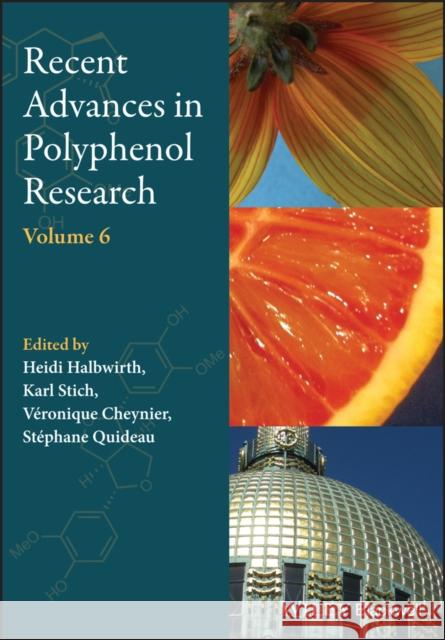
Recent Advances in Polyphenol Research, Volume 6
ISBN-13: 9781119427933 / Angielski / Twarda / 2019 / 432 str.
Recent Advances in Polyphenol Research, Volume 6
ISBN-13: 9781119427933 / Angielski / Twarda / 2019 / 432 str.
(netto: 858,03 VAT: 5%)
Najniższa cena z 30 dni: 889,93
ok. 22 dni roboczych.
Darmowa dostawa!
Contributors xiiiPreface xviiAcknowledgements xxi1 The Lignans: A Family of Biologically Active Polyphenolic Secondary Metabolites 1Anna K.F. Albertson and Jean-Philip Lumb1.1 Introduction 11.2 Biosynthesis of Lignans 31.3 Synthetic Approaches to Lignans and Derivatives 71.4 Conclusion 60References 652 Anthocyanin Accumulation is Controlled by Layers of Repression 71Andrew C. Allan, Kathy E. Schwinn, and Richard V. Espley2.1 Introduction 712.2 MYBs and bHLHs Directly Activate Anthocyanin Production 722.3 Exciting Phenotypes in Horticulture are often caused by Variations in the Expression of Key MYBs 732.4 Is There a Cost to the Plant of over accumulation of Anthocyanins? 742.5 Controlling Anthocyanin Levels 752.6 The MYB Activator is Degraded at Night 762.7 MYB Activator Competes with MYB Repressors 772.8 miRNA- Targeted Degradation of MYB Transcript 782.9 Turnover of Anthocyanin Vacuolar Content by Peroxidases 782.10 Summary 79References 793 The Subtleties of Subcellular Distribution: Pointing the Way to Underexplored Functions for Flavonoid Enzymes and End Products 89Brenda S.J. Winkel3.1 Multienzyme Complexes and Metabolic Networks 893.2 New Insights from Global Surveys of Protein Interactions 903.3 The Flavonoid Metabolon 913.4 Subcellular Distribution of Flavonoid Enzymes and Evidence for Alternative Metabolons 943.5 Posttranslational Modifications - An Underexplored Area of Flavonoid Metabolism 983.6 Why Do We Need to Know? 993.7 Future Prospects 99References 1004 Transcriptional and Metabolite Profiling Analyses Uncover Novel Genes Essential for Polyphenol Accumulation 109Wilfried Schwab, Ludwig Ring, and Chuankui Song4.1 Introduction 1094.2 Transcriptional and Metabolite Profiling Analyses in Strawberry Fruit 1104.3 Characterization of Peroxidase 27 1134.4 Competition of the Lignin and Flavonoid/Anthocyanin Pathways as Demonstrated by the Activity of Peroxidase 27 1154.5 Candidate Genes Putatively Correlated with Phenolics Accumulation in Strawberry Fruit 1154.6 Acylphloroglucinol Biosynthesis in Strawberry Fruit 1184.7 Glucosylation of Acylphloroglucinols 1204.8 ConclusionReferences 1245 Dietary (Poly)Phenols and Vascular Health 127Christine Morand, Nicolas Barber-Chamoux, Laurent-Emmanuel Monfoulet, and Dragan Milenkovic5.1 Introduction 1275.2 Vascular Health: A Prerequisite to Prevent Cardiometabolic Diseases and Cognitive Decline 1285.3 Diet and Vascular Health 1305.4 (Poly)Phenols: A Major Family of Dietary Plant Bioactive Compounds 1315.5 Fate of (Poly)Phenols in the Body and Biological Activities 1335.6 Nutritional Effects of Flavonoids in Protecting Cardiovascular Health 1355.7 Limitation of Knowledge and Strategy for Research 1385.8 Findings from Translational Research on Citrus Flavanones and Vascular Health 1395.9 Conclusion 142References 1426 Cellular-Specific Detection of Polyphenolic Compounds by NMR-and MS-Based Techniques: Application to the Representative Polycyclic Aromatics of Members of the Hypericaceae, the Musaceae and the Haemodoraceae 149Dirk Hölscher,6.1 Introduction 1496.2 The Plant Genus Hypericum 1506.3 Phenylphenalenones: Plant Secondary Metabolites of the Haemodoraceae 1516.4 Phenalenone- Type Phytoalexins 1576.5 Laser Microdissection and Cryogenic NMR as a Combined Tool for Cell Type-Specific Metabolite Profiling 1606.6 Matrix- free UV Laser Desorption/Ionization (LDI) at the Single-Cell Level: Distribution of Secondary Metabolites of Hypericum Species 1636.7 LDI- MSI-Based Detection of Phenalenone-Type Phytoalexins in a Banana- Nematode Interaction 1666.8 LDI- FT-ICR-MSI Reveals the Occurrence of Phenylphenalenones in Red Paracytic Stomata 1696.9 Conclusion 1716.10 Acknowledgements 171References 1717 Metabolomics Strategies for the De replication of Polyphenols and Other Metabolites in Complex Natural Extracts 183Jean-Luc Wolfender, Pierre-Marie Allard, Miwa Kubo, and Emerson Ferreira Queiroz7.1 Introduction 1837.2 Metabolite Profiling and Metabolomics 1847.3 Metabolite Annotation and Dereplication 1887.4 Targeted Isolation of Original Polyphenols 1987.5 Conclusion 201References 2018 Polyphenols from Plant Roots: An Expanding Biological Frontier 207Ryosuke Munakata, Romain Larbat, Léonor Duriot, Alexandre Olry, Carole Gavira, Benoit Mignard, Alain Hehn, and Frédéric Bourgaud8.1 Introduction 2078.2 Polyphenols in Roots versus Shoots: Not More, Not Less, But Often Different 2078.3 Allelochemical Functions of Root Polyphenols 2138.4 Physiological Functions of Root Polyphenols in Plants 2178.5 Biotechnologies to Produce Root Polyphenols 2208.6 Conclusion 227References 2279 Biosynthesis of Polyphenols in Recombinant Micro-organisms: A Path to Sustainability 237Kanika Sharma, Jian Zha, Sonam Chouhan, Sanjay Guleria, and Mattheos A.G. Koffas9.1 Introduction 2379.2 Flavonoids 2399.3 Stilbenes 2479.4 Coumarins 2519.5 Conclusion 253References 25410 Revisiting Wine Polyphenols Chemistry in Relation to Their Sensory Characteristics 263Victor de Freitas10.1 Introduction 26310.2 Astringency of Polyphenols 26510.3 Bitter Taste of Polyphenols 26910.4 Red Wine Colour 27110.5 Conclusion 276References 27811 Advances in Bio-based Thermosetting Polymers 285Hélène Fulcrand, Laurent Rouméas, Guillaume Billerach, Chahinez Aouf, and Eric Dubreucq11.1 Introduction 28511.2 Industrial Sources of Polyphenols 28911.3 Principles of Thermoset Production 29011.4 Relationships between Structure and Reactivity of Polyphenols 29211.5 Thermosets from Industrial Lignins and Tannins 29511.6 Depolymerization of Lignins and Tannins to Produce Phenolic Building Blocks and their Glycidylether Derivatives 30611.7 Development of Dimethyloxirane Monophenols and Bisphenols as Thermosetting Building Blocks 31011.8 Conclusion 322References 32312 Understanding the Misunderstood: Products and Mechanisms of the Degradation of Curcumin 335Claus Schneider12.1 Introduction 33512.2 Degradation of Curcumin - A Historical and Personal Perspective 33612.3 The Degradation is an Autoxidation 34112.4 Novel Products of the Degradation/Autoxidation of Curcumin 34412.5 Transformation of Curcumin to Bicyclopentadione 34812.6 A Proposed Mechanism for the Autoxidation of Curcumin 35012.7 Microbial Degradation of Curcumin 35412.8 Conclusion 357References 35713 How to Model a Metabolon: Theoretical Strategies 363Julien Diharce and Serge Antonczak13.1 Introduction 36313.2 Localization 36413.3 Existing Structures 36513.4 Three- Dimensional Structures of Enzymes: Homology Modelling 36713.5 Modes of Access to Active Sites: Randomly Accelerated Molecular Dynamics 37013.6 Protein- Protein Association: Protein-Protein Docking 37213.7 Substrate Channelling and Molecular Dynamics 37413.8 Metabolon 37813.9 Conclusion 379References 381Index 387
About the EditorsHeidi Halbwirth is Associate Professor at Technische Universität Wien in Vienna, Austria. Her research activities have concentrated on plant secondary metabolism in horticulturally relevant plants with a strong focus on the enzymes involved and their structure-function relationships. Her particular research passion is flower colour, which allows the study of fundamental aspects of plant biochemistry and physiology.Karl Stich is Professor at Technische Universität Wien in Vienna, Austria. His field of expertise is the biochemistry of plants, and applied biochemistry in the field of plant protection with a strong focus on the secondary metabolism of plants. He is a longstanding member of Groupe Polyphenols and was awarded the 11th GP Medal for his scientific contributions to the elucidation of the flavonoid pathway.Véronique Cheynier, former president of the " Groupe Polyphénols " (2012-2016), is research director at the French National Institute for Agricultural Research (INRA) in Montpellier, France. Her research interests concern the study of the structure of polyphenolic compounds, notably vegetable tannins and anthocyanin pigments, their reactions during plant transformation processes, and their influence on the quality of foods and beverages, especially wine.Stéphane Quideau, former president of the " Groupe Polyphénols " (2008-2012), is full professor of Organic and Bioorganic Chemistry at the University of Bordeaux, France. His research laboratory is specialized in plant polyphenol chemistry and chemical biology, with a focus on the studies of ellagitannin chemical reactivity and synthesis, and interactions of bioactive polyphenols with their protein targets.




Czytaj nas na:
1997-2026 DolnySlask.com Agencja Internetowa
KrainaKsiazek.PL - Księgarnia Internetowa


