• Wyszukiwanie zaawansowane
  • Kategorie
  • Kategorie BISAC
  • Książki na zamówienie
  • Promocje
  • Granty
  • Książka na prezent
  • Opinie
  • Pomoc
  • Załóż konto
  • Zaloguj się

Real-Time Object Uniform Design Methodology with UML » książka


zaloguj się | załóż konto
Logo Krainaksiazek.pl

koszyk

konto

szukaj
topmenu
Księgarnia internetowa
Szukaj
Książki na zamówienie
Promocje
Granty
Książka na prezent
Moje konto
Pomoc
 
 
Wyszukiwanie zaawansowane
Pusty koszyk
Bezpłatna dostawa dla zamówień powyżej 20 złBezpłatna dostawa dla zamówień powyżej 20 zł

Kategorie główne

• Nauka
 [2946600]
• Literatura piękna
 [1856966]

  więcej...
• Turystyka
 [72221]
• Informatyka
 [151456]
• Komiksy
 [35826]
• Encyklopedie
 [23190]
• Dziecięca
 [619653]
• Hobby
 [140543]
• AudioBooki
 [1577]
• Literatura faktu
 [228355]
• Muzyka CD
 [410]
• Słowniki
 [2874]
• Inne
 [445822]
• Kalendarze
 [1744]
• Podręczniki
 [167141]
• Poradniki
 [482898]
• Religia
 [510455]
• Czasopisma
 [526]
• Sport
 [61590]
• Sztuka
 [243598]
• CD, DVD, Video
 [3423]
• Technologie
 [219201]
• Zdrowie
 [101638]
• Książkowe Klimaty
 [124]
• Zabawki
 [2473]
• Puzzle, gry
 [3898]
• Literatura w języku ukraińskim
 [254]
• Art. papiernicze i szkolne
 [8170]
Kategorie szczegółowe BISAC

Real-Time Object Uniform Design Methodology with UML

ISBN-13: 9781402059766 / Angielski / Twarda / 2007 / 480 str.
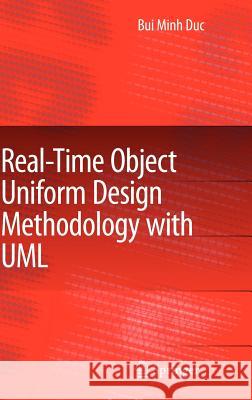
Duc Minh Bui;Bui Minh Duc
Real-Time Object Uniform Design Methodology with UML Duc Minh Bui Bui Minh Duc 9781402059766 Springer - książkaWidoczna okładka, to zdjęcie poglądowe, a rzeczywista szata graficzna może różnić się od prezentowanej.

Real-Time Object Uniform Design Methodology with UML

ISBN-13: 9781402059766 / Angielski / Twarda / 2007 / 480 str.

Duc Minh Bui;Bui Minh Duc
cena 605,23 zł
(netto: 576,41 VAT:  5%)

Najniższa cena z 30 dni: 578,30 zł
Termin realizacji zamówienia:
ok. 22 dni roboczych
Bez gwarancji dostawy przed świętami

Darmowa dostawa!

Book Description Real-Time Object Uniform Design Methodology with UML is a theoretical and practicalbookwrittenforbusy people who want to untanglethe complex world of system development, nd essential materials without digging in UML st- dard documentation, grasp subtle concepts of object orientation, practice the new Model Driven Architecture (MDA), experience the reuse mechanism, and transform the bare metal programming of real-time and embedded products into more handsome platform-independent and platform-speci c components. With this rapid methodology of development, practitioners can spare time, avoid tons of written documentation by relieving this tedious task to smart CASE (computer-aided software engineering) tools, and have a quick and s- thetic view of any system through a well-built set of pictures and blueprints. The methodology presented in this book is a neutral methodology based on a thorough study of fundamental modeling concepts and then a temporary mapping of these concepts on current available standards and tools. We say temporary because research is in fact a never-ending activity. Good st- dards are evolving standards and the truth is always questionable. We are not pretending to add a new methodology to the numerous existent or in-house methodologies. We hope that the reader is able to catch the thoughts presented in this book to have a more critical view on any future methodology (a kind of meta methodology ). So, feel free to prune o? parts that you do not feel comfortable with."


Kategorie:
Technologie
Kategorie BISAC:
Computers > Software Development & Engineering - General
Computers > Languages - General
Technology & Engineering > Electronics - Microelectronics
Wydawca:
Springer
Język:
Angielski
ISBN-13:
9781402059766
Rok wydania:
2007
Wydanie:
2007
Ilość stron:
480
Waga:
0.89 kg
Wymiary:
23.39 x 15.6 x 2.87
Oprawa:
Twarda
Wolumenów:
01
Dodatkowe informacje:
Wydanie ilustrowane

List of Figures. List of Tables. Preface. 1. Introduction to the world of systems, problems and solutions. 1.1. The world of systems, problems and solutions. 1.2. Real time and embedded systems: Disaster control and Quality of Service. 1.3. Human organizations and structures: How software can simulate and study them. 1.4. This book is also a system. 2. Coping with complexity. 2.1. Visual formulisms for handling complexity. 2.2. Object/function decompoision. 2.3. Functional decomposition to handle complexity. 2.4. How object technology handles complexity. 2.5. Object paradigm applied to control applications. 2.6. Object paradigm applied to database applications. 2.7. Objects and databases. 2.8. Object paradigm and Component reuse. 2.9. Mastering development complexity. 3. UML Infrastructure: Core concepts. 3.1. Core concepts compliant to MOF. 3.2. Infrastructure. 4. UML Superstrucutre: Language definition and diagrams. 4.1. Making our own development methodology with UML. 4.2. Structure and behavior. 4.3. Hierarchy of UML metaclasses. 4.4. Superstructure and compliance levels. 4.5. Reuse of the Infrastructure. 4.6. Structure: class diagram. 4.7. Structure: Object diagram. 4.8. Structure: Package diagram. 4.9. Structure: Composite Structure diagram. 4.10. Structure: Component diagram. 4.11. Structure: Deployment diagram. 4.12. Hierarchy of metaclasses defined in the Behavior part. 4.13. Behavior: State Machine diagram. 4.14. Behavior: Activity diagram. 4.15. Behavior: Interaction Suite. 4.16. Behavior: Use case diagram. 4.17. Auxiliary constructs: Profiles. 5. Fundamental concepts of the real world and their mapping into UML. 5.1. Abstraction, concept, domain, ontology, model. 5.2. Structural, functional and dynamic views of systems. 5.3. Concepts of the functional view. 5.4. Fundamental concepts of the dynamic view. 5.5. Fundamental concepts of the structural view. 6. The Uniform concept. 6.1. Elements of the uniform concept. 6.2. Requirement analysis model. 6.3. Requirements analysis with technical diagrams. 6.4. System Requirements Specifications. 6.5. Designing real time Applications with MDA. 6.6. Designing reusable database models. 6.7. Unifying real time and database applications. 7. Real time behavioral study beyond UML. 7.1. SEN or State-Event Net diagram. 7.2. UML diagrams mapped into SEN. 7.3. Timing constraints with SEN. 7.4. Case study with SEN. 7.5. Safety-critical systems. 8. Real time case study. 8.1. Design of an inclined elevator or track lift tram. 8.2. Emergency service in a hospital & Design of a database coupled with a real time system. References. Index.

The competitiveness of organizations facing globalization, information and communication technologies relies on strategic issues such as reuse of knowledge from past experiences to make higher quality decisions, deployment of innovative, fast methodological approaches for solving problems and building systems. Real-life systems are often multidisciplinary; their development commands a uniform way of object modeling in order to close the loop of various interactions crossing multiple domains.

An innovative methodology, built on UML version 2 and MDA (Model Driven Architecture), is proposed to explain how to design large-scale systems and make software reuse a reality, how logical models can be built progressively and transformed into business assets, how real time and database systems can be integrated smoothly along a single development stream. First, the metalanguage of UML is introduced as a lesson of rigorous and meta system development. That helps developers to acquire a deep understanding of meta elements of UML, rules that govern connections. Second, thirteen UML diagrams are studied in details with short examples. Third, fundamental modeling concepts are mapped into UML objects and represented with diagrams that are the visual parts of any CASE tool.

Two advanced research topics beyond UML are exposed to complement the arsenal of development tools. A state-event network (SEN), a new diagram based on Petri net, supports dynamical studies and refines UML behavioral diagrams before implementation. The "image attribute method" is a combinatorial technique deployed to study dynamic behavior of safety-critical systems; it takes internal state variables of an object, makes images of surrounding objects interacting with this central object to explain its complex behavior and thus, automate the design of algorithms.

One part of Real-Time Object Uniform Design Methodology with UML is targeted to be used as a basic textbook in Computer Science for teaching object modeling, fundamental concepts learning and system designing with thirteen UML diagrams. Another part is devoted to advanced research topics, samples and case studies. They are must readings for any system developer or any graduate student in any discipline that needs materials and thoughts for future developments, the power of object modeling packed along a serious development methodology.


Udostępnij

Facebook - konto krainaksiazek.pl


Opinie o Krainaksiazek.pl na Opineo.pl

Partner Mybenefit

Krainaksiazek.pl w programie rzetelna firma Krainaksiaze.pl - płatności przez paypal

Czytaj nas na:

Facebook - krainaksiazek.pl
  • książki na zamówienie
  • granty
  • książka na prezent
  • kontakt
  • pomoc
  • opinie
  • regulamin
  • polityka prywatności

Zobacz:

  • Księgarnia czeska

  • Wydawnictwo Książkowe Klimaty

1997-2025 DolnySlask.com Agencja Internetowa

© 1997-2022 krainaksiazek.pl
     
KONTAKT | REGULAMIN | POLITYKA PRYWATNOŚCI | USTAWIENIA PRYWATNOŚCI
Zobacz: Księgarnia Czeska | Wydawnictwo Książkowe Klimaty | Mapa strony | Lista autorów
KrainaKsiazek.PL - Księgarnia Internetowa

Polityka prywatnosci - link
Krainaksiazek.pl - płatnośc Przelewy24
Przechowalnia Przechowalnia





