• Wyszukiwanie zaawansowane
  • Kategorie
  • Kategorie BISAC
  • Książki na zamówienie
  • Promocje
  • Granty
  • Książka na prezent
  • Opinie
  • Pomoc
  • Załóż konto
  • Zaloguj się

Rapid Chemical and Biological Techniques for Water Monitoring » książka

zaloguj się | załóż konto
Logo Krainaksiazek.pl

koszyk

konto

szukaj
topmenu
Księgarnia internetowa
Szukaj
Książki na zamówienie
Promocje
Granty
Książka na prezent
Moje konto
Pomoc
 
 
Wyszukiwanie zaawansowane
Pusty koszyk
Bezpłatna dostawa dla zamówień powyżej 20 złBezpłatna dostawa dla zamówień powyżej 20 zł

Kategorie główne

• Nauka
 [2946350]
• Literatura piękna
 [1816154]

  więcej...
• Turystyka
 [70666]
• Informatyka
 [151172]
• Komiksy
 [35576]
• Encyklopedie
 [23172]
• Dziecięca
 [611458]
• Hobby
 [135995]
• AudioBooki
 [1726]
• Literatura faktu
 [225763]
• Muzyka CD
 [378]
• Słowniki
 [2917]
• Inne
 [444280]
• Kalendarze
 [1179]
• Podręczniki
 [166508]
• Poradniki
 [469467]
• Religia
 [507199]
• Czasopisma
 [496]
• Sport
 [61352]
• Sztuka
 [242330]
• CD, DVD, Video
 [3348]
• Technologie
 [219391]
• Zdrowie
 [98638]
• Książkowe Klimaty
 [124]
• Zabawki
 [2382]
• Puzzle, gry
 [3525]
• Literatura w języku ukraińskim
 [259]
• Art. papiernicze i szkolne
 [7107]
Kategorie szczegółowe BISAC

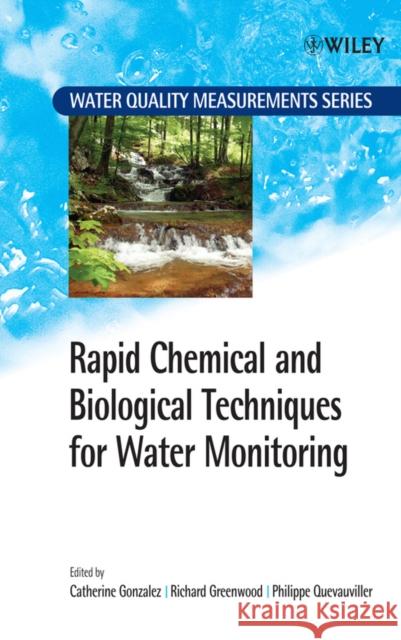
Rapid Chemical and Biological Techniques for Water Monitoring

ISBN-13: 9780470058114 / Angielski / Twarda / 2009 / 440 str.
Catherine Gonzalez
Rapid Chemical and Biological Techniques for Water Monitoring Catherine Gonzalez 9780470058114  - książkaWidoczna okładka, to zdjęcie poglądowe, a rzeczywista szata graficzna może różnić się od prezentowanej.

Rapid Chemical and Biological Techniques for Water Monitoring

ISBN-13: 9780470058114 / Angielski / Twarda / 2009 / 440 str.

Catherine Gonzalez
cena 793,68
(netto: 755,89 VAT:  5%)

Najniższa cena z 30 dni: 783,99
Termin realizacji zamówienia:
ok. 30 dni roboczych.

Darmowa dostawa!

Rapid Chemical and Biological Techniques for Water Monitoring presents in one volume the broad spectrum of monitoring tools, both available and under development, and provides an assessment of their potential for underpinning environmental management and legislation. The book explores screening methods in the context of water policies; chemical methods; biological methods; potential use of screening methods; quality assurance and validation methods; integration of screening methods in water monitoring strategies. The text provides a timely source of information for post-graduates, researchers, and professionals involved in water management at all levels.


Kategorie:
Technologie
Kategorie BISAC:
Science > Chemia - Organiczna
Technology & Engineering > Environmental - General
Język:
Angielski
ISBN-13:
9780470058114
Rok wydania:
2009
Numer serii:
000314803
Ilość stron:
440
Waga:
0.79 kg
Wymiary:
23.11 x 16.0 x 2.79
Oprawa:
Twarda
Wolumenów:
01
Dodatkowe informacje:
Bibliografia
Wydanie ilustrowane

"Scientists, analysts and policy developers will find the book attractive for their specific needs." (Chemistry Journals, 11 April 2011)


Series Preface.

Preface.

The Series Editor Philippe Quevauviller.

List of Contributors.

Section 1: Screening Methods in the Context of Water Policies.

1.1 WFD Monitoring and Metrological Implications (Philippe Quevauviller).

1.2 Use of Screening Methods in US Water Regulation (Guillaume Junqua, Estelle Baurès, Emmanuelle Hélias and Olivier Thomas).

1.3 Existing and New Methods for Chemical and Ecological Status Monitoring under the WFD (Benoit Roig, Ian Allan, Graham A. Mills, Nathalie Guigues, Richard Greenwood and Catherine Gonzalez).

Section 2: Chemical Methods.

2.1 The Potential of Passive Sampling to Support Regulatory Monitoring of the Chemical Quality of Environmental Waters (Graham A. Mills, Branislav Vrana and Richard Greenwood).

2.2 Polar Organic Chemical Integrative Sampler and Semi–permeable Membrane Devices (David Alvarez and Audrone Simule).

2.3 Main Existing Methods for Chemical Monitoring (Guillaume Junqua, Catherine Gonzalez and Evelyne Touraud).

2.4 UV Spectrophotometry: Environmental Monitoring Solutions (Daniel Constant, Catherine Gonzalez, Evelyne Touraud, Nathalie Guigues and Olivier Thomas).

Section 3: Biological Methods.

3.1 Application of Microbial Assay for Risk Assessment (MARA) to Evaluate Toxicity of Chemicals and Environmental Samples (Kirit Wadhia and K. Clive Thompson).

3.2 Bioassays and Biosensors (Marinella Farré and Damia Barcelò).

3.3 Immunochemical Methods (Petra M. Krämer).

3.4 Biomolecular Recognition Systems for Water Monitoring Benoit Roig, Ingrid Bazin, Sandrine Bayle, Denis Habauzit and Joel Chopineau).

3.5 Continuous Monitoring of Waters by Biological Early Warning Systems (Kees J.M. Kramer).

3.6 Biological Markers of Exposure and Effect for Water Pollution Monitoring (Josephine A. Hagger and Tamara S. Galloway).

Section 4: Potential Use of Screening Methods and Performance Evaluation.

4.1 Monitoring Heavy Metals Using Passive Sampling Devices (Graham A. Mills, Ian J. Allan, Nathalie Guigues, Jesper Knutsson A. Holmberg and Richard Greenwood).

4.2 On–site Heavy Metal Monitoring Using a Portable Screen–printed Electrode Sensor (Catherine Berho, Nathalie Guigues, Jean–Philippe Ghestem, Catherine Crouzet, Anne Strugeon, Stéphane Roy and Anne–Marie Fouillac).

4.3 Field Monitoring of PAHs in River Water by Direct Fluorimetry on C18 Solid Sorbent (Guillaume Bernier and Michel Lamotte).

4.4 Evaluation of the Field Performance of Emerging Water Quality Monitoring Tools (Catherine Berho, Nathalie Guigues, Anne Togola, Stéphane Roy, Anne–Marie Fouillac, Ian Allan, Graham A. Mills, Richard Greenwood, Benoît Roig, Charlotte Valat and Nirit Ulitzur).

4.5 Sampling Uncertainty and Environmental Variability for Trace Elements on the Meuse River, France (Anne Strugeon–Dercourt).

Section 5: Quality Assurance and Validation Method.

5.1 Preparation of Reference Materials for Proficiency Testing Schemes (Angels Sahuquillo, Marina Ricci, Ofelia Bercaru, Hakan Emteborg, Franz Ulberth, Roberto Morabito, Claudia Brunori, Yolanda Madrid, Erwin Rosenberg, Klara Polyak and Herbert Muntau).

5.2 Participation of Screening Methods and Emerging Tools (SMETs) to Proficiency Testing Schemes on the Determination of Priority Substances in Real Water Matrices Organized in Support of the Water Framework Directive Implementation (Claudia Brunori, Ildi Ipolyi and Roberto Morabito).

5.3 Traceability and Interlaboratory Studies on Yeast–based Assays for the Determination of Estrogenicity (Rikke Brix and Damià Barcelò).

Section 6: Integration of Screening Methods in Water Monitoring Strategies.

6.1 Assessing the Impacts of Alternative Monitoring Methods and Tools on Costs and Decision Making: Methodology and Experience from Case Studies (Helen Lückge, Pierre Strosser, Nina Graveline, Thomas Dworak and Jean–Daniel Rinaudo).

6.2 Acceptance of Screening Methods by Actors Involved in Water Monitoring (Didier Taverne).

Index.

Developments in legislation to protect the aquatic environment, including surface waters, ground water, the coastal zone, and wetlands, make effective monitoring of water quality essential. Thus the development and validation of cost–effective technologies and methodologies that can be adopted widely for routine monitoring are needed. As well as the current methods used, the range of promising tools under development have the potential to be included in the toolboxes of those charged with managing water quality.

This volume sets out to

  • examine the range of technologies and methodologies, their properties and their applicability and potential contribution in monitoring programmes. 
  • illustrate by example, the utility of the monitoring tools for laboratory and field applications.
  • bring together a wide range of monitoring tools both those available, and some under development
  • provide an assessment of the potential for underpinning environmental management and legislation.

Water Quality Measurements Series

This series provides comprehensive coverage of the analytical techniques used for the measurement of substances in water, from sampling through to laboratory analysis. The scope of the series encompasses topic issues including quality assurance, standard procedures, and the best practices in measuring water quality, from surface and drinking water to marine and wastewater. The techniques are discussed in relation to current legislation and guidelines.

The series aims to offer workable answers to specific issues related to measurements of the water cycle quality using a comprehensive and scientifically sound approach.


Udostępnij

Facebook - konto krainaksiazek.pl


Opinie o Krainaksiazek.pl na Opineo.pl

Partner Mybenefit

Krainaksiazek.pl w programie rzetelna firma Krainaksiaze.pl - płatności przez paypal

Czytaj nas na:

Facebook - krainaksiazek.pl
  • książki na zamówienie
  • granty
  • książka na prezent
  • kontakt
  • pomoc
  • opinie
  • regulamin
  • polityka prywatności

Zobacz:

  • Księgarnia czeska

  • Wydawnictwo Książkowe Klimaty

1997-2026 DolnySlask.com Agencja Internetowa

© 1997-2022 krainaksiazek.pl
     
KONTAKT | REGULAMIN | POLITYKA PRYWATNOŚCI | USTAWIENIA PRYWATNOŚCI
Zobacz: Księgarnia Czeska | Wydawnictwo Książkowe Klimaty | Mapa strony | Lista autorów
KrainaKsiazek.PL - Księgarnia Internetowa

Polityka prywatnosci - link
Krainaksiazek.pl - płatnośc Przelewy24
Przechowalnia Przechowalnia







