• Wyszukiwanie zaawansowane
  • Kategorie
  • Kategorie BISAC
  • Książki na zamówienie
  • Promocje
  • Granty
  • Książka na prezent
  • Opinie
  • Pomoc
  • Załóż konto
  • Zaloguj się

Radiationless Transitions in Polyatomic Molecules » książka


zaloguj się | załóż konto
Logo Krainaksiazek.pl

koszyk

konto

szukaj
topmenu
Księgarnia internetowa
Szukaj
Książki na zamówienie
Promocje
Granty
Książka na prezent
Moje konto
Pomoc
 
 
Wyszukiwanie zaawansowane
Pusty koszyk
Bezpłatna dostawa dla zamówień powyżej 20 złBezpłatna dostawa dla zamówień powyżej 20 zł

Kategorie główne

• Nauka
 [2946912]
• Literatura piękna
 [1852311]

  więcej...
• Turystyka
 [71421]
• Informatyka
 [150889]
• Komiksy
 [35717]
• Encyklopedie
 [23177]
• Dziecięca
 [617324]
• Hobby
 [138808]
• AudioBooki
 [1671]
• Literatura faktu
 [228371]
• Muzyka CD
 [400]
• Słowniki
 [2841]
• Inne
 [445428]
• Kalendarze
 [1545]
• Podręczniki
 [166819]
• Poradniki
 [480180]
• Religia
 [510412]
• Czasopisma
 [525]
• Sport
 [61271]
• Sztuka
 [242929]
• CD, DVD, Video
 [3371]
• Technologie
 [219258]
• Zdrowie
 [100961]
• Książkowe Klimaty
 [124]
• Zabawki
 [2341]
• Puzzle, gry
 [3766]
• Literatura w języku ukraińskim
 [255]
• Art. papiernicze i szkolne
 [7810]
Kategorie szczegółowe BISAC

Radiationless Transitions in Polyatomic Molecules

ISBN-13: 9783642851117 / Angielski / Miękka / 2012 / 374 str.
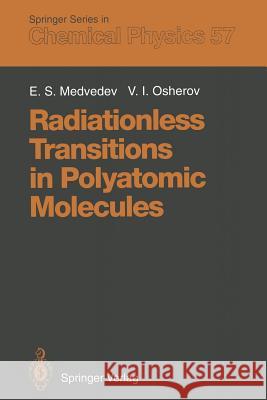
Emile S. Medvedev; Vladimir I. Osherov
Radiationless Transitions in Polyatomic Molecules Emile S. Medvedev Vladimir I. Osherov 9783642851117 Springer - książkaWidoczna okładka, to zdjęcie poglądowe, a rzeczywista szata graficzna może różnić się od prezentowanej.

Radiationless Transitions in Polyatomic Molecules

ISBN-13: 9783642851117 / Angielski / Miękka / 2012 / 374 str.

Emile S. Medvedev; Vladimir I. Osherov
cena 402,53
(netto: 383,36 VAT:  5%)

Najniższa cena z 30 dni: 385,52
Termin realizacji zamówienia:
ok. 22 dni roboczych
Bez gwarancji dostawy przed świętami

Darmowa dostawa!

Radiationless transitions comprise an important class of physical phenomena occurring in the excited states of molecules. They affect the lifetimes of the ex- cited states and govern primary photochemical and photophysical processes. Much effort has been devoted to the understanding of radiationless transi- tions. Still, owing to recent advances, the field continues to attract attention. The demand for a book on the theory of these processes naturally arises in at- tempting to comprehend a large body of literature, as the famous review article by K. F. Freed and the book by R. Englman do not encompass some issues of current interest. Our intent is to highlight the underlying physical principles and methods in such a way that the book both in its content and its presentation is instruc- tive for a wide audience. The basic ideas are treated in simple mathematical terms intelligible to ex- perimentalists and to readers unfamiliar with the field. Complicated theoret- ical methods are always expounded from first principles, so that a knowledge of quantum mechanics and mathematics at the graduate-student level will enable the reader to easily follow the derivations. Experts will find efficient methods of calculating the transition rates, as well as new applications of quasiclassical methods and fresh treatments of standard problems. Details of measurements are not discussed, and experimental data are only invoked to illustrate the theory.


Kategorie:
Nauka, Fizyka
Kategorie BISAC:
Technology & Engineering > Optics
Science > Chemia - Nieorganiczna
Science > Chemia - Fizyczna
Wydawca:
Springer
Seria wydawnicza:
Springer Series in Chemical Physics
Język:
Angielski
ISBN-13:
9783642851117
Rok wydania:
2012
Wydanie:
Softcover Repri
Numer serii:
000120746
Ilość stron:
374
Waga:
0.59 kg
Wymiary:
23.5 x 15.5
Oprawa:
Miękka
Wolumenów:
01

1. Introduction.- 2. Qualitative Theory of Radiationless Transitions.- 2.1 Balance Equation.- 2.2 Experimental Observations and Empirical Rules.- 2.3 Molecular Energy Level Model.- 2.4 Physical Nature of Radiationless Transitions.- 2.4.1 The Nature of the Initial State.- 2.4.2 Freed-Jortner Irreversibility Criterion.- 2.5 General Description of Luminescence Kinetics: Intermediate Case and Statistical Limit.- 2.5.1 Strong Coupling.- 2.5.2 Experimental Criterion for the Statistical Limit.- 2.5.3 Upper Limit for Radiationless Transition Rates.- 2.5.4 Weak Coupling.- 2.6 Strong-Coupling Limit.- 2.6.1 The Bixon-Jortner Model.- 2.6.2 Inclusion of Level Broadening.- 2.6.3 Mono- and Biexponential Decays.- 2.7 Weak-Coupling Limit.- 2.7.1 The Role of Vibrational Relaxation in the Final Electronic State.- 2.7.2 The Robinson-Frosch Theory.- 2.7.3 The Trifonov-Shekhtman Model.- 2.7.4 Periodic Quantum Beats and Biexponential Decay.- 2.8 Time-Dependent Perturbation Theory.- 2.9 Comparison of Various Expressions for the Transition Rate.- 2.10 Characterization of the Final States of an Isolated Molecule.- 2.11 Small, Large and Intermediate Molecules.- 3. Luminescence Intensity as a Function of Time and the Radiationless Transition Rate.- 3.1 Formulation of the Problem.- 3.2 Laplace Transformation, Green’s Functions and Resonant States.- 3.3 Computation of the Green’s Functions.- 3.4 Evolution of the Initial State and the Luminescence Intensity.- 3.5 Resonant States.- 3.5.1 Small Molecules.- 3.5.2 Intermediate Case.- 3.5.3 Statistical Limit.- 3.6 Method of Projection Operators.- 4. Matrix Elements of Intramolecular Interactions.- 4.1 Adiabatic Approximation.- 4.2 Accuracy of the Adiabatic Approximation.- 4.3 Crude Adiabatic Approximation.- 4.4 Coupling Operators.- 4.4.1 Nonadiabatic Coupling.- 4.4.2 Spin-Orbit Coupling.- 4.4.3 Rotational Matrix Elements.- 4.4.4 Coriolis Coupling.- 4.5 Condon Approximation.- 4.6 Model of Noninteracting Oscillators.- 4.7 Mechanisms and Selection Rules for Radiationless Transitions.- 4.8 Overlap Integrals for Harmonic and Morse Oscillators.- 5. Quasiclassical Methods.- 5.1 Introductory Remarks.- 5.2 Overlap Integral for a Harmonic Oscillator.- 5.2.1 Basic Derivation.- 5.2.2 Conditions for Applicability of the Quasiclassical Approximation.- 5.2.3 Comparison of Frequency and Displacement Effects.- 5.3 Overlap Integral for an Anharmonic Oscillator.- 5.3.1 Morse Oscillator with ??=0.- 5.3.2 Morse Oscillator with ???0 and Arbitrary Potentials.- 5.3.3 Selection Rule for the Morse Oscillator.- 5.4 Franck-Condon Principle for Radiationless Transitions.- 5.4.1 General Formulation.- 5.4.2 Real and Complex Term Intersections.- 5.4.3 Classical Franck-Condon Factor.- 5.4.4 Franck-Condon Principle and the Selection Rules.- 5.5 Transitions Between Parallel Terms.- 5.5.1 Model of Parallel Terms.- 5.5.2 Tunneling Nonradiative and Radiative Transitions.- 5.6 Overtone Vibrational Transitions.- 5.6.1 Derivation of the Quasiclassical Formula.- 5.6.2 Comparison with Exact Calculations.- 5.6.3 Normal Intensity Distributions.- 5.6.4 Dynamical Tunneling Depth.- 5.6.5 Intensity Anomalies in Absorption Spectra.- 5.7 Collision Model.- 5.7.1 Transition Matrix in the Linear Model.- 5.7.2 Perturbation Theory for Nonadiabatic Transitions.- 5.7.3 Method of the Classical ?-Matrix.- 5.8 Two-State Vibronic Levels.- 6. The Statistical Limit.- 6.1 Accepting Modes, Effective States and the Transition Rate.- 6.2 Generating-Function Method.- 6.3 Saddle-Point Method.- 6.3.1 First Saddle-Point Approximation (FSPA).- 6.3.2 Validity Conditions for the FSPA.- 6.3.3 Saddle-Point Method Versus Effective-States Method.- 6.4 Single Vibronic Level (SVL) Transition-Rate Dependence upon Initial Vibrational Energy.- 6.5 Transition Rate from Statistically Equilibrated Initial States.- 6.6 Summation of the Franck-Condon Factors.- 6.7 Inductive-Resonant-Transfer Mechanism.- 7. The Intermediate Case.- 7.1 Physical Effects.- 7.1.1 Absorption Spectra and Luminescence Kinetics.- 7.1.2 Pressure Dependence of the Transition Rate.- 7.1.3 Energy-Gap Dependence.- 7.1.4 Vibrational and Rotational Energy Dependence.- 7.1.5 Deuteration Effect.- 7.1.6 Comparative Description of the Intermediate Case and the Statistical Limit.- 7.2 Correlation-Function Method.- 7.3 Kinetic Model.- 8. Conclusion.- Appendix. Commutation Rules for Angular Momentum in the Laboratory and Molecular Frame.- References.

The theory developed in this monograph as an introduction to the dynamics of electronically excited states and radiationless processes in polyatomic molecules for experimentalists, and theorists not intimately familiar with the field. For the expert it contains efficient methods to calculate transition probabilities, new applications of quasiclassical methods and fresh treatments of standard problems.


Udostępnij

Facebook - konto krainaksiazek.pl


Opinie o Krainaksiazek.pl na Opineo.pl

Partner Mybenefit

Krainaksiazek.pl w programie rzetelna firma Krainaksiaze.pl - płatności przez paypal

Czytaj nas na:

Facebook - krainaksiazek.pl
  • książki na zamówienie
  • granty
  • książka na prezent
  • kontakt
  • pomoc
  • opinie
  • regulamin
  • polityka prywatności

Zobacz:

  • Księgarnia czeska

  • Wydawnictwo Książkowe Klimaty

1997-2025 DolnySlask.com Agencja Internetowa

© 1997-2022 krainaksiazek.pl
     
KONTAKT | REGULAMIN | POLITYKA PRYWATNOŚCI | USTAWIENIA PRYWATNOŚCI
Zobacz: Księgarnia Czeska | Wydawnictwo Książkowe Klimaty | Mapa strony | Lista autorów
KrainaKsiazek.PL - Księgarnia Internetowa

Polityka prywatnosci - link
Krainaksiazek.pl - płatnośc Przelewy24
Przechowalnia Przechowalnia





