• Wyszukiwanie zaawansowane
  • Kategorie
  • Kategorie BISAC
  • Książki na zamówienie
  • Promocje
  • Granty
  • Książka na prezent
  • Opinie
  • Pomoc
  • Załóż konto
  • Zaloguj się

Radar Array Processing » książka


zaloguj się | załóż konto
Logo Krainaksiazek.pl

koszyk

konto

szukaj
topmenu
Księgarnia internetowa
Szukaj
Książki na zamówienie
Promocje
Granty
Książka na prezent
Moje konto
Pomoc
 
 
Wyszukiwanie zaawansowane
Pusty koszyk
Bezpłatna dostawa dla zamówień powyżej 20 złBezpłatna dostawa dla zamówień powyżej 20 zł

Kategorie główne

• Nauka
 [2949965]
• Literatura piękna
 [1857847]

  więcej...
• Turystyka
 [70818]
• Informatyka
 [151303]
• Komiksy
 [35733]
• Encyklopedie
 [23180]
• Dziecięca
 [617748]
• Hobby
 [139972]
• AudioBooki
 [1650]
• Literatura faktu
 [228361]
• Muzyka CD
 [398]
• Słowniki
 [2862]
• Inne
 [444732]
• Kalendarze
 [1620]
• Podręczniki
 [167233]
• Poradniki
 [482388]
• Religia
 [509867]
• Czasopisma
 [533]
• Sport
 [61361]
• Sztuka
 [243125]
• CD, DVD, Video
 [3451]
• Technologie
 [219309]
• Zdrowie
 [101347]
• Książkowe Klimaty
 [123]
• Zabawki
 [2362]
• Puzzle, gry
 [3791]
• Literatura w języku ukraińskim
 [253]
• Art. papiernicze i szkolne
 [7933]
Kategorie szczegółowe BISAC

Radar Array Processing

ISBN-13: 9783642773495 / Angielski / Miękka / 2011 / 317 str.
Simon Haykin; John Litva; Terence J. Shepherd
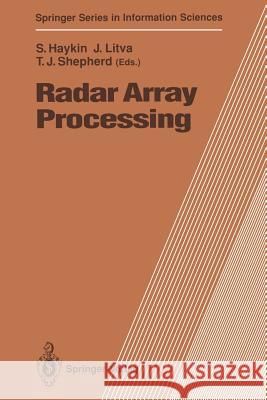
Radar Array Processing Simon Haykin John Litva Terence J. Shepherd 9783642773495 Springer - książkaWidoczna okładka, to zdjęcie poglądowe, a rzeczywista szata graficzna może różnić się od prezentowanej.

Radar Array Processing

ISBN-13: 9783642773495 / Angielski / Miękka / 2011 / 317 str.

Simon Haykin; John Litva; Terence J. Shepherd
cena 403,47 zł
(netto: 384,26 VAT:  5%)

Najniższa cena z 30 dni: 385,52 zł
Termin realizacji zamówienia:
ok. 22 dni roboczych
Bez gwarancji dostawy przed świętami

Darmowa dostawa!

Radar Array Processing presents modern techniques and methods for processingradar signals received by an array of antenna elements. With the recent rapid growth of the technology of hardware for digital signal processing, itis now possible to apply this to radar signals and thus to enlist the full power of sophisticated computational algorithms. Topics covered in detail here include: super-resolution methods of array signal processing as applied to radar, adaptive beam forming for radar, and radar imaging. This book will be of interest to researchers and studentsin the radar community and also in related fields such as sonar, seismology, acoustics and radio astronomy.


Kategorie:
Technologie
Kategorie BISAC:
Science > Acoustics & Sound
Science > Fizyka matematyczna
Technology & Engineering > Engineering (General)
Wydawca:
Springer
Seria wydawnicza:
Springer Series in Information Sciences
Język:
Angielski
ISBN-13:
9783642773495
Rok wydania:
2011
Wydanie:
Softcover Repri
Numer serii:
000022120
Ilość stron:
317
Waga:
0.46 kg
Wymiary:
23.39 x 15.6 x 1.75
Oprawa:
Miękka
Wolumenów:
01

1. Overview.- I Detection and Estimation.- 2. Radar Detection Using Array Processing.- 2.1 Observation Model.- 2.2 Coherent Radar Detection.- 2.2.1 Signal and Noise Model.- 2.2.2 Detection of Targets with Known Directions.- 2.2.3 Detection of Targets with Unknown Directions.- 2.3 Noncoherent Radar Detection.- 2.3.1 Signal and Noise Model.- 2.3.2 Detection of Targets with Known Directions.- 2.3.3 Detection of Targets with Unknown Directions: Deterministic Signal.- 2.3.4 Detection of Targets with Unknown Directions: Gaussian Signal.- 2.4 Passive Radar Detection.- 2.4.1 Signal and Noise Model.- 2.4.2 Detection of Emitters with Known Directions.- 2.4.3 Detection of Emitters with Unknown Directions: Deterministic Signal.- 2.4.4 Detection of Emitters with Unknown Directions: Gaussian Signal.- 2.5 Discussion.- References.- Additional References.- 3. Radar Target Parameter Estimation with Array Antennas.- 3.1 Radar Parameter Estimation Problem.- 3.1.1 Range and Angle Estimation.- 3.1.2 Frequency and Power Estimation.- 3.2 Angle Estimation.- 3.2.1 Monopulse Estimation (Single Target Estimation).- 3.2.2 Covariance Matrix Estimation.- 3.2.3 Linear Prediction Methods.- 3.2.4 Capon-Pisarenko-Type Methods.- 3.2.5 Signal Subspace Methods.- 3.2.6 Parametric Target Model Fitting.- 3.2.7 Aspects of Implementation.- 3.3 Frequency Estimation.- 3.3.1 Doppler Filter Bank.- 3.3.2 Superresolution Methods.- 3.4 Range, Amplitude and Power Estimation.- 3.4.1 Conventional Range Estimation.- 3.4.2 Superresolution in Range.- 3.4.3 Amplitude and Power Estimation.- 3.5 Summary.- References.- 4. Exact and Large Sample Maximum Likelihood Techniques for Parameter Estimation and Detection in Array Processing.- 4.1 Background.- 4.2 Chapter Outline.- 4.3 Sensor Array Processing.- 4.3.1 Narrowband Data Model.- 4.3.2 Parametric Data Model.- 4.3.3 Assumptions and Problem Formulation.- 4.3.4 Parameter Identifiability.- 4.4 Exact Maximum Likelihood Estimation.- 4.4.1 Stochastic Maximum Likelihood Method.- 4.4.2 Deterministic Maximum Likelihood Method.- 4.4.3 Bounds of Estimation Accuracy.- 4.4.4 Asymptotic Properties of Maximum Likelihood Estimates.- 4.4.5 Order Relations.- 4.5 Large Sample Maximum Likelihood Approximations.- 4.5.1 Subspace Based Approach.- 4.5.2 Relation Between Subspace Formulations.- 4.5.3 Relation to Maximum Likelihood Estimation.- 4.6 Calculating the Estimates.- 4.6.1 Newton-Type Search Algorithms.- 4.6.2 Gradients and Approximate Hessians.- 4.6.3 Uniform Linear Arrays.- 4.6.4 Practical Aspects.- 4.7 Detection of Coherent/Noncoherent Signals.- 4.7.1 Generalized Likelihood Ratio Test Based Detection.- 4.7.2 Subspace Based Detection.- 4.8 Numerical Examples and Simulations.- 4.9 Conclusions.- Appendix 4.A Differentiation of the Projection Matrix.- Appendix 4.B Asymptotic Distribution of the Weighted Subspace Fitting Criterion.- References.- II Systolic Arrays.- 5. Systolic Adaptive Beamforming.- 5.1 Adaptive Antenna Arrays.- 5.2 Systolic and Wavefront Arrays.- 5.3 Canonical Problem.- 5.3.1 Canonical Configuration.- 5.3.2 Least-Squares Formulation.- 5.4 QR Decomposition by Givens Rotations.- 5.4.1 QR Decomposition.- 5.4.2 Givens Rotations.- 5.4.3 Systolic Array Implementation.- 5.4.4 Square-Root-Free Algorithm.- 5.4.5 Sensitivity to Arithmetic Precision.- 5.5 Direct Residual Extraction.- 5.5.1 Definition of Residuals.- 5.5.2 Properties of Rotation Matrix Q?(n).- 5.5.3 A Posteriori Residual Extraction.- 5.5.4 A Priori Residual Extraction.- 5.6 Weight Freezing and Flushing.- 5.6.1 Basic Concept.- 5.6.2 Frozen Networks.- 5.6.3 Serial Weight Flushing.- 5.6.4 Further Insights.- 5.7 Linear Constraint Pre-Processor.- 5.7.1 Single Constraint Pre-Processor.- 5.7.2 Multiple Constraint Pre-Processor.- 5.7.3 Generalized Sidelobe Canceller.- 5.8 Minimum Variance Distortionless Response Beamforming.- 5.8.1 Schreiber’s Algorithm.- 5.8.2 SystoUc Array Implementation.- 5.8.3 Square-Root-Free Minimum Variance Distortionless Response Algorithm.- 5.9 Adaptive Antenna Processor Test-Bed.- 5.9.1 Wavefront Array Processor.- 5.10 Further Developments.- 5.10.1 Parallel Weight Extraction.- 5.10.2 QR-with-Feedback.- 5.10.3 Structures for Broad-Band Adaptive Beamforming.- 5.10.4 QR Decomposition and Neural Networks.- 5.11 Comments and Conclusions.- 5.11.1 Additional Topics.- Appendix 5.A Modified Gram-Schmidt Algorithm.- Appendix 5.B Constraints with Leading Zeros.- Appendix 5.C Weighted Least-Squares and Hyperbolic Rotations.- Appendix 5.D Principal Symbols Used in this Chapter.- References.- 6. Two-Dimensional Adaptive Beamforming: Algorithms and Their Implementation.- 6.1 Arrangement of the Chapter.- 6.2 Adaptive Beamforming Techniques.- 6.2.1 Introduction.- 6.2.2 Classical Adaptive Beamforming.- 6.2.3 Modern Adaptive Beamforming.- 6.3 2D Adaptive Beamforming Algorithm and Implementation.- 6.3.1 Introduction.- 6.3.2 Classical Approaches.- 6.3.3 2D QRD-LS Algorithm and Systolic Array Implementation.- 6.4 Simulation Results.- 6.5 Concluding Remarks.- References.- III Imaging.- 7. The Radio Camera.- 7.1 Problems.- 7.2 Adaptive Beamforming: Dominant Scatterer Algorithm.- 7.3 Experiments.- 7.4 Adaptive Beamforming: Spatial Correlation Algorithm.- 7.5 Experiments.- 7.6 Number of Elements.- 7.7 Number of Bits per Sample.- 7.8 Data Truncation.- 7.9 Conclusions.- References.

Radar Array Processing presents modern techniques and methods for processing radar signals received by an array of antenna elements. The techniques are almost universally relevant to all applications employing arrays of detectors. Thus, besides being of interest to researchers and students in the radar community, this book will also appeal to those in related fields such as sonar, seismology, acoustics and radio astronomy.

Haykin, Simon SIMON HAYKIN, PhD, is Distinguished University Pro... więcej >


Udostępnij

Facebook - konto krainaksiazek.pl


Opinie o Krainaksiazek.pl na Opineo.pl

Partner Mybenefit

Krainaksiazek.pl w programie rzetelna firma Krainaksiaze.pl - płatności przez paypal

Czytaj nas na:

Facebook - krainaksiazek.pl
  • książki na zamówienie
  • granty
  • książka na prezent
  • kontakt
  • pomoc
  • opinie
  • regulamin
  • polityka prywatności

Zobacz:

  • Księgarnia czeska

  • Wydawnictwo Książkowe Klimaty

1997-2025 DolnySlask.com Agencja Internetowa

© 1997-2022 krainaksiazek.pl
     
KONTAKT | REGULAMIN | POLITYKA PRYWATNOŚCI | USTAWIENIA PRYWATNOŚCI
Zobacz: Księgarnia Czeska | Wydawnictwo Książkowe Klimaty | Mapa strony | Lista autorów
KrainaKsiazek.PL - Księgarnia Internetowa

Polityka prywatnosci - link
Krainaksiazek.pl - płatnośc Przelewy24
Przechowalnia Przechowalnia




