• Wyszukiwanie zaawansowane
  • Kategorie
  • Kategorie BISAC
  • Książki na zamówienie
  • Promocje
  • Granty
  • Książka na prezent
  • Opinie
  • Pomoc
  • Załóż konto
  • Zaloguj się

RFID Systems: Research Trends and Challenges » książka


zaloguj się | załóż konto
Logo Krainaksiazek.pl

koszyk

konto

szukaj
topmenu
Księgarnia internetowa
Szukaj
Książki na zamówienie
Promocje
Granty
Książka na prezent
Moje konto
Pomoc
 
 
Wyszukiwanie zaawansowane
Pusty koszyk
Bezpłatna dostawa dla zamówień powyżej 20 złBezpłatna dostawa dla zamówień powyżej 20 zł

Kategorie główne

• Nauka
 [2946350]
• Literatura piękna
 [1816154]

  więcej...
• Turystyka
 [70666]
• Informatyka
 [151172]
• Komiksy
 [35576]
• Encyklopedie
 [23172]
• Dziecięca
 [611458]
• Hobby
 [135995]
• AudioBooki
 [1726]
• Literatura faktu
 [225763]
• Muzyka CD
 [378]
• Słowniki
 [2917]
• Inne
 [444280]
• Kalendarze
 [1179]
• Podręczniki
 [166508]
• Poradniki
 [469467]
• Religia
 [507199]
• Czasopisma
 [496]
• Sport
 [61352]
• Sztuka
 [242330]
• CD, DVD, Video
 [3348]
• Technologie
 [219391]
• Zdrowie
 [98638]
• Książkowe Klimaty
 [124]
• Zabawki
 [2382]
• Puzzle, gry
 [3525]
• Literatura w języku ukraińskim
 [259]
• Art. papiernicze i szkolne
 [7107]
Kategorie szczegółowe BISAC

RFID Systems: Research Trends and Challenges

ISBN-13: 9780470746028 / Angielski / Twarda / 2010 / 576 str.
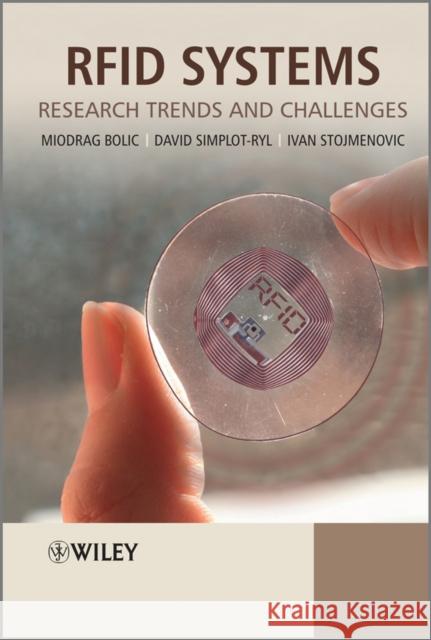
Miodrag Bolic;David Simplot–Ryl;Ivan Stojmenovic
RFID Systems: Research Trends and Challenges Bolic, Miodrag 9780470746028  - książkaWidoczna okładka, to zdjęcie poglądowe, a rzeczywista szata graficzna może różnić się od prezentowanej.

RFID Systems: Research Trends and Challenges

ISBN-13: 9780470746028 / Angielski / Twarda / 2010 / 576 str.

Miodrag Bolic;David Simplot–Ryl;Ivan Stojmenovic
cena 587,46
(netto: 559,49 VAT:  5%)

Najniższa cena z 30 dni: 580,29
Termin realizacji zamówienia:
ok. 30 dni roboczych.

Darmowa dostawa!

This book provides an insight into the 'hot' field of Radio Frequency Identification (RFID) Systems In this book, the authors provide an insight into the field of RFID systems with an emphasis on networking aspects and research challenges related to passive Ultra High Frequency (UHF) RFID systems. The book reviews various algorithms, protocols and design solutions that have been developed within the area, including most recent advances. In addition, authors cover a wide range of recognized problems in RFID industry, striking a balance between theoretical and practical coverage. Limitations of the technology and state-of-the-art solutions are identified and new research opportunities are addressed. Finally, the book is authored by experts and respected researchers in the field and every chapter is peer reviewed. Key Features:

  • Provides the most comprehensive analysis of networking aspects of RFID systems, including tag identification protocols and reader anti-collision algorithms
  • Covers in detail major research problems of passive UHF systems such as improving reading accuracy, reading range and throughput
  • Analyzes other "hot topics" including localization of passive RFID tags, energy harvesting, simulator and emulator design, security and privacy
  • Discusses design of tag antennas, tag and reader circuits for passive UHF RFID systems
  • Presents EPCGlobal architecture framework, middleware and protocols
  • Includes an accompanying website with PowerPoint slides and solutions to the problems http: //www.site.uottawa.ca/ mbolic/RFIDBook/
This book will be an invaluable guide for researchers and graduate students in electrical engineering and computer science, and researchers and developers in telecommunication industry.


This book provides an insight into the ‘hot’ field of Radio Frequency Identification (RFID) SystemsIn this book, the authors provide an insight into the field of RFID systems with an emphasis on networking aspects and research challenges related to passive Ultra High Frequency (UHF) RFID systems. The book reviews various algorithms, protocols and design solutions that have been developed within the area, including most recent advances. In addition, authors cover a wide range of recognized problems in RFID industry, striking a balance between theoretical and practical coverage. Limitations of the technology and state–of–the–art solutions are identified and new research opportunities are addressed. Finally, the book is authored by experts and respected researchers in the field and every chapter is peer reviewed.Key Features:•Provides the most comprehensive analysis of networking aspects of RFID systems, including tag identification protocols and reader anti–collision algorithms•Covers in detail major research problems of passive UHF systems such as improving reading accuracy, reading range and throughput•Analyzes other “hot topics” including localization of passive RFID tags, energy harvesting, simulator and emulator design, security and privacy•Discusses design of tag antennas, tag and reader circuits for passive UHF RFID systems•Presents EPCGlobal architecture framework, middleware and protocols•Includes an accompanying website with PowerPoint slides and solutions to the problems (http://www.wiley.com/go/bolic—rfid)This book will be an invaluable guide for researchers and graduate students in electrical engineering and computer science, and researchers and developers in telecommunication industry.

Kategorie:
Technologie
Kategorie BISAC:
Technology & Engineering > Telecommunications
Technology & Engineering > Mobile & Wireless Communications
Język:
Angielski
ISBN-13:
9780470746028
Rok wydania:
2010
Ilość stron:
576
Waga:
1.10 kg
Wymiary:
24.38 x 17.02 x 3.56
Oprawa:
Twarda
Wolumenów:
01
Dodatkowe informacje:
Bibliografia
Wydanie ilustrowane

About the Editors.

Preface.

Acknowledgements.

Part I COMPONENTS OF RFID SYSTEMS AND PERFORMANCE METRICS.

1 Performance of Passive UHF RFID Systems in Practice (Miodrag Bolic, Akshay Athalye, and Tzu Hao Li).

1.1 Introduction.

1.2 Ideal RFID System.

1.3 Practical RFID Systems.

1.4 Overview of the Book.

1.5 Conclusion.

References.

2 Performance Metrics and Operational Parameters of RFID Systems (Raj Bridelall and Abhiman Hande).

2.1 Overview.

2.2 Key Operational Parameters.

2.3 Classification of Commercially Available Products.

2.4 Conclusion.

Problems.

References.

3 UHF RFID Antennas (Daniel Deavours).

3.1 Dipoles and Relatives.

3.2 T–Match and Relatives.

3.3 Putting it Together: Building an RFID Tag.

3.4 The Environment.

3.5 Conclusions, Trends, and Challenges.

References.

4 RFID Tag Chip Design (Na Yan, Wenyi Che, Yuqing Yang, and Qiang Li).

4.1 Tag Architecture Systems.

4.2 Memory in Standard CMOS Processes.

4.3 Baseband of RFID Tag.

4.4 RFID Tag Performance Optimization.

4.5 Conclusion.

Problems.

References.

5 Design of Passive Tag RFID Readers (Scott Chiu).

5.1 Overview.

5.2 Basics of Passive RFID Operation.

5.3 Passive RFID Reader Designs.

5.4 Advanced Topics on RFID Reader Design.

5.5 Conclusion.

Problems.

References.

6 RFID Middleware: Concepts and Architecture (Nathalie Mitton, Loïc Schmidt, and David Simplot–Ryl).

6.1 Introduction.

6.2 Overview of an RFID Middleware Architecture.

6.3 Readers Management.

6.4 Data Management and Application–Level Events.

6.5 Store and Share Data.

6.6 Example.

6.7 Conclusion.

Problems.

References.

Part II TAG IDENTIFICATION PROTOCOLS.

7 Aloha–Based Protocols (Kwan–Wu Chin and Dheeraj Klair).

7.1 Pure Aloha.

7.2 Slotted Aloha.

7.3 Framed Slotted Aloha.

7.4 Conclusion.

Problems.

References.

8 Tree–Based Anti–Collision Protocols for RFID Tags (Petar Popovski).

8.1 Introduction.

8.2 Principles of Tree–Based Anti–Collision Protocols.

8.3 Tree Protocols in the Existing RFID Specifications.

8.4 Practical Issues and Transmission Errors.

8.5 Cooperative Readers and Generalized Arbitration Spaces.

8.6 Conclusion.

Problems.

References.

9 A Comparison of TTF and RTF UHF RFID Protocols (Alwyn Hoffman, Johann Holm, and Henri–Jean Marais).

9.1 Introduction.

9.2 Requirements for RFID Protocols.

9.3 Different Approaches Used in UHF Protocols.

9.4 Description of Stochastic TTF Protocols.

9.5 Comparison between ISO18000–6C and TTF Protocols.

9.6 Conclusion.

Problems.

References.

Part III READER INFRASTRUCTURE NETWORKING.

10 Integrating RFID Readers in Enterprise IT (Christian Floerkemeier and Sanjay Sarma).

10.1 Related Work.

10.2 RFID System Services.

10.3 Reader Capabilities.

10.4 RFID System Architecture Taxonomy.

10.5 EPCglobal Standards.

10.6 Adoption of High–Level Reader Protocols.

10.7 Potential Future Standardization Activities.

10.8 Conclusion.

Problems.

References.

11 Reducing Interference in RFID Reader Networks (Sung Won Kim and Gyanendra Prasad Joshi).

11.1 Introduction.

11.2 Interference Problem in RFID Reader Networks.

11.3 Access Mechanism, Regulations, Standards and Algorithms.

11.4 Comparison.

11.5 Conclusion.

Problems.

References.

12 Optimal Tag Coverage and Tag Report Elimination (Bogdan Carbunar, Murali Krishna Ramanathan, Mehmet Koyuturk, Suresh Jagannathan, and Ananth Grama).

12.1 Introduction.

12.2 Overview of RFID Systems.

12.3 Tree Walking: An Algorithm for Detecting Tags in the Presence of Collisions.

12.4 Reader Collision Avoidance.

12.5 Coverage Redundancy in RFID Systems: Comparison with Sensor Networks.

12.6 Network Model.

12.7 Optimal Tag Coverage and Tag Reporting.

12.8 Redundant Reader Elimination Algorithms: A Centralized Heuristic.

12.9 RRE: A Distributed Solution.

12.10 Adapting to Topological Changes.

12.11 The Layered Elimination Optimization (LEO).

12.12 Related Work.

12.13 Conclusion.

Problems.

References.

13 Delay/Disruption–Tolerant Mobile RFID Networks: Challenges and Opportunities (Hongyi Wu and Zhipeng Yang).

13.1 Motivation.

13.2 Overview of FINDERS.

13.3 General Feasibility Study.

13.4 Unique Challenges and Tactics.

13.5 Related Work.

13.6 Conclusion.

Problems.

References.

Part IV ADDRESSING OTHER CHALLENGES IN RFID SYSTEMS.

14 Improving Read Ranges and Read Rates for Passive RFID Systems (Zhiguang Fan, Fazhong Shen, Jianhua Shen, and Lixin Ran).

14.1 Introduction.

14.2 Signal Descriptions and Formulations for Passive Backscatter RFID Systems.

14.3 Improving the Read Range of a Passive RFID System.

14.4 Improving the Read Rate of a Passive RFID System.

14.5 Two Design Examples for RFID System.

14.6 Conclusion.

Problems.

References.

15 Principles and Techniques of RFID Positioning (Yimin Zhang, Xin Li, and Moeness Amin).

15.1 Introduction.

15.2 Tag Range Estimation Techniques.

15.3 DOA Estimation Techniques.

15.4 RFID Positioning Techniques.

15.5 Improving Positioning Accuracy.

15.6 Conclusion.

Problems.

References.

16 Towards Secure and Privacy–Enhanced RFID Systems (Heiko Knospe and Kerstin Lemke–Rust).

16.1 Introduction.

16.2 Security and Privacy.

16.3 Classification of RFID Systems.

16.4 Attacks on RFID Systems and Appropriate Countermeasures.

16.5 Lightweight Cryptography for RFID.

16.6 Conclusion.

Problems.

References.

17 Cryptographic Approaches for Improving Security and Privacy Issues of RFID Systems (Miyako Ohkubo, Koutarou Suzuki, and Shingo Kinoshita).

17.1 Introduction.

17.2 Threats against the RFID System.

17.3 Required Properties.

17.4 Cryptographic Protocols for Identification with Privacy.

17.5 Cryptographic Protocols for Authentication without Privacy.

17.6 Cryptographic Protocols for Privacy and Other Requirements.

17.7 Implementation.

17.8 Real Systems and Attacks.

17.9 Conclusion.

Problems.

References.

18 Novel RFID Technologies: Energy Harvesting for Self–Powered Autonomous RFID Systems (Raj Bridelall and Abhiman Hande).

18.1 Introduction.

18.2 Novel Low Power Architectures.

18.3 Energy Harvesting Optimized for RFID.

18.4 Future Trends in Energy Harvesting.

18.5 Conclusion.

Problems.

References.

19 Simulators and Emulators for Different Abstraction Layers of UHF RFID Systems (Christian Steger, Alex Janek, Reinhold Weiß, Vojtech Derbek, Manfred Jantscher, Josef Preishuber–Pfluegl, and Markus Pistauer).

19.1 Introduction.

19.2 The Simulation/Emulation Platforms.

19.3 UHF RFID Simulation Platform.

19.4 Real–Time HIL–Verification and Emulation Platform.

19.5 Higher Class Tag Architecture Based on Energy Harvesting.

19.6 Conclusion.

Problems.

References.

Index.

This book provides an insight into the ‘hot’ field of Radio Frequency Identification (RFID) Systems

In this book, the authors provide an insight into the field of RFID systems with an emphasis on networking aspects and research challenges related to passive Ultra High Frequency (UHF) RFID systems. The book reviews various algorithms, protocols and design solutions that have been developed within the area, including most recent advances. In addition, authors cover a wide range of recognized problems in RFID industry, striking a balance between theoretical and practical coverage. Limitations of the technology and state–of–the–art solutions are identified and new research opportunities are addressed. Finally, the book is authored by experts and respected researchers in the field and every chapter is peer reviewed.

Key Features:

  • Provides the most comprehensive analysis of networking aspects of RFID systems, including tag identification protocols and reader anti–collision algorithms
  • Covers in detail major research problems of passive UHF systems such as improving reading accuracy, reading range and throughput
  • Analyzes other “hot topics” including localization of passive RFID tags, energy harvesting, simulator and emulator design, security and privacy
  • Discusses design of tag antennas, tag and reader circuits for passive UHF RFID systems
  • Presents EPCGlobal architecture framework, middleware and protocols
  • Includes an accompanying website with PowerPoint slides and solutions to the problems (http://www.site.uottawa.ca/∼mbolic/RFIDBook/)

This book will be an invaluable guide for researchers and graduate students in electrical engineering and computer science, and researchers and developers in telecommunication industry.




Udostępnij

Facebook - konto krainaksiazek.pl


Opinie o Krainaksiazek.pl na Opineo.pl

Partner Mybenefit

Krainaksiazek.pl w programie rzetelna firma Krainaksiaze.pl - płatności przez paypal

Czytaj nas na:

Facebook - krainaksiazek.pl
  • książki na zamówienie
  • granty
  • książka na prezent
  • kontakt
  • pomoc
  • opinie
  • regulamin
  • polityka prywatności

Zobacz:

  • Księgarnia czeska

  • Wydawnictwo Książkowe Klimaty

1997-2026 DolnySlask.com Agencja Internetowa

© 1997-2022 krainaksiazek.pl
     
KONTAKT | REGULAMIN | POLITYKA PRYWATNOŚCI | USTAWIENIA PRYWATNOŚCI
Zobacz: Księgarnia Czeska | Wydawnictwo Książkowe Klimaty | Mapa strony | Lista autorów
KrainaKsiazek.PL - Księgarnia Internetowa

Polityka prywatnosci - link
Krainaksiazek.pl - płatnośc Przelewy24
Przechowalnia Przechowalnia




