• Wyszukiwanie zaawansowane
  • Kategorie
  • Kategorie BISAC
  • Książki na zamówienie
  • Promocje
  • Granty
  • Książka na prezent
  • Opinie
  • Pomoc
  • Załóż konto
  • Zaloguj się

Quantum Mechanics for Chemistry » książka


zaloguj się | załóż konto
Logo Krainaksiazek.pl

koszyk

konto

szukaj
topmenu
Księgarnia internetowa
Szukaj
Książki na zamówienie
Promocje
Granty
Książka na prezent
Moje konto
Pomoc
 
 
Wyszukiwanie zaawansowane
Pusty koszyk
Bezpłatna dostawa dla zamówień powyżej 20 złBezpłatna dostawa dla zamówień powyżej 20 zł

Kategorie główne

• Nauka
 [2952079]
• Literatura piękna
 [1850969]

  więcej...
• Turystyka
 [71058]
• Informatyka
 [151066]
• Komiksy
 [35579]
• Encyklopedie
 [23181]
• Dziecięca
 [620496]
• Hobby
 [139036]
• AudioBooki
 [1646]
• Literatura faktu
 [228729]
• Muzyka CD
 [379]
• Słowniki
 [2932]
• Inne
 [445708]
• Kalendarze
 [1409]
• Podręczniki
 [164793]
• Poradniki
 [480107]
• Religia
 [510956]
• Czasopisma
 [511]
• Sport
 [61267]
• Sztuka
 [243299]
• CD, DVD, Video
 [3411]
• Technologie
 [219640]
• Zdrowie
 [100984]
• Książkowe Klimaty
 [124]
• Zabawki
 [2281]
• Puzzle, gry
 [3363]
• Literatura w języku ukraińskim
 [258]
• Art. papiernicze i szkolne
 [8020]
Kategorie szczegółowe BISAC

Quantum Mechanics for Chemistry

ISBN-13: 9783031302176 / Angielski
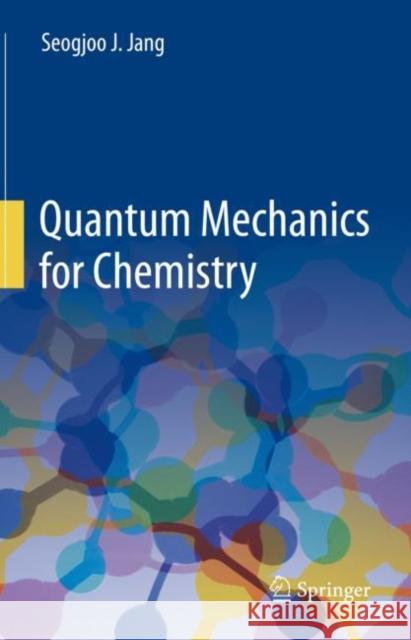
Seogjoo J. Jang
Quantum Mechanics for Chemistry Seogjoo J. Jang 9783031302176 Springer - książkaWidoczna okładka, to zdjęcie poglądowe, a rzeczywista szata graficzna może różnić się od prezentowanej.

Quantum Mechanics for Chemistry

ISBN-13: 9783031302176 / Angielski

Seogjoo J. Jang
cena 402,53
(netto: 383,36 VAT:  5%)

Najniższa cena z 30 dni: 385,52
Termin realizacji zamówienia:
ok. 22 dni roboczych
Dostawa w 2026 r.

Darmowa dostawa!
inne wydania

This textbook forms the basis for an advanced undergraduate or graduate level quantum chemistry course, and can also serve as a reference for researchers in physical chemistry and chemical physics. In addition to the standard core topics such as principles of quantum mechanics, vibrational and rotational states, hydrogen-like molecules, perturbation theory, variational principles, and molecular orbital theories, this book also covers essential theories of electronic structure calculation, the primary methods for calculating quantum dynamics, and major spectroscopic techniques for quantum measurement. Plus, topics that are overlooked in conventional textbooks such as path integral formulation, open system quantum dynamics methods, and Green’s function approaches are addressed. This book helps readers grasp the essential quantum mechanical principles and results that serve as the foundation of modern chemistry and become knowledgeable in major methods of computational chemistry and spectroscopic experiments being conducted by present-day researchers. Dirac notation is used throughout, and right balance between comprehensiveness, rigor, and readability is achieved, ensuring that the book remains accessible while providing all the relevant details. Complete with exercises, this book is ideal for a course on quantum chemistry or as a self-study resource.


This textbook forms the basis for an advanced undergraduate or graduate level quantum chemistry course, and can also serve as a reference for researchers in physical chemistry and chemical physics. In addition to the standard core topics such as principles of quantum mechanics, vibrational and rotational states, hydrogen-like molecules, perturbation theory, variational principles, and molecular orbital theories, this book also covers essential theories of electronic structure calculation, the primary methods for calculating quantum dynamics, and major spectroscopic techniques for quantum measurement. Plus, topics that are overlooked in conventional textbooks such as path integral formulation, open system quantum dynamics methods, and Green’s function approaches are addressed. This book helps readers grasp the essential quantum mechanical principles and results that serve as the foundation of modern chemistry and become knowledgeable in major methods of computational chemistry and spectroscopic experiments being conducted by present-day researchers. Dirac notation is used throughout, and right balance between comprehensiveness, rigor, and readability is achieved, ensuring that the book remains accessible while providing all the relevant details. Complete with exercises, this book is ideal for a course on quantum chemistry or as a self-study resource.

Kategorie:
Nauka, Fizyka
Kategorie BISAC:
Science > Chemia - Fizyczna
Science > Fizyka atomowa i molekularna
Science > Fizyka kwantowa
Wydawca:
Springer
Język:
Angielski
ISBN-13:
9783031302176

Chapter 1. Concepts and Assumptions of Quantum Mechanics

1.1   Assumptions of Classical Mechanics

1.2   Concepts of Quantum Mechanics

1.2.1          Quantization of Light Energy and Planck constant

1.2.2          de Broglie’s Theory of Material Wave

1.2.3          Uncertainty Principle

1.2.4          Wave-Particle Duality

1.3   Schrödinger Equation (in one dimension) and Probability Amplitude

1.3.1          Stationary States

1.3.2          Eigenfunction and eigenvalue

1.4   Example of a Quantum Particle in a One-Dimensional Box

1.4.1          Time Independent Schrödinger Equation

1.4.2          Time Dependent States

1.4.3          Completeness


Chapter 2. Dirac Notation for Quantum States and Operators

2.1 Ket, Bra, and Products

2.2 Operators

2.2.1 Hermitian Operator

2.2.2 One-dimensional Position Operator and Eigenket

2.2.3 One-dimensional Momentum Operator and Eigenket

2.2.4 Commutator

2.2.5 Compatibility and Completeness

2.2.6 Unitary Operator

2.3. Direct Product


Chapter 3. Harmonic Oscillator and Vibrational Spectroscopy

3.1 Schrödinger Equation

3.2 Operator Approach

3.3. General Time Dependent State

3.4 Vibrational Spectroscopy


Chapter 4. Multidimensional Systems and Separation of Variables

4.1 Position, Momentum, and Hamiltonian in Multidimensional Space

4.2 Particle in a Three-dimensional Rectangular Box

4.3 Center of Mass and Relative Coordinate System


Chapter 5. Rotational States and Spectroscopy

5.1 Rotation in Two-dimension

5.2 Rotation in Three-dimension

5.3 General Three-dimensional Rotation of a Diatomic Molecule

5.4 Rotational Spectroscopy

5.5 Ro-vibrational Transition


Chapter 6. Hydrogen-like Systems and Spin-Orbit States of Electron

6.1 Separation in Spherical Coordinate System

6.2 Energies and Spatial States of an Electron in Hydrogen-like Systems

6.3 Spin States of an Electron


Chapter 7. Approximation Methods

7.1 Variational Principle

7.1.1 General Proof

7.1.2 Simple Examples

7.1.3 Approximation with Linear Combination of Basis Sets

7.2 Time Independent Perturbation Theory

7.2.1 Non-degenerate Perturbation Theory and Examples

7.2.3 Degenerate Perturbation Theory and Examples

7.3 Time Dependent Perturbation Theory

7.3.1 General Derivation of Fermi’s Golden Rule

7.3.2 Super-Exchange Approximation


Chapter 8. Many-electron Systems and Atomic Spectroscopy

8.1 Spins and Pauli Principle

8.2 Aufbau Principle and Selection Rules for Atomic Spectroscopy

8.3 Helium Atom

8.2.1 Self-consistent Field Approximation

8.2.2 Application of Perturbation Theory

8.4 Hartree-Fock Theory

8.5 Density Functional Theory


Chapter 9. Polyatomic Molecules and Molecular Spectroscopy

9.1 Born-Oppenheimer Approximation

9.2 Example of H2

9.3 Conjugated Hydrocarbons and Hückel Approximation

9.4 Group Theory

9.5 Spectroscopy of Polyatomic Molecules

9.5.1 Infrared and Raman Spectroscopy

9.5.2 Linear Electronic Spectroscopy


Chapter 10. Electronic Structure Calculation Methods of Polyatomic Molecules

10.1 Hartree-Fock Theory

10.2 Configuration Interaction and Multi-reference methods

10.2 Density Functional Theory

10.3 Time Dependent Density Functional Theory

10.4 Green Function Approaches


Chapter 11. Path Integral Representation and Applications

11.1 Path Integral Representation of Real Time Propagator

11.2 Simple Examples

11.3 Path Integral Representation of Density Operator


Chapter 12. Quantum Dynamics Methods

12.1 Numerical Solution of Time Dependent Schrödinger Equation

12.2 Open System Quantum Dynamics Methods

12.2.1 Projection Operator Formalism

12.2.2 Stochastic Schrödinger Equation Approach


Chapter 13. Quantum Light

13.1 Second Quantization of Electromagnetic Field

13.2 Interaction of Molecules with Quantum Light


Chapter 14. Quantum Information, Control, Computation, and Sensing


Chapter 15. Conclusion and Open Issues for Research

Seogjoo J. Jang is a Professor of Chemistry at Queens College of the City University of New York (CUNY), and is a doctoral faculty member of both the Chemistry and Physics PhD programs at the Graduate Center of CUNY. He obtained his BS (1989) and MS (1993) degrees in Chemistry from Seoul National University, and a Ph.D. degree (1999) in Chemistry from the University of Pennsylvania. He then worked as a postdoctoral associate at MIT (1999-2002) and as a Goldhaber Distinguished Fellow (2003-2005) at Brookhaven National Laboratory before starting his faculty position at Queens College, CUNY in 2005. His research expertise is in quantum dynamics theories and computational modeling. In particular, he has pioneered modern theories of resonance energy transfer that are now being incorporated into theoretical analyses of experimental data on complex molecular systems and has made key contributions to understanding the role of delocalized excitons in photosynthetic light harvesting complexes. He is a recipient of the National Science Foundation CAREER Award (2009) and the Camille Dreyfus Teacher Scholar Award (2010).

This textbook forms the basis for an advanced undergraduate or graduate level quantum chemistry course, and can also serve as a reference for researchers in physical chemistry and chemical physics. In addition to the standard core topics such as principles of quantum mechanics, vibrational and rotational states, hydrogen-like molecules, perturbation theory, variational principles, and molecular orbital theories, this book also covers essential theories of electronic structure calculation, the primary methods for calculating quantum dynamics, and major spectroscopic techniques for quantum measurement. Plus, topics that are overlooked in conventional textbooks such as path integral formulation, open system quantum dynamics methods, and Green’s function approaches are addressed. This book helps readers grasp the essential quantum mechanical principles and results that serve as the foundation of modern chemistry and become knowledgeable in major methods of computational chemistry and spectroscopic experiments being conducted by present-day researchers. Dirac notation is used throughout, and right balance between comprehensiveness, rigor, and readability is achieved, ensuring that the book remains accessible while providing all the relevant details. Complete with exercises, this book is ideal for a course on quantum chemistry or as a self-study resource.




Udostępnij

Facebook - konto krainaksiazek.pl


Opinie o Krainaksiazek.pl na Opineo.pl

Partner Mybenefit

Krainaksiazek.pl w programie rzetelna firma Krainaksiaze.pl - płatności przez paypal

Czytaj nas na:

Facebook - krainaksiazek.pl
  • książki na zamówienie
  • granty
  • książka na prezent
  • kontakt
  • pomoc
  • opinie
  • regulamin
  • polityka prywatności

Zobacz:

  • Księgarnia czeska

  • Wydawnictwo Książkowe Klimaty

1997-2025 DolnySlask.com Agencja Internetowa

© 1997-2022 krainaksiazek.pl
     
KONTAKT | REGULAMIN | POLITYKA PRYWATNOŚCI | USTAWIENIA PRYWATNOŚCI
Zobacz: Księgarnia Czeska | Wydawnictwo Książkowe Klimaty | Mapa strony | Lista autorów
KrainaKsiazek.PL - Księgarnia Internetowa

Polityka prywatnosci - link
Krainaksiazek.pl - płatnośc Przelewy24
Przechowalnia Przechowalnia



