• Wyszukiwanie zaawansowane
  • Kategorie
  • Kategorie BISAC
  • Książki na zamówienie
  • Promocje
  • Granty
  • Książka na prezent
  • Opinie
  • Pomoc
  • Załóż konto
  • Zaloguj się

Quantum Mechanics » książka


zaloguj się | załóż konto
Logo Krainaksiazek.pl

koszyk

konto

szukaj
topmenu
Księgarnia internetowa
Szukaj
Książki na zamówienie
Promocje
Granty
Książka na prezent
Moje konto
Pomoc
 
 
Wyszukiwanie zaawansowane
Pusty koszyk
Bezpłatna dostawa dla zamówień powyżej 20 złBezpłatna dostawa dla zamówień powyżej 20 zł

Kategorie główne

• Nauka
 [2949965]
• Literatura piękna
 [1857847]

  więcej...
• Turystyka
 [70818]
• Informatyka
 [151303]
• Komiksy
 [35733]
• Encyklopedie
 [23180]
• Dziecięca
 [617748]
• Hobby
 [139972]
• AudioBooki
 [1650]
• Literatura faktu
 [228361]
• Muzyka CD
 [398]
• Słowniki
 [2862]
• Inne
 [444732]
• Kalendarze
 [1620]
• Podręczniki
 [167233]
• Poradniki
 [482388]
• Religia
 [509867]
• Czasopisma
 [533]
• Sport
 [61361]
• Sztuka
 [243125]
• CD, DVD, Video
 [3451]
• Technologie
 [219309]
• Zdrowie
 [101347]
• Książkowe Klimaty
 [123]
• Zabawki
 [2362]
• Puzzle, gry
 [3791]
• Literatura w języku ukraińskim
 [253]
• Art. papiernicze i szkolne
 [7933]
Kategorie szczegółowe BISAC

Quantum Mechanics

ISBN-13: 9780470874097 / Angielski / Twarda / 2012 / 448 str.
Dennis M. Sullivan
Quantum Mechanics Sullivan, Dennis M. 9780470874097 IEEE Press Series on Microelectronic Systems - książkaWidoczna okładka, to zdjęcie poglądowe, a rzeczywista szata graficzna może różnić się od prezentowanej.

Quantum Mechanics

ISBN-13: 9780470874097 / Angielski / Twarda / 2012 / 448 str.

Dennis M. Sullivan
cena 446,45 zł
(netto: 425,19 VAT:  5%)

Najniższa cena z 30 dni: 441,88 zł
Termin realizacji zamówienia:
ok. 30 dni roboczych
Bez gwarancji dostawy przed świętami

Darmowa dostawa!

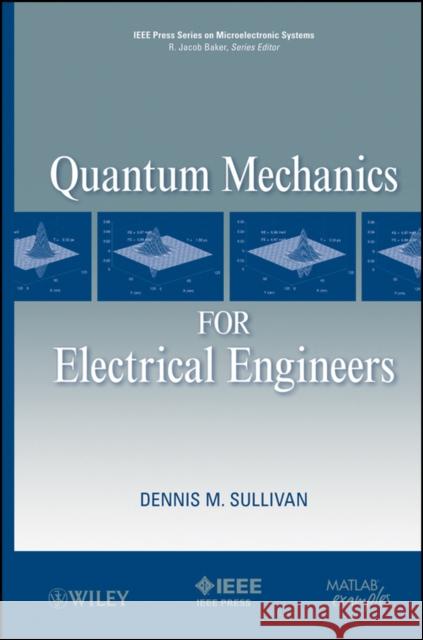
The main topic of this book is quantum mechanics, as the title indicates. It specifically targets those topics within quantum mechanics that are needed to understand modern semiconductor theory. It begins with the motivation for quantum mechanics and why classical physics fails when dealing with very small particles and small dimensions. Two key features make this book different from others on quantum mechanics, even those usually intended for engineers: First, after a brief introduction, much of the development is through Fourier theory, a topic that is at the heart of most electrical engineering theory. In this manner, the explanation of the quantum mechanics is rooted in the mathematics familiar to every electrical engineer. Secondly, beginning with the first chapter, simple computer programs in MATLAB are used to illustrate the principles. The programs can easily be copied and used by the reader to do the exercises at the end of the chapters or to just become more familiar with the material. Many of the figures in this book have a title across the top. This title is the name of the MATLAB program that was used to generate that figure. These programs are available to the reader. Appendix D lists all the programs, and they are also downloadable at http: //booksupport.wiley.com


Kategorie:
Technologie
Kategorie BISAC:
Science > Fizyka kwantowa
Technology & Engineering > Electronics - General
Wydawca:
IEEE Press Series on Microelectronic Systems
Język:
Angielski
ISBN-13:
9780470874097
Rok wydania:
2012
Numer serii:
000047437
Ilość stron:
448
Waga:
0.74 kg
Wymiary:
23.62 x 16.0 x 2.79
Oprawa:
Twarda
Wolumenów:
01
Dodatkowe informacje:
Bibliografia

Preface xiii

Acknowledgments xv

About the Author xvii

1. Introduction 1

1.1 Why Quantum Mechanics?, 1

1.1.1 Photoelectric Effect, 1

1.1.2 Wave Particle Duality, 2

1.1.3 Energy Equations, 3

1.1.4 The Schrödinger Equation, 5

1.2 Simulation of the One–Dimensional, Time–Dependent Schrödinger Equation, 7

1.2.1 Propagation of a Particle in Free Space, 8

1.2.2 Propagation of a Particle Interacting with a Potential, 11

1.3 Physical Parameters: The Observables, 14

1.4 The Potential V(x), 17

1.4.1 The Conduction Band of a Semiconductor, 17

1.4.2 A Particle in an Electric Field, 17

1.5 Propagating through Potential Barriers, 20

1.6 Summary, 23

Exercises, 24

References, 25

2. Stationary States 27

2.1 The Infi nite Well, 28

2.1.1 Eigenstates and Eigenenergies, 30

2.1.2 Quantization, 33

2.2 Eigenfunction Decomposition, 34

2.3 Periodic Boundary Conditions, 38

2.4 Eigenfunctions for Arbitrarily Shaped Potentials, 39

2.5 Coupled Wells, 41

2.6 Bra–ket Notation, 44

2.7 Summary, 47

Exercises, 47

References, 49

3. Fourier Theory in Quantum Mechanics 51

3.1 The Fourier Transform, 51

3.2 Fourier Analysis and Available States, 55

3.3 Uncertainty, 59

3.4 Transmission via FFT, 62

3.5 Summary, 66

Exercises, 67

References, 69

4. Matrix Algebra in Quantum Mechanics 71

4.1 Vector and Matrix Representation, 71

4.1.1 State Variables as Vectors, 71

4.1.2 Operators as Matrices, 73

4.2 Matrix Representation of the Hamiltonian, 76

4.2.1 Finding the Eigenvalues and Eigenvectors of a Matrix, 77

4.2.2 A Well with Periodic Boundary Conditions, 77

4.2.3 The Harmonic Oscillator, 80

4.3 The Eigenspace Representation, 81

4.4 Formalism, 83

4.4.1 Hermitian Operators, 83

4.4.2 Function Spaces, 84

Appendix: Review of Matrix Algebra, 85

Exercises, 88

References, 90

5. A Brief Introduction to Statistical Mechanics 91

5.1 Density of States, 91

5.1.1 One–Dimensional Density of States, 92

5.1.2 Two–Dimensional Density of States, 94

5.1.3 Three–Dimensional Density of States, 96

5.1.4 The Density of States in the Conduction Band of a Semiconductor, 97

5.2 Probability Distributions, 98

5.2.1 Fermions versus Classical Particles, 98

5.2.2 Probability Distributions as a Function of Energy, 99

5.2.3 Distribution of Fermion Balls, 101

5.2.4 Particles in the One–Dimensional Infi nite Well, 105

5.2.5 Boltzmann Approximation, 106

5.3 The Equilibrium Distribution of Electrons and Holes, 107

5.4 The Electron Density and the Density Matrix, 110

5.4.1 The Density Matrix, 111

Exercises, 113

References, 114

6. Bands and Subbands 115

6.1 Bands in Semiconductors, 115

6.2 The Effective Mass, 118

6.3 Modes (Subbands) in Quantum Structures, 123

Exercises, 128

References, 129

7. The Schrödinger Equation for Spin–1/2 Fermions 131

7.1 Spin in Fermions, 131

7.1.1 Spinors in Three Dimensions, 132

7.1.2 The Pauli Spin Matrices, 135

7.1.3 Simulation of Spin, 136

7.2 An Electron in a Magnetic Field, 142

7.3 A Charged Particle Moving in Combined E and B Fields, 146

7.4 The Hartree Fock Approximation, 148

7.4.1 The Hartree Term, 148

7.4.2 The Fock Term, 153

Exercises, 155

References, 157

8. The Green s Function Formulation 159

8.1 Introduction, 160

8.2 The Density Matrix and the Spectral Matrix, 161

8.3 The Matrix Version of the Green s Function, 164

8.3.1 Eigenfunction Representation of Green s Function, 165

8.3.2 Real Space Representation of Green s Function, 167

8.4 The Self–Energy Matrix, 169

8.4.1 An Electric Field across the Channel, 174

8.4.2 A Short Discussion on Contacts, 175

Exercises, 176

References, 176

9. Transmission 177

9.1 The Single–Energy Channel, 177

9.2 Current Flow, 179

9.3 The Transmission Matrix, 181

9.3.1 Flow into the Channel, 183

9.3.2 Flow out of the Channel, 184

9.3.3 Transmission, 185

9.3.4 Determining Current Flow, 186

9.4 Conductance, 189

9.5 Büttiker Probes, 191

9.6 A Simulation Example, 194

Exercises, 196

References, 197

10. Approximation Methods 199

10.1 The Variational Method, 199

10.2 Nondegenerate Perturbation Theory, 202

10.2.1 First–Order Corrections, 203

10.2.2 Second–Order Corrections, 206

10.3 Degenerate Perturbation Theory, 206

10.4 Time–Dependent Perturbation Theory, 209

10.4.1 An Electric Field Added to an Infinite Well, 212

10.4.2 Sinusoidal Perturbations, 213

10.4.3 Absorption, Emission, and Stimulated Emission, 215

10.4.4 Calculation of Sinusoidal Perturbations Using Fourier Theory, 216

10.4.5 Fermi s Golden Rule, 221

Exercises, 223

References, 225

11. The Harmonic Oscillator 227

11.1 The Harmonic Oscillator in One Dimension, 227

11.1.1 Illustration of the Harmonic Oscillator Eigenfunctions, 232

11.1.2 Compatible Observables, 233

11.2 The Coherent State of the Harmonic Oscillator, 233

11.2.1 The Superposition of Two Eigentates in an Infinite Well, 234

11.2.2 The Superposition of Four Eigenstates in a Harmonic Oscillator, 235

11.2.3 The Coherent State, 236

11.3 The Two–Dimensional Harmonic Oscillator, 238

11.3.1 The Simulation of a Quantum Dot, 238

Exercises, 244

References, 244

12. Finding Eigenfunctions Using Time–Domain Simulation 245

12.1 Finding the Eigenenergies and Eigenfunctions in One Dimension, 245

12.1.1 Finding the Eigenfunctions, 248

12.2 Finding the Eigenfunctions of Two–Dimensional Structures, 249

12.2.1 Finding the Eigenfunctions in an Irregular Structure, 252

12.3 Finding a Complete Set of Eigenfunctions, 257

Exercises, 259

References, 259

Appendix A. Important Constants and Units 261

Appendix B. Fourier Analysis and the Fast Fourier Transform (FFT) 265

B.1 The Structure of the FFT, 265

B.2 Windowing, 267

B.3 FFT of the State Variable, 270

Exercises, 271

References, 271

Appendix C. An Introduction to the Green s Function Method 273

C.1 A One–Dimensional Electromagnetic Cavity, 275

Exercises, 279

References, 279

Appendix D. Listings of the Programs Used in this Book 281

D.1 Chapter 1, 281

D.2 Chapter 2, 284

D.3 Chapter 3, 295

D.4 Chapter 4, 309

D.5 Chapter 5, 312

D.6 Chapter 6, 314

D.7 Chapter 7, 323

D.8 Chapter 8, 336

D.9 Chapter 9, 345

D.10 Chapter 10, 356

D.11 Chapter 11, 378

D.12 Chapter 12, 395

D.13 Appendix B, 415

Index 419

MATLAB Coes are downloadable from http://booksupport.wiley.com

DENNIS M. SULLIVAN is Professor of Electrical and Computer Engineering at the University of Idaho as well as an award–winning author and researcher. In 1997, Dr. Sullivan′s paper "Z Transform Theory and FDTD Method" won the IEEE Antennas and Propagation Society′s R. P. W. King Award for the Best Paper by a Young Investigator. He is the author of Electromagnetic Simulation Using the FDTD Method.

Explains quantum mechanics in language that electrical engineers understand

As semiconductor devices become smaller and smaller, classical physics alone cannot fully explain their behavior. Instead, electrical engineers need to understand the principles of quantum mechanics in order to successfully design and work with today′s semiconductors.

Written by an electrical engineering professor for students and professionals in electrical engineering, Quantum Mechanics for Electrical Engineers focuses on those topics in quantum mechanics that are essential for modern semiconductor theory.

This book begins with an introduction to the field, explaining why classical physics fails when dealing with very small particles and small dimensions. Next, the author presents a variety of topics in quantum mechanics, including:

  • The Schrödinger equation

  • Fourier theory in quantum mechanics

  • Matrix theory in quantum mechanics

  • An introduction to statistical mechanics

  • Transport in semiconductors

Because this book is written for electrical engineers, the explanations of quantum mechanics are rooted in mathematics such as Fourier theory and matrix theory that are familiar to all electrical engineers. Beginning with the first chapter, the author employs simple MATLAB computer programs to illustrate key principles. These computer programs can be easily copied and used by readers to become more familiar with the material. They can also be used to perform the exercises at the end of each chapter.

Quantum Mechanics for Electrical Engineers is recommended for upper–level undergraduates and graduate students as well as professional electrical engineers who want to understand the semiconductors of today and the future.


Udostępnij

Facebook - konto krainaksiazek.pl


Opinie o Krainaksiazek.pl na Opineo.pl

Partner Mybenefit

Krainaksiazek.pl w programie rzetelna firma Krainaksiaze.pl - płatności przez paypal

Czytaj nas na:

Facebook - krainaksiazek.pl
  • książki na zamówienie
  • granty
  • książka na prezent
  • kontakt
  • pomoc
  • opinie
  • regulamin
  • polityka prywatności

Zobacz:

  • Księgarnia czeska

  • Wydawnictwo Książkowe Klimaty

1997-2025 DolnySlask.com Agencja Internetowa

© 1997-2022 krainaksiazek.pl
     
KONTAKT | REGULAMIN | POLITYKA PRYWATNOŚCI | USTAWIENIA PRYWATNOŚCI
Zobacz: Księgarnia Czeska | Wydawnictwo Książkowe Klimaty | Mapa strony | Lista autorów
KrainaKsiazek.PL - Księgarnia Internetowa

Polityka prywatnosci - link
Krainaksiazek.pl - płatnośc Przelewy24
Przechowalnia Przechowalnia






