• Wyszukiwanie zaawansowane
  • Kategorie
  • Kategorie BISAC
  • Książki na zamówienie
  • Promocje
  • Granty
  • Książka na prezent
  • Opinie
  • Pomoc
  • Załóż konto
  • Zaloguj się

Quantum Field Theory 2e » książka


zaloguj się | załóż konto
Logo Krainaksiazek.pl

koszyk

konto

szukaj
topmenu
Księgarnia internetowa
Szukaj
Książki na zamówienie
Promocje
Granty
Książka na prezent
Moje konto
Pomoc
 
 
Wyszukiwanie zaawansowane
Pusty koszyk
Bezpłatna dostawa dla zamówień powyżej 20 złBezpłatna dostawa dla zamówień powyżej 20 zł

Kategorie główne

• Nauka
 [2949965]
• Literatura piękna
 [1857847]

  więcej...
• Turystyka
 [70818]
• Informatyka
 [151303]
• Komiksy
 [35733]
• Encyklopedie
 [23180]
• Dziecięca
 [617748]
• Hobby
 [139972]
• AudioBooki
 [1650]
• Literatura faktu
 [228361]
• Muzyka CD
 [398]
• Słowniki
 [2862]
• Inne
 [444732]
• Kalendarze
 [1620]
• Podręczniki
 [167233]
• Poradniki
 [482388]
• Religia
 [509867]
• Czasopisma
 [533]
• Sport
 [61361]
• Sztuka
 [243125]
• CD, DVD, Video
 [3451]
• Technologie
 [219309]
• Zdrowie
 [101347]
• Książkowe Klimaty
 [123]
• Zabawki
 [2362]
• Puzzle, gry
 [3791]
• Literatura w języku ukraińskim
 [253]
• Art. papiernicze i szkolne
 [7933]
Kategorie szczegółowe BISAC

Quantum Field Theory 2e

ISBN-13: 9780471496847 / Angielski / Miękka / 2010 / 496 str.
Graham (University of Manchester) Shaw
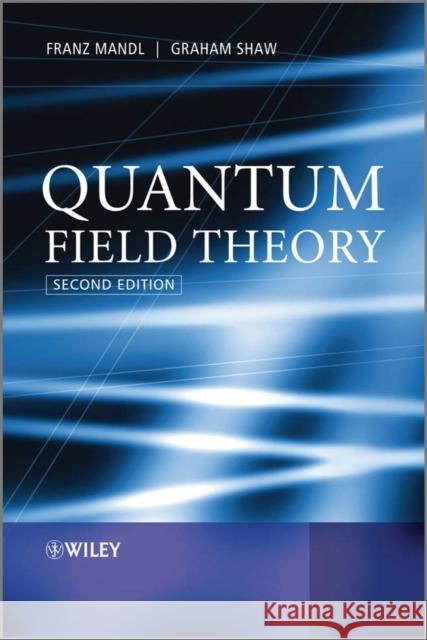
Quantum Field Theory 2e Graham (University of Manchester) Shaw 9780471496847 John Wiley & Sons Inc - książkaWidoczna okładka, to zdjęcie poglądowe, a rzeczywista szata graficzna może różnić się od prezentowanej.

Quantum Field Theory 2e

ISBN-13: 9780471496847 / Angielski / Miękka / 2010 / 496 str.

Graham (University of Manchester) Shaw
cena 215,40 zł
(netto: 205,14 VAT:  5%)

Najniższa cena z 30 dni: 213,19 zł
Termin realizacji zamówienia:
ok. 30 dni roboczych
Bez gwarancji dostawy przed świętami

Darmowa dostawa!
inne wydania

Following on from the successful first (1984) and revised (1993) editions, this extended and revised text is designed as a short and simple introduction to quantum field theory for final year physics students and for postgraduate students beginning research in theoretical and experimental particle physics. The three main objectives of the book are to: Explain the basic physics and formalism of quantum field theory To make the reader proficient in theory calculations using Feynman diagrams To introduce the reader to gauge theories, which play a central role in elementary particle physics. Thus, the first ten chapters deal with QED in the canonical formalism, and are little changed from the first edition. A brief introduction to gauge theories (Chapter 11) is then followed by two sections, which may be read independently of each other. They cover QCD and related topics (Chapters 12-15) and the unified electroweak theory (Chapters 16 - 19) respectively. Problems are provided at the end of each chapter. New to this edition: Five new chapters, giving an introduction to quantum chromodynamics and the methods used to understand it: in particular, path integrals and the renormalization group. The treatment of electroweak interactions has been revised and updated to take account of more recent experiments.


Kategorie:
Nauka, Fizyka
Kategorie BISAC:
Science > Fizyka kwantowa
Wydawca:
John Wiley & Sons Inc
Język:
Angielski
ISBN-13:
9780471496847
Rok wydania:
2010
Ilość stron:
496
Waga:
0.81 kg
Wymiary:
24.05 x 16.94 x 2.72
Oprawa:
Miękka
Wolumenów:
01
Dodatkowe informacje:
Bibliografia
Wydanie ilustrowane

Preface.

Notes.

1 Photons and the Electromagnetic Field.

1.1 Particles and Fields.

1.2 The Electromagnetic Field in the Absence of Charges.

1.3 The Electric Dipole Interaction.

1.4 The Electromagnetic Field in the Presence of Charges.

1.5 Appendix: The Schrödinger, Heisenberg and Interaction Pictures.

Problems.

2 Lagrangian Field Theory.

2.1 Relativistic Notation.

2.2 Classical Lagrangian Field Theory.

2.3 Quantized Lagrangian Field Theory.

2.4 Symmetries and Conservation Laws.

Problems.

3 The Klein Gordon field.

3.1 The Real Klein Gordon Field.

3.2 The Complex Klein Gordon Field.

3.3 Covariant Commutation Relations.

3.4 The Meson Propagator.

Problems.

4 The Dirac Field.

4.1 The Number Representation for Fermions.

4.2 The Dirac Equation.

4.3 Second Quantization.

4.4 The Fermion Propagator.

4.5 The Electromagnetic Interaction and Gauge Invariance.

Problems.

5 Photons: Covariant Theory.

5.1 The Classical Fields.

5.2 Covariant Quantization.

5.3 The Photon Propagator.

Problems.

6 The S–Matrix Expansion.

6.1 Natural Dimensions and Units.

6.2 The S–Matrix Expansion.

6.3 Wick s Theorem.

7 Feynman Diagrams and Rules in QED.

7.1 Feynman Diagrams in Configuration Space.

7.2 Feynman Diagrams in Momentum Space.

7.3 Feynman Rules for QED.

7.4 Leptons.

Problems.

8 QED Processes in Lowest Order.

8.1 The Cross–Section.

8.2 Spin Sums.

8.3 Photon Polarization Sums.

8.4 Lepton Pair Production in (e+e–) Collisions.

8.5 Bhabha Scattering.

8.6 Compton Scattering.

8.7 Scattering by an External Field.

8.8 Bremsstrahlung.

8.9 The Infra–Red Divergence.

Problems.

9 Radiative Corrections.

9.1 The Second–Order Radiative Corrections of QED.

9.2 The Photon Self–Energy.

9.3 The Electron Self–Energy.

9.4 External Line Renormalization.

9.5 The Vertex Modification.

9.6 Applications.

9.7 The Infra–Red Divergence.

9.8 Higher–Order Radiative Corrections.

9.9 Renomalizability.

Problems.

10 Regularization.

10.1 Mathematical Preliminaries.

10.2 Cut–Off Regularization: The Electron Mass Shift.

10.3 Dimensional Regularization.

10.4 Vacuum Polarization.

10.5 The Anomalous Magnetic Moment.

Problems.

11 Gauge Theories.

11.1 The Simplest Gauge Theory: QED.

11.2 Quantum Chromodynamics.

11.3 Alternative Interactions?.

11.4 Appendix: Two Gauge Transformation Results.

Problems.

12 Field Theory Methods.

12.1 Green Functions.

12.2 Feynman Diagrams and Feynman Rules.

12.3 Relation to S–Matrix Elements.

12.4 Functionals and Grassmann Fields.

12.5 The Generating Functional.

Problems.

13 Path Integrals.

13.1 Functional Integration.

13.2 Path Integrals.

13.3 Perturbation Theory.

13.4 Gauge Independent Quantization?.

Problems.

14 Quantum Chromodynamics.

14.1 Gluon Fields.

14.2 Including Quarks.

14.3 Perturbation Theory.

14.4 Feynman Rules for QCD.

14.5 Renormalizability of QCD.

Problems.

15 Asymptotic Freedom.

15.1 Electron–Positron Annihilation.

15.2 The Renormalization Scheme.

15.3 The Renormalization Group.

15.4 The Strong Coupling Constant.

15.5 Applications.

15.6 Appendix: Some Loop Diagrams in QCD.

Problems.

16 Weak Interactions.

16.1 Introduction.

16.2 Leptonic Weak Interactions.

16.3 The Free Vector Boson Field.

16.4 The Feynman Rules for the IVB Theory.

16.5 Decay Rates.

16.6 Applications of the IVB Theory.

16.7 Neutrino Masses.

16.8 Difficulties with the IVB Theory.

Problems.

17 A Gauge Theory of Weak Interactions.

17.1 QED Revisited.

17.2 Global Phase Transformations and Conserved Weak Currents.

17.3 The Gauge–Invariant Electro–Weak Interaction.

17.4 Properties of the Gauge Bosons.

17.5 Lepton and Gauge Boson Masses.

18 Spontaneous Symmetry Breaking.

18.1 The Goldstone Model.

18.2 The Higgs Model.

18.3 The Standard Electro–Weak Theory.

19 The Standard Electroweak Theory.

19.1 The Lagrangian Density in the Unitary Gauge.

19.2 Feynman Rules.

19.3 Elastic Neutrino Electron Scattering.

19.4 Electron Positron Annihilation.

19.5 The Higgs Boson.

Problems.

Appendix A The Dirac Equation. 

Appendix B Feynman Rules and Formulae for Pertubation Therory.

Index.

Following on from the successful first (1984) and revised (1993) editions, this extended and revised text is designed as a short and simple introduction to quantum field theory for final year physics students and for postgraduate students beginning research in theoretical and experimental particle physics.

The three main objectives of the book are to:

  • Explain the basic physics and formalism of quantum field theory
  • To make the reader proficient in theory calculations using Feynman diagrams
  • To introduce the reader to gauge theories, which play a central role in elementary particle physics.

Thus, the first ten chapters deal with QED in the canonical formalism, and are little changed from the first edition. A brief introduction to gauge theories (Chapter 11) is then followed by two sections, which may be read independently of each other. They cover QCD and related topics (Chapters 12–15) and the unified electroweak theory (Chapters 16 19) respectively. Problems are provided at the end of each chapter.

New to this edition:

  • Five new chapters, giving an introduction to quantum chromodynamics and the methods used to understand it: in particular, path integrals and the renormalization group.
  • The treatment of electroweak interactions has been revised and updated to take account of more recent experiments.




Udostępnij

Facebook - konto krainaksiazek.pl


Opinie o Krainaksiazek.pl na Opineo.pl

Partner Mybenefit

Krainaksiazek.pl w programie rzetelna firma Krainaksiaze.pl - płatności przez paypal

Czytaj nas na:

Facebook - krainaksiazek.pl
  • książki na zamówienie
  • granty
  • książka na prezent
  • kontakt
  • pomoc
  • opinie
  • regulamin
  • polityka prywatności

Zobacz:

  • Księgarnia czeska

  • Wydawnictwo Książkowe Klimaty

1997-2025 DolnySlask.com Agencja Internetowa

© 1997-2022 krainaksiazek.pl
     
KONTAKT | REGULAMIN | POLITYKA PRYWATNOŚCI | USTAWIENIA PRYWATNOŚCI
Zobacz: Księgarnia Czeska | Wydawnictwo Książkowe Klimaty | Mapa strony | Lista autorów
KrainaKsiazek.PL - Księgarnia Internetowa

Polityka prywatnosci - link
Krainaksiazek.pl - płatnośc Przelewy24
Przechowalnia Przechowalnia



