• Wyszukiwanie zaawansowane
  • Kategorie
  • Kategorie BISAC
  • Książki na zamówienie
  • Promocje
  • Granty
  • Książka na prezent
  • Opinie
  • Pomoc
  • Załóż konto
  • Zaloguj się

Quantum Causality: Conceptual Issues in the Causal Theory of Quantum Mechanics » książka


zaloguj się | załóż konto
Logo Krainaksiazek.pl

koszyk

konto

szukaj
topmenu
Księgarnia internetowa
Szukaj
Książki na zamówienie
Promocje
Granty
Książka na prezent
Moje konto
Pomoc
 
 
Wyszukiwanie zaawansowane
Pusty koszyk
Bezpłatna dostawa dla zamówień powyżej 20 złBezpłatna dostawa dla zamówień powyżej 20 zł

Kategorie główne

• Nauka
 [2949965]
• Literatura piękna
 [1857847]

  więcej...
• Turystyka
 [70818]
• Informatyka
 [151303]
• Komiksy
 [35733]
• Encyklopedie
 [23180]
• Dziecięca
 [617748]
• Hobby
 [139972]
• AudioBooki
 [1650]
• Literatura faktu
 [228361]
• Muzyka CD
 [398]
• Słowniki
 [2862]
• Inne
 [444732]
• Kalendarze
 [1620]
• Podręczniki
 [167233]
• Poradniki
 [482388]
• Religia
 [509867]
• Czasopisma
 [533]
• Sport
 [61361]
• Sztuka
 [243125]
• CD, DVD, Video
 [3451]
• Technologie
 [219309]
• Zdrowie
 [101347]
• Książkowe Klimaty
 [123]
• Zabawki
 [2362]
• Puzzle, gry
 [3791]
• Literatura w języku ukraińskim
 [253]
• Art. papiernicze i szkolne
 [7933]
Kategorie szczegółowe BISAC

Quantum Causality: Conceptual Issues in the Causal Theory of Quantum Mechanics

ISBN-13: 9789048124022 / Angielski / Twarda / 2009 / 230 str.
Peter J. Riggs
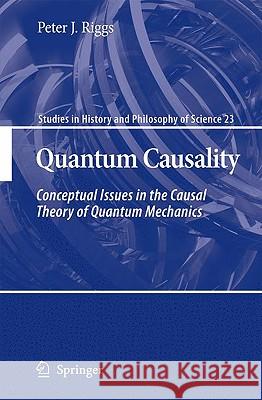
Quantum Causality: Conceptual Issues in the Causal Theory of Quantum Mechanics Riggs, Peter J. 9789048124022 Springer - książkaWidoczna okładka, to zdjęcie poglądowe, a rzeczywista szata graficzna może różnić się od prezentowanej.

Quantum Causality: Conceptual Issues in the Causal Theory of Quantum Mechanics

ISBN-13: 9789048124022 / Angielski / Twarda / 2009 / 230 str.

Peter J. Riggs
cena 403,47
(netto: 384,26 VAT:  5%)

Najniższa cena z 30 dni: 385,52
Termin realizacji zamówienia:
ok. 22 dni roboczych
Bez gwarancji dostawy przed świętami

Darmowa dostawa!
inne wydania

There is no sharp dividing line between the foundations of physics and philosophy of physics. This is especially true for quantum mechanics. The debate on the interpretation of quantum mechanics has raged in both the scientific and philosophical communities since the 1920s and continues to this day. (We shall understand the unqualified term 'quantum mechanics' to mean the mathematical formalism, i. e. laws and rules by which empirical predictions and theoretical advances are made. ) There is a popular rendering of quantum mechanics which has been publicly endorsed by some well known physicists which says that quantum mechanics is not only 1 more weird than we imagine but is weirder than we can imagine. Although it is readily granted that quantum mechanics has produced some strange and counter-intuitive results, the case will be presented in this book that quantum mechanics is not as weird as we might have been led to believe The prevailing theory of quantum mechanics is called Orthodox Quantum Theory (also known as the Copenhagen Interpretation). Orthodox Quantum Theory endows a special status on measurement processes by requiring an intervention of an observer or an observer's proxy (e. g. a measuring apparatus). The placement of the observer (or proxy) is somewhat arbitrary which introduces a degree of subjectivity. Orthodox Quantum Theory only predicts probabilities for measured values of physical quantities. It is essentially an instrumental theory, i. e.


Kategorie:
Nauka, Filozofia
Kategorie BISAC:
Science > Philosophy & Social Aspects
Science > Fizyka kwantowa
Science > Fizyka matematyczna
Wydawca:
Springer
Seria wydawnicza:
Studies in History and Philosophy of Science
Język:
Angielski
ISBN-13:
9789048124022
Rok wydania:
2009
Wydanie:
2009
Numer serii:
000318552
Ilość stron:
230
Waga:
0.51 kg
Wymiary:
23.39 x 15.6 x 1.42
Oprawa:
Twarda
Wolumenów:
01
Dodatkowe informacje:
Bibliografia
Wydanie ilustrowane

From the reviews:

"This text on the derivation of both the time dependent and time independent Schrodinger equations is breaking new ground concerning the single, 2D, and 3D quantum mechanical systems. It is very well written and superbly written for both student and expert ... . the text will be of great value for future physicists, chemists, and other fields of science at both the introductory level, but also in addition to more advanced levels in both teaching/ research. I highly recommend this book for all readers." (Joseph J. Grenier, Amazon.com, November, 2013)

1. General Introduction. 2. Preliminaries. 3: The Causal Theory of Quantum Mechanics. 4: Energy and the Wave Field. 5: Energy-Momentum Transfer and the Quantum Potential. 6: The Exclusion Principle. 7: Conclusions.

This is a treatise devoted to the foundations of quantum physics and the role that causality plays in the microscopic world governed by the laws of quantum mechanics. There is no sharp dividing line between physics and philosophy of physics. This is especially true for quantum physics where debate on its interpretation and the status of the various entities postulated has raged in both the scientific and philosophical communities since the 1920s and continues to this day. Although it is readily granted that quantum mechanics produces some strange and counter-intuitive results, it is argued in Quantum Causality that quantum mechanics is not as weird as we might have been led to believe.

The dominant theory of quantum mechanics is called Orthodox Quantum Theory (also known as the Copenhagen Interpretation). Orthodox Quantum Theory is a ‘theoretical tool’ for making predictions for the possible results of experiments on quantum systems and requires the intervention of an observer or an observer’s proxy (e.g. a measuring apparatus) in order to produce predictions. Orthodox Quantum Theory does away with the notion of causality and denies the existence of an underlying quantum realm.

The Causal Theory is not well known within the physics community and many physicists who do know of it are generally dismissive in their attitudes. This is a historical legacy inherited by the majority of the physics community from the most influential founders of quantum mechanics, Niels Bohr and Werner Heisenberg. They both denied the independent existence of a quantum level of reality and declared that causality does not apply to quantum events.

Quantum Causality shows that the Causal Theory of Quantum Mechanics is a viable physical theory that provides realistic explanations for quantum phenomena. Much of what is argued for in this book will be controversial but, at the very least, these arguments will likely engender some lively debate on the various issues raised.


Udostępnij

Facebook - konto krainaksiazek.pl


Opinie o Krainaksiazek.pl na Opineo.pl

Partner Mybenefit

Krainaksiazek.pl w programie rzetelna firma Krainaksiaze.pl - płatności przez paypal

Czytaj nas na:

Facebook - krainaksiazek.pl
  • książki na zamówienie
  • granty
  • książka na prezent
  • kontakt
  • pomoc
  • opinie
  • regulamin
  • polityka prywatności

Zobacz:

  • Księgarnia czeska

  • Wydawnictwo Książkowe Klimaty

1997-2025 DolnySlask.com Agencja Internetowa

© 1997-2022 krainaksiazek.pl
     
KONTAKT | REGULAMIN | POLITYKA PRYWATNOŚCI | USTAWIENIA PRYWATNOŚCI
Zobacz: Księgarnia Czeska | Wydawnictwo Książkowe Klimaty | Mapa strony | Lista autorów
KrainaKsiazek.PL - Księgarnia Internetowa

Polityka prywatnosci - link
Krainaksiazek.pl - płatnośc Przelewy24
Przechowalnia Przechowalnia





