• Wyszukiwanie zaawansowane
  • Kategorie
  • Kategorie BISAC
  • Książki na zamówienie
  • Promocje
  • Granty
  • Książka na prezent
  • Opinie
  • Pomoc
  • Załóż konto
  • Zaloguj się

Quantitative Methods: An Introduction for Business Management » książka


zaloguj się | załóż konto
Logo Krainaksiazek.pl

koszyk

konto

szukaj
topmenu
Księgarnia internetowa
Szukaj
Książki na zamówienie
Promocje
Granty
Książka na prezent
Moje konto
Pomoc
 
 
Wyszukiwanie zaawansowane
Pusty koszyk
Bezpłatna dostawa dla zamówień powyżej 20 złBezpłatna dostawa dla zamówień powyżej 20 zł

Kategorie główne

• Nauka
 [2946912]
• Literatura piękna
 [1852311]

  więcej...
• Turystyka
 [71421]
• Informatyka
 [150889]
• Komiksy
 [35717]
• Encyklopedie
 [23177]
• Dziecięca
 [617324]
• Hobby
 [138808]
• AudioBooki
 [1671]
• Literatura faktu
 [228371]
• Muzyka CD
 [400]
• Słowniki
 [2841]
• Inne
 [445428]
• Kalendarze
 [1545]
• Podręczniki
 [166819]
• Poradniki
 [480180]
• Religia
 [510412]
• Czasopisma
 [525]
• Sport
 [61271]
• Sztuka
 [242929]
• CD, DVD, Video
 [3371]
• Technologie
 [219258]
• Zdrowie
 [100961]
• Książkowe Klimaty
 [124]
• Zabawki
 [2341]
• Puzzle, gry
 [3766]
• Literatura w języku ukraińskim
 [255]
• Art. papiernicze i szkolne
 [7810]
Kategorie szczegółowe BISAC

Quantitative Methods: An Introduction for Business Management

ISBN-13: 9780470496343 / Angielski / Twarda / 2011 / 912 str.
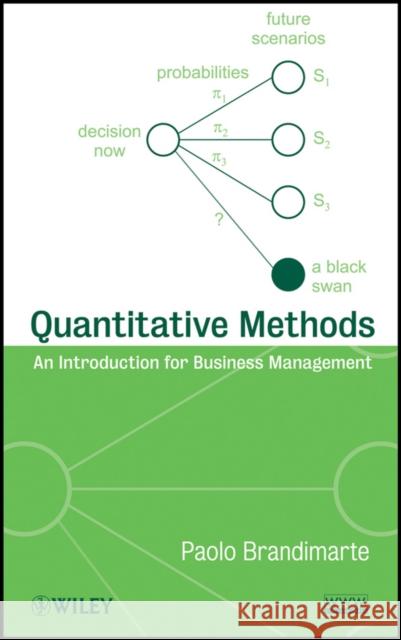
Paolo Brandimarte
Quantitative Methods: An Introduction for Business Management Brandimarte, Paolo 9780470496343 John Wiley & Sons - książkaWidoczna okładka, to zdjęcie poglądowe, a rzeczywista szata graficzna może różnić się od prezentowanej.

Quantitative Methods: An Introduction for Business Management

ISBN-13: 9780470496343 / Angielski / Twarda / 2011 / 912 str.

Paolo Brandimarte
cena 617,21
(netto: 587,82 VAT:  5%)

Najniższa cena z 30 dni: 614,67
Termin realizacji zamówienia:
ok. 30 dni roboczych
Bez gwarancji dostawy przed świętami

Darmowa dostawa!

An accessible introduction to the essential quantitative methods for making valuable business decisions Quantitative methods-research techniques used to analyze quantitative data-enable professionals to organize and understand numbers and, in turn, to make good decisions. Quantitative Methods: An Introduction for Business Management presents the application of quantitative mathematical modeling to decision making in a business management context and emphasizes not only the role of data in drawing conclusions, but also the pitfalls of undiscerning reliance of software packages that implement standard statistical procedures. With hands-on applications and explanations that are accessible to readers at various levels, the book successfully outlines the necessary tools to make smart and successful business decisions. Progressing from beginner to more advanced material at an easy-to-follow pace, the author utilizes motivating examples throughout to aid readers interested in decision making and also provides critical remarks, intuitive traps, and counterexamples when appropriate. The book begins with a discussion of motivations and foundations related to the topic, with introductory presentations of concepts from calculus to linear algebra. Next, the core ideas of quantitative methods are presented in chapters that explore introductory topics in probability, descriptive and inferential statistics, linear regression, and a discussion of time series that includes both classical topics and more challenging models. The author also discusses linear programming models and decision making under risk as well as less standard topics in the field such as game theory and Bayesian statistics. Finally, the book concludes with a focus on selected tools from multivariate statistics, including advanced regression models and data reduction methods such as principal component analysis, factor analysis, and cluster analysis. The book promotes the importance of an analytical approach, particularly when dealing with a complex system where multiple individuals are involved and have conflicting incentives. A related website features Microsoft Excel(R) workbooks and MATLAB(R) scripts to illustrate concepts as well as additional exercises with solutions. Quantitative Methods is an excellent book for courses on the topic at the graduate level. The book also serves as an authoritative reference and self-study guide for financial and business professionals, as well as readers looking to reinforce their analytical skills.


Kategorie:
Nauka, Matematyka
Kategorie BISAC:
Mathematics > Prawdopodobieństwo i statystyka
Business & Economics > Training
Wydawca:
John Wiley & Sons
Język:
Angielski
ISBN-13:
9780470496343
Rok wydania:
2011
Ilość stron:
912
Waga:
1.35 kg
Wymiary:
23.62 x 16.26 x 5.08
Oprawa:
Twarda
Wolumenów:
01
Dodatkowe informacje:
Bibliografia

Preface.

Part I. Motivations and Foundations.

1 Quantitative Methods: Should we Bother?.

1.1 A decision problem without uncertainty: product mix.

1.2 The role of uncertainty.

1.3 Endogenous vs. exogenous uncertainty: Are we alone?.

1.4 Quantitative models and methods.

1.5 Quantitative analysis and problem solving.

Problems.

For further reading.

References.

2 Calculus.

2.1 A motivating example: economic order quantity.

2.2 A little background.

2.3 Functions.

2.4 Continuous functions.

2.5 Composite functions.

2.6 Inverse functions.

2.7 Derivatives.

2.8 Rules for calculating derivatives.

2.9 Using derivatives for graphing functions.

2.10 Higher–order derivatives and Taylor expansions.

2.11 Convexity and optimization.

2.12 Sequences and series.

Problems.

For further reading.

References.

3 Linear Algebra.

3.1 A motivating example: binomial option pricing.

3.2 Solving systems of linear equations.

3.3 Vector algebra.

3.4 Matrix algebra.

3.5 Linear spaces.

3.6 Determinant.

3.7 Eigenvalues and eigenvectors.

3.8 Quadratic forms.

3.9 Calculus in multiple dimensions.

Problems.

For further reading.

References.

Part II Elementary Probability and Statistics.

4 Descriptive Statistics: On the Way to Elementary Probability.

4.1 What is Statistics?.

4.2 Organizing and representing raw data.

4.3 Summary measures.

4.4 Cumulative frequencies and percentiles.

4.5 Multidimensional data.

Problems.

For further reading.

References.

5 Probability Theories.

5.1 Different concepts of probability.

5.2 The axiomatic approach.

5.3 Conditional probability and independence.

5.4 Total probability and Bayes theorems.

Problems.

For further reading.

References.

6 Discrete Random Variables.

6.1 Random variables.

6.2 Characterizing discrete distributions.

6.3 Expected value.

6.4 Variance and standard deviation.

Problems.

For further reading.

References.

7 Continuous Random Variables.

7.1 Building intuition: from discrete to continuous random variables.

7.2 Cumulative distribution and probability density functions.

7.3 Expected value and variance.

7.4 Mode, median, and quantiles.

7.5 Higher–order moments, skewness, and kurtosis.

7.6 A few useful continuous probability distributions.

7.7 Sums of independent random variables.

7.8 Miscellaneous applications.

7.9 Stochastic processes.

7.10 Probability spaces, measurability, and information.

Problems.

For further reading.

References.

8 Dependence, Correlation, and Conditional Expectation.

8.1 Joint and marginal distributions.

8.2 Independent random variables.

8.3 Covariance and correlation.

8.4 Jointly normal variables.

8.5 Conditional expectation.

Problems.

For further reading.

References.

9 Inferential Statistics.

9.1 Random samples and sample statistics.

9.2 Confidence intervals.

9.3 Hypothesis testing.

9.4 Beyond the mean of one population.

9.5 Checking the fit of hypothetical distributions: the chi–square test.

9.6 Analysis of variance.

9.7 Monte Carlo simulation.

9.8 Stochastic convergence and the law of large numbers.

9.9 Parameter estimation.

9.10 Some more hypothesis testing theory.

Problems.

For further reading.

References.

10 Simple Linear Regression.

10.1 Least squares method.

10.2 The need for a statistical framework.

10.3 The case of a non–stochastic regressor.

10.4 Using regression models.

10.5 A glimpse of stochastic regressors and heteroskedastic errors.

10.6 A vector space look at linear regression.

Problems.

For further reading.

References.

11 Time Series Models.

11.1 Before we start: Framing the forecasting process.

11.2 Measuring forecasting errors.

11.3 Time series decomposition.

11.4 Moving average.

11.5 Heuristic exponential smoothing.

11.6 A glance at advanced time series modeling.

Problems.

For further reading.

References.

Part III Models for Decision Making.

12 Deterministic Decision Models.

12.1 A taxonomy of optimization models.

12.2 Building linear programming models.

12.3 A repertoire of model formulation tricks.

12.4 Building integer programming models.

12.5 Nonlinear programming concepts.

12.6 A glance at solution methods.

Problems.

For further reading.

References.

13 Decision Making under Risk.

13.1 Decision trees.

13.2 Risk aversion and risk measures.

13.3 Two–stage stochastic programming models.

13.4 Multi–stage stochastic linear programming with recourse.

13.5 Robustness, regret, and disappointment.

Problems.

For further reading.

References.

14 Multiple Decision Makers, Subjective Probability, and Other Wild Beasts.

14.1 What is uncertainty?.

14.2 Decision problems with multiple decision makers.

14.3 Incentive misalignment in supply chain management.

14.4 Game theory.

14.5 Braess′ paradox for traffic networks.

14.6 Dynamic feedback effects and herding behavior.

14.7 Subjective probability: the Bayesian view.

Problems.

For further reading.

References.

Part IV Advanced Statistical Modeling.

15 Introduction to Multivariate Analysis.

15.1 Issues in multivariate analysis.

15.2 An overview of multivariate methods.

15.3 Matrix algebra and multivariate analysis.

For further reading.

References.

16 Advanced Regression Models.

16.1 Multiple linear regression by least squares.

16.2 Building, testing, and using multiple linear regression models.

16.3 Logistic regression.

16.4 A glance at nonlinear regression.

Problems.

For further reading.

References.

17 Dealing with Complexity: Data Reduction and Clustering.

17.1 The need for data reduction.

17.2 Principal component analysis (PCA).

17.3 Factor analysis.

17.4 Cluster analysis.

For further reading.

References.

Index.

Paolo Brandimarte is Professor of Quantitative Methods for Finance and Logistics at Politecnico di Torino (Italy). He has published numerous journal articles on the application of optimization and simulation methods in different areas, ranging from production management to finance. Dr. Brandimarte is the author of Numerical Methods in Finance and Economics: A MATLAB–Based Introduction, Second Edition and coauthor of Introduction to Distribution Logistics, both published by Wiley.

An accessible introduction to the essential quantitative methods for making valuable business decisions

Quantitative methods research techniques used to analyze quantitative data enable professionals to organize and understand numbers and, in turn, to make good decisions. Quantitative Methods: An Introduction for Business Management presents the application of quantitative mathematical modeling to decision making in a business management context and emphasizes not only the role of data in drawing conclusions, but also the pitfalls of undiscerning reliance on software packages that implement standard statistical procedures. With hands–on applications and explanations that are accessible to readers at various levels, the book successfully outlines the necessary tools to make smart and successful business decisions.

Progressing from beginner to more advanced material at an easy–to–follow pace, the author utilizes motivating examples throughout to aid readers interested in decision making and also provides critical remarks, intuitive traps, and counterexamples when appropriate. The book begins with a discussion of motivations and foundations related to the topic, with introductory presentations of concepts from calculus and linear algebra. Next, the core ideas of quantitative methods are presented in chapters that explore introductory topics in probability, descriptive and inferential statistics, and linear regression, followed by a discussion of time series that includes both classical topics and more challenging models. The author also presents linear programming models and decision making under risk as well as less standard topics in the field such as game theory and Bayesian statistics. The book concludes with a focus on selected tools from multivariate statistics, including advanced regression models and data reduction methods such as principal component analysis, factor analysis, and cluster analysis.

The author promotes the importance of an analytical approach, particularly when dealing with a complex system where multiple individuals are involved and have conflicting incentives. A related website features Microsoft Excel® workbooks and MATLAB® scripts to illustrate concepts, as well as additional exercises with solutions.

Quantitative Methods is an excellent book for courses on the topic at the graduate level. The book also serves as an authoritative reference and self–study guice for financial and business professionals, as well as for readers looking to reinforce their analytical skills.

Brandimarte, Paolo Paolo Brandimarte is Full Professor of Quantitativ... więcej >


Udostępnij

Facebook - konto krainaksiazek.pl


Opinie o Krainaksiazek.pl na Opineo.pl

Partner Mybenefit

Krainaksiazek.pl w programie rzetelna firma Krainaksiaze.pl - płatności przez paypal

Czytaj nas na:

Facebook - krainaksiazek.pl
  • książki na zamówienie
  • granty
  • książka na prezent
  • kontakt
  • pomoc
  • opinie
  • regulamin
  • polityka prywatności

Zobacz:

  • Księgarnia czeska

  • Wydawnictwo Książkowe Klimaty

1997-2025 DolnySlask.com Agencja Internetowa

© 1997-2022 krainaksiazek.pl
     
KONTAKT | REGULAMIN | POLITYKA PRYWATNOŚCI | USTAWIENIA PRYWATNOŚCI
Zobacz: Księgarnia Czeska | Wydawnictwo Książkowe Klimaty | Mapa strony | Lista autorów
KrainaKsiazek.PL - Księgarnia Internetowa

Polityka prywatnosci - link
Krainaksiazek.pl - płatnośc Przelewy24
Przechowalnia Przechowalnia




