Quantitative Finance with Python: A Practical Guide to Investment Management, Trading, and Financial Engineering » książka





Quantitative Finance with Python: A Practical Guide to Investment Management, Trading, and Financial Engineering
ISBN-13: 9781032014432 / Angielski / Twarda / 2022 / 659 str.
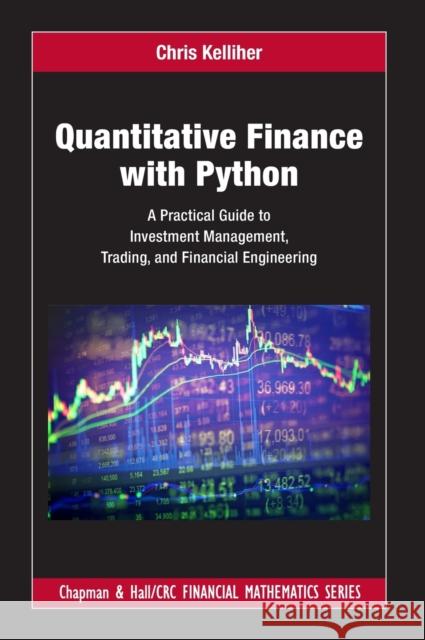
Quantitative Finance with Python: A Practical Guide to Investment Management, Trading, and Financial Engineering
ISBN-13: 9781032014432 / Angielski / Twarda / 2022 / 659 str.
(netto: 487,78 VAT: 5%)
Najniższa cena z 30 dni: 503,69 zł
ok. 22 dni roboczych
Bez gwarancji dostawy przed świętami
Darmowa dostawa!
This book bridges the gap between the theory of mathematical finance and the practical applications of these concepts for derivative pricing and portfolio management. The book provides students with a very hands-on, rigorous introduction to foundational topics in quant finance.
Wydanie ilustrowane
Section I. Foundations of Quant Modeling. 1. Setting the Stage: Quant Landscape. 1.1. Introduction. 1.2. Quant Finance Institutions. 1.3. Most Common Quant Career Paths. 1.4. Types of Financial Instruments. 1.5. Stages of a Quant Project. 1.6. Trends: Where is Quant Finance Going? 2. Theoretical Underpinnings of Quant Modeling: Modeling the Risk Neutral Measure. 2.1. Introduction. 2.2. Risk Neutral Pricing & No Arbitrage. 2.3. Binomial Trees. 2.4. Building Blocks of Stochastic Calculus. 2.5. Stochastic Differential Equations. 2.6. Itô’s Lemma. 2.7. Connection between SDEs and PDES. 2.8. Girsanov’s Theorem. 3. Theoretical Underpinnings of Quant Modeling: Modeling the Physical Measure. 3.1. Introduction: Forecasting vs. Replication. 3.2. Market Efficiency and Risk Premia. 3.3. Linear Regression Models. 3.4. Time Series Models. 3.5. Panel Regression Models. 3.6. Core Portfolio and Investment Concepts. 3.7. Bootstrapping. 3.8. Principal Component Analysis. 3.9. Conclusions: Comparison to Risk Neutral Measure Modelling. 4. Python Programming Environment. 4.1. The Python Programming Language. 4.2. Advantages and Disadvantages of Python. 4.3. Python Development Environments. 4.4. Basic Programming Concepts in Python. 5. Programming Concepts in Python. 5.1. Introduction. 5.2. Numpy Library. 5.3. Pandas Library. 5.4. Data Structures in Python. 5.5. Implementation of Quant Techniques in Python. 5.6. Object-Oriented Programming in Python. 5.7. Design Patterns. 5.8. Search Algorithms. 5.9. Sort Algorithms. 6. Working with Financial Datasets. 6.1. Introduction. 6.2. Data Collection. 6.3. Common Financial Datasets. 6.4. Common Financial Data Sources. 6.5. Cleaning Different Types of Financial Data. 6.6. Handling Missing Data. 6.7. Outlier Detection. 7. Model Validation. 7.1. Why Is Model Validation So Important? 7.2. How Do We Ensure Our Models Are Correct? 7.3. Components of a Model Validation Process. 7.4. Goals of Model Validation. 7.5. Trade-off between Realistic Assumptions and Parsimony in Models. Section II. Options Modeling. 8. Stochastic Models. 8.1. Simple Models. 8.2. Stochastic Volatility Models. 8.3. Jump Diffusion Models. 8.4. Local Volatility Models. 8.5. Stochastic Local Volatility Models. 8.6. Practicalities of using these Models. 9. Options Pricing Techniques for European Options. 9.1. Models with Closed Form Solutions or Asymptotic Approximations. 9.2. Option Pricing via Quadrature. 9.3. Option Pricing via FFT. 9.4. Root Finding. 9.5. Optimization Techniques. 9.6. Calibration of Volatility Surfaces. 10. Options Pricing Techniques for Exotic Options. 10.1. Introduction. 10.2. Simulation. 10.3. Numerical Solutions to PDEs. 10.4. Modeling Exotic Options in Practice. 11. Greeks and Options Trading. 11.1. Introduction. 11.2. Black-Scholes Greeks. 11.3. Theta vs. Gamma. 11.4. Model Dependence of Greeks. 11.5. Greeks for Exotic Options. 11.6. Estimation of Greeks via Finite Differences. 11.7. Smile Adjusted Greeks. 11.8. Hedging in Practice. 11.9. Common Options Trading Structures. 11.10. Volatility as an Asset Class. 11.11. Risk Premia in the Options Market: Implied vs. Realized Volatility. 11.12. Case Study: GameStop Reddit Mania. 12. Extraction of Risk Neutral Densities. 12.1. Motivation. 12.2. Breden—Litzenberger. 12.3. Connection Between Risk Neutral Distributions and Market Instruments. 12.4. Optimization Framework for Non-Parametric Density Extraction. 12.5. Weigthed Monte Carlo. 12.6. Relationship between Volatility skew and Risk Neutral Densities. 12.7. Risk Premia in the Options Market: Comparison OF Risk Neutral vs. Physical Measures. 12.8. Conclusions & Assessment of Parametric vs. Non-Parametric Methods. Section III. Quant Modelling in Different Markets. 13. Interest Rate Markets. 13.1. Market Setting. 13.2. Bond Pricing Concepts. 13.3. Main Components of a Yield Curve. 13.4. Market Rates. 13.5. Yield Curve Construction. 13.6. Modelling Interest Rate Derivatives. 13.7 Modeling Volatility for a Single Rate: Caps / Floors. 13.8. Modeling Volatility for a Single Rate: Swaptions. 13.9. Modelling the Term Structure: Short Rate Models. 13.10. Modelling the Term Structure: Forward Rate Models. 13.11. Exotic Options. 13.12. Investment Perspective: Traded Structures. 13.13. Case Study: Introduction of Negative Rates. 14. Credit Markets. 14.1. Market Setting. 14.2. Modeling Default Risk: Hazard Rate Models. 14.3. Risky Bond. 14.4. Credit Default Swaps. 14.5. CDS vs. Corporate Bonds. 14.6. Bootstrapping a Survival Curve. 14.7. Indices of Credit Default Swaps. 14.8. Market Implied vs. Empirical Default Probabilities. 14.9. Options on CDS & CDX Indices. 14.10. Modeling Correlation: CDOS. 14.11. Models Connecting Equity and Credit. 14.12. Mortgage-backed Securities. 14.13. Investment Perspective: Traded Structures. 15. Foreign Exchange Markets. 15.1. Market Setting. 15.2. Modeling in a Currency Setting. 15.3. Volatility Smiles IN Foreign Exchange Markets. 15.4. Exotic Options in Foreign Exchange Markets. 15.5. Investment Perspective: Traded Structures. 15.6. Case Study: CHF Peg Break in 2015. 16. Equity & Commodity Markets. 16.1. Market Setting. 16.2. Futures Curves in Equity & Commodity Markets. 16.3. Volatility Surfaces in Equity & Commodity Markets. 16.4. Exotic Options in Equity & Commodity Markets. 16.5. Investment Perspective: Traded Structures. 16.6. Case Study: Nat Gas Short Squeeze. 16.7. Case Study: Volatility ETP Apocalypse of 2018. Section IV. Portfolio Construction & Risk Management. 17. Portfolio Construction & Optimization Techniques. 17.1. Theoretical Background. 17.2. Mean-Variance Optimization. 17.3. Challenges Associated with Mean-Variance Optimization. 17.4. Capital Asset Pricing Model. 17.5. Black-Litterman. 17.6. Resampling. 17.7. Downside Risk Based Optimization. 17.8. Risk Parity. 17.9. Comparison OF Methodologies. 18. Modelling Expected Returns and Covariance Matrices. 18.1. Single & Multi-Factor Models for Expected Returns. 18.2. Modelling Volatility. 19. Risk Management. 19.1. Motivation & Setting. 19.2. Common Risk Measures. 19.3. Calculation of Portfolio VAR and CVAR. 19.4. Risk Management of Non-Linear Instruments. 19.5. Risk Management in Rates & Credit Markets. 20. Quantitative Trading Models. 20.1. Introduction to Quant Trading Models. 20.2. Back-Testing. 20.3. Common Stat-Arb Strategies. 20.4. Systematic Options Based Strategies. 20.5. Combining Quant Strategies. 20.6. Principles of Discretionary vs. Systematic Investing. 21. Incorporating Machine Learning Techniques. 21.1. Machine Learning Framework. 21.2. Supervised vs. Unsupervised Learning Methods. 21.3. Clustering. 21.4. Classification Techniques. 21.5. Feature Importance & Interpretability. 21.6. Other Applications OF Machine Learning. Bibliography. Index
Chris Kelliher is a Senior Quantitative Researcher in the Global Asset Allocation group at Fidelity Investments. In addition, Mr. Kelliher is a Lecturer in the Masters in Mathematical Finance and Financial Technology program at Boston University's Questrom School of Business. In this role he teaches multiple graduate level courses including Computational Methods in Finance, Fixed Income & Programming for Quant Finance. Prior to joining Fidelity in 2019, Mr. Kelliher served as a portfolio manager for RDC Capital Partners. Before joining RDC, Mr. Kelliher served as a principal and quantitative portfolio manager at a leading quantitative investment management firm, FDO Partners. Prior to FDO, Mr. Kelliher was a senior quantitative portfolio analyst and trader at Convexity Capital Management and a senior quantitative researcher at Bracebridge Capital. He has been in the financial industry since 2004. Mr. Kelliher earned a BA in Economics from Gordon College, where he graduated Cum Laude with Departmental Honours, and an MS in Mathematical Finance from New York University's Courant Institute.




Czytaj nas na:
1997-2025 DolnySlask.com Agencja Internetowa
KrainaKsiazek.PL - Księgarnia Internetowa


