• Wyszukiwanie zaawansowane
  • Kategorie
  • Kategorie BISAC
  • Książki na zamówienie
  • Promocje
  • Granty
  • Książka na prezent
  • Opinie
  • Pomoc
  • Załóż konto
  • Zaloguj się

Quantitative Equity Investing: Techniques and Strategies » książka


zaloguj się | załóż konto
Logo Krainaksiazek.pl

koszyk

konto

szukaj
topmenu
Księgarnia internetowa
Szukaj
Książki na zamówienie
Promocje
Granty
Książka na prezent
Moje konto
Pomoc
 
 
Wyszukiwanie zaawansowane
Pusty koszyk
Bezpłatna dostawa dla zamówień powyżej 20 złBezpłatna dostawa dla zamówień powyżej 20 zł

Kategorie główne

• Nauka
 [2946912]
• Literatura piękna
 [1852311]

  więcej...
• Turystyka
 [71421]
• Informatyka
 [150889]
• Komiksy
 [35717]
• Encyklopedie
 [23177]
• Dziecięca
 [617324]
• Hobby
 [138808]
• AudioBooki
 [1671]
• Literatura faktu
 [228371]
• Muzyka CD
 [400]
• Słowniki
 [2841]
• Inne
 [445428]
• Kalendarze
 [1545]
• Podręczniki
 [166819]
• Poradniki
 [480180]
• Religia
 [510412]
• Czasopisma
 [525]
• Sport
 [61271]
• Sztuka
 [242929]
• CD, DVD, Video
 [3371]
• Technologie
 [219258]
• Zdrowie
 [100961]
• Książkowe Klimaty
 [124]
• Zabawki
 [2341]
• Puzzle, gry
 [3766]
• Literatura w języku ukraińskim
 [255]
• Art. papiernicze i szkolne
 [7810]
Kategorie szczegółowe BISAC

Quantitative Equity Investing: Techniques and Strategies

ISBN-13: 9780470262474 / Angielski / Twarda / 2010 / 512 str.
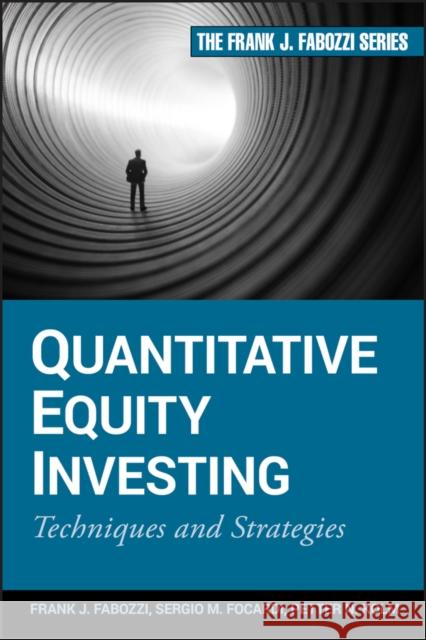
Cfa Frank J. Fabozzi; Sergio M. Focardi; Petter N. Kolm
Quantitative Equity Investing: Techniques and Strategies Focardi, Sergio M. 9780470262474 John Wiley & Sons - książkaWidoczna okładka, to zdjęcie poglądowe, a rzeczywista szata graficzna może różnić się od prezentowanej.

Quantitative Equity Investing: Techniques and Strategies

ISBN-13: 9780470262474 / Angielski / Twarda / 2010 / 512 str.

Cfa Frank J. Fabozzi; Sergio M. Focardi; Petter N. Kolm
cena 362,09
(netto: 344,85 VAT:  5%)

Najniższa cena z 30 dni: 362,09
Termin realizacji zamówienia:
ok. 16-18 dni roboczych
Bez gwarancji dostawy przed świętami

Darmowa dostawa!

A comprehensive look at the tools and techniques used in quantitative equity management Some books attempt to extend portfolio theory, but the real issue today relates to the practical implementation of the theory introduced by Harry Markowitz and others who followed. The purpose of this book is to close the implementation gap by presenting state-of-the art quantitative techniques and strategies for managing equity portfolios. Throughout these pages, Frank Fabozzi, Sergio Focardi, and Petter Kolm address the essential elements of this discipline, including financial model building, financial engineering, static and dynamic factor models, asset allocation, portfolio models, transaction costs, trading strategies, and much more. They also provide ample illustrations and thorough discussions of implementation issues facing those in the investment management business and include the necessary background material in probability, statistics, and econometrics to make the book self-contained.

  • Written by a solid author team who has extensive financial experience in this area
  • Presents state-of-the art quantitative strategies for managing equity portfolios
  • Focuses on the implementation of quantitative equity asset management
  • Outlines effective analysis, optimization methods, and risk models
In today's financial environment, you have to have the skills to analyze, optimize and manage the risk of your quantitative equity investments. This guide offers you the best information available to achieve this goal.

Kategorie:
Nauka, Ekonomia i biznes
Kategorie BISAC:
Business & Economics > Finance - General
Business & Economics > Inwestycje i papiery wartościowe
Wydawca:
John Wiley & Sons
Język:
Angielski
ISBN-13:
9780470262474
Rok wydania:
2010
Numer serii:
000244446
Ilość stron:
512
Waga:
0.74 kg
Wymiary:
23.11 x 15.49 x 4.83
Oprawa:
Twarda
Wolumenów:
01
Dodatkowe informacje:
Bibliografia
Obwoluta

Preface.

About the Authors.

Chapter 1 Introduction.

In Praise of Mathematical Finance.

Studies of the Use of Quantitative Equity Management.

Looking Ahead for Quantitative Equity Investing.

Chapter 2 Financial Econometrics I: Linear Regressions.

Historical Notes.

Covariance and Correlation.

Regressions, Linear Regressions, and Projections.

Multivariate Regression.

Quantile Regressions.

Regression Diagnostic.

Robust Estimation of Regressions.

Classification and Regression Trees.

Summary.

Chapter 3 Financial Econometrics II: Time Series.

Stochastic Processes.

Time Series.

Stable Vector Autoregressive Processes.

Integrated and Cointegrated Variables.

Estimation of Stable Vector Autoregressive (Var) Models.

Estimating the Number of Lags.

Autocorrelation and Distributional Properties of Residuals.

Stationary Autoregressive Distributed Lag Models.

Estimation of Nonstationary VAR models.

Estimation with Canonical Correlations.

Estimation with Principal Component Analysis.

Estimation with the Eigenvalues of the Companion Matrix.

Nonlinear Models in Finance.

Causality.

Summary.

Chapter 4 Common Pitfalls in Financial Modeling.

Theory and Engineering.

Engineering and Theoretical Science.

Engineering and Product Design in Finance.

Learning, Theoretical, and Hybrid Approaches to Portfolio Management.

Sample Biases.

The Bias in Averages.

Pitfalls in Choosing from Large Data Sets.

Time Aggregation of Models and Pitfalls in the Selection of Data Frequency.

Model Risk and its Mitigation.

Summary.

Chapter 5 Factor Models and Their Estimation.

The Notion of Factors.

Static Factor Models.

Factor Analysis and Principal Components Analysis.

Why Factor Models of Returns.

Approximate Factor Models of Returns.

Dynamic Factor Models.

Summary.

Chapter 6 Factor–Based Trading Strategies I: Factor Construction and Analysis.

Factor–Based Trading.

Developing Factor–Based Trading Strategies.

Risk to Trading Strategies.

Desirable Properties of Factors.

Sources for Factors.

Building Factors from Company Characteristics.

Working with Data.

Analysis of Factor Data.

Summary.

Chapter 7 Factor–Based Trading Strategies II: Cross–Sectional Models and Trading Strategies.

Cross–Sectional Methods for Evaluation of Factor Premiums.

Factor Models.

Performance Evaluation of Factors.

Model Construction Methodologies for a Factor–Based Trading Strategy.

Backtesting.

Backtesting Our Factor Trading Strategy.

Summary.

Chapter 8 Portfolio Optimization: Basic Theory and Practice.

Mean–Variance Analysis: Overview.

Classical Framework for Mean–Variance Optimization.

Mean–variance Optimization with a Risk–Free Asset.

Portfolio Constraints Commonly Used in Practice.

Estimating the Inputs Used in Mean–Variance Optimization: Expected Return and Risk.

Portfolio Optimization with Other Risk Measures.

Summary.

Chapter 9 Portfolio Optimization: Bayesian Techniques and the Black–Litterman Model.

Practical Problems Encountered in Mean–Variance Optimization.

Shrinkage Estimation.

The Black–Litterman Model.

Summary.

Chapter 10 Robust Portfolio Optimization.

Robust Mean–Variance Formulations.

Using Robust Mean–Variance Portfolio Optimization in Practice.

Some Practical Remarks on Robust Portfolio Optimization Models.

Summary.

Chapter 11 Transaction Costs and Trade Execution.

A Taxonomy of Transaction Costs.

Liquidity and Transaction Costs.

Market Impact Measurements and Empirical Findings.

Forecasting and Modeling Market Impact.

Incorporating Transaction Costs in Asset–Allocation Models.

Integrated Portfolio Management: Beyond Expected Return and Portfolio Risk.

Summary.

Chapter 12 Investment Management and Algorithmic Trading.

Market Impact and the Order Book.

Optimal Execution.

Impact Models.

Popular Algorithmic Trading Strategies.

What Is Next?

Some Comments about the High–Frequency Arms Race.

Summary.

Appendix A Data Descriptions and Factor Definitions.

The MSCI World Index.

One–Month LIBOR.

The Compustat Point–in–Time, IBES Consensus Databases and Factor Definitions.

Appendix B Summary of Well–Known Factors and Their Underlying Economic Rationale.

Appendix C Review of Eigenvalues and Eigenvectors.

The SWEEP Operator.

Index.

Frank J. Fabozzi is Professor in the Practice of Finance and Becton Fellow at the Yale School of Management and Editor of the Journal of Portfolio Management. He is a Chartered Financial Analyst and earned a doctorate in economics from the City University of New York.

Sergio M. Focardi is Professor of Finance at EDHEC Business School in Nice and a founding partner of the Paris–based consulting firm The Intertek Group. He is also a member of the Editorial Board of the Journal of Portfolio Management. Sergio holds a degree in electronic engineering from the University of Genoa and a PhD in mathematical finance from the University of Karlsruhe as well as a postgraduate degree in communications from the Galileo Ferraris Electrotechnical Institute (Turin).

Petter N. Kolm is the Deputy Director of the Mathematics in Finance Master′s Program and Clinical Associate Professor of Mathematics at the Courant Institute of Mathematical Sciences, New York University; and a founding Partner of the New York based financial consulting firm the Heimdall Group, LLC. Previously, Petter worked in the Quantitative Strategies Group at Goldman Sachs Asset Management. He received an MS in mathematics from ETH in Zurich; an MPhil in applied mathematics from the Royal Institute of Technology in Stockholm; and a PhD in applied mathematics from Yale University.

Quantitative Equity Investing
Techniques and strategies for successfulquantitative equity management

Quantitative equity portfolio management is a fundamental building block of investment management. This hands–on guide closes the gap between theory and practice by presenting state–of–the–art quantitative techniques and strategies for managing equity portfolios.

Authors Frank Fabozzi, Sergio Focardi, and Petter Kolm all of whom have extensive experience in this area address the essential elements of this discipline, including financial model building, financial engineering, static and dynamic factor models, asset allocation, portfolio models, transaction costs, trading strategies, and much more. They provide numerous illustrations and thorough discussions of implementation issues facing those in the investment management business and include the necessary background material in financial econometrics to make the book self–contained. For many of the advanced topics, they also provide the reader with references to the most recent applicable research in this rapidly evolving field.

In today′s financial environment, you need the skills to analyze, optimize, and manage the risk of your quantitative equity portfolio. This guide offers you the best information available to achieve this goal.


Udostępnij

Facebook - konto krainaksiazek.pl


Opinie o Krainaksiazek.pl na Opineo.pl

Partner Mybenefit

Krainaksiazek.pl w programie rzetelna firma Krainaksiaze.pl - płatności przez paypal

Czytaj nas na:

Facebook - krainaksiazek.pl
  • książki na zamówienie
  • granty
  • książka na prezent
  • kontakt
  • pomoc
  • opinie
  • regulamin
  • polityka prywatności

Zobacz:

  • Księgarnia czeska

  • Wydawnictwo Książkowe Klimaty

1997-2025 DolnySlask.com Agencja Internetowa

© 1997-2022 krainaksiazek.pl
     
KONTAKT | REGULAMIN | POLITYKA PRYWATNOŚCI | USTAWIENIA PRYWATNOŚCI
Zobacz: Księgarnia Czeska | Wydawnictwo Książkowe Klimaty | Mapa strony | Lista autorów
KrainaKsiazek.PL - Księgarnia Internetowa

Polityka prywatnosci - link
Krainaksiazek.pl - płatnośc Przelewy24
Przechowalnia Przechowalnia






