• Wyszukiwanie zaawansowane
  • Kategorie
  • Kategorie BISAC
  • Książki na zamówienie
  • Promocje
  • Granty
  • Książka na prezent
  • Opinie
  • Pomoc
  • Załóż konto
  • Zaloguj się

Quantifying Functional Biodiversity » książka


zaloguj się | załóż konto
Logo Krainaksiazek.pl

koszyk

konto

szukaj
topmenu
Księgarnia internetowa
Szukaj
Książki na zamówienie
Promocje
Granty
Książka na prezent
Moje konto
Pomoc
 
 
Wyszukiwanie zaawansowane
Pusty koszyk
Bezpłatna dostawa dla zamówień powyżej 20 złBezpłatna dostawa dla zamówień powyżej 20 zł

Kategorie główne

• Nauka
 [2949965]
• Literatura piękna
 [1857847]

  więcej...
• Turystyka
 [70818]
• Informatyka
 [151303]
• Komiksy
 [35733]
• Encyklopedie
 [23180]
• Dziecięca
 [617748]
• Hobby
 [139972]
• AudioBooki
 [1650]
• Literatura faktu
 [228361]
• Muzyka CD
 [398]
• Słowniki
 [2862]
• Inne
 [444732]
• Kalendarze
 [1620]
• Podręczniki
 [167233]
• Poradniki
 [482388]
• Religia
 [509867]
• Czasopisma
 [533]
• Sport
 [61361]
• Sztuka
 [243125]
• CD, DVD, Video
 [3451]
• Technologie
 [219309]
• Zdrowie
 [101347]
• Książkowe Klimaty
 [123]
• Zabawki
 [2362]
• Puzzle, gry
 [3791]
• Literatura w języku ukraińskim
 [253]
• Art. papiernicze i szkolne
 [7933]
Kategorie szczegółowe BISAC

Quantifying Functional Biodiversity

ISBN-13: 9789400726475 / Angielski / Miękka / 2011 / 98 str.
Laura Pla;Fernando Casanoves;Julio Di Rienzo
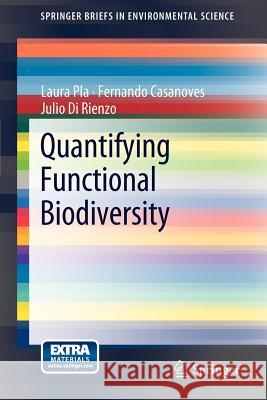
Quantifying Functional Biodiversity Laura Pla, Fernando Casanoves, Julio Di Rienzo 9789400726475 Springer - książkaWidoczna okładka, to zdjęcie poglądowe, a rzeczywista szata graficzna może różnić się od prezentowanej.

Quantifying Functional Biodiversity

ISBN-13: 9789400726475 / Angielski / Miękka / 2011 / 98 str.

Laura Pla;Fernando Casanoves;Julio Di Rienzo
cena 201,56 zł
(netto: 191,96 VAT:  5%)

Najniższa cena z 30 dni: 192,59 zł
Termin realizacji zamówienia:
ok. 22 dni roboczych
Bez gwarancji dostawy przed świętami

Darmowa dostawa!

This book synthesizes current methods used to quantify functional diversity, providing step-by-step examples for defining functional groups and estimating functional indices. The authors show how to compare communities, and how to analyze changes of diversity along environmental gradients, using real-life examples throughout. One section of the book demonstrates the selection of traits, and the standardization and characterization of ecosystem data. Another section presents methods used to quantify functional diversity, shows how to relate functional diversity with environmental variables and how to connect these to ecosystem services. The concluding section introduces FDiversity, a free program developed by the authors. The reader is guided through every step from software installation and basic functions, to sample and database design, to graphical projection methods, employing case study data to illustrate key concepts.


Functional diversity (FD) the value, range, and abundance of functional traits in a given community or ecosystem is increasingly accepted as a synthetic ecological concept that sheds light on ecosystem functioning. Standard tools for comparing FD across different ecosystems and for different ecosystem processes would be invaluable for supporting a better, more general understanding of the functional role of biodiversity in the provision of ecosystem services. Functional group richness and functional biodiversity indices have been proposed as standards for quantifying the functional diversity of communities and their components.§This book synthesizes current methods used to quantify functional diversity, providing step-by-step examples for defining functional groups and estimating functional indices. The authors show how to compare communities, and how to analyze changes of diversity along environmental gradients, using real-life examples throughout. One section of the book demonstrates the selection of traits, and the standardization and characterization of ecosystem data. Another section presents methods used to quantify functional diversity, shows how to relate functional diversity with environmental variables and how to connect these to ecosystem services. The concluding section introduces FDiversity, a free program developed by the authors. The reader is guided through every step from software installation and basic functions, to sample and database design, to graphical projection methods, employing case study data to illustrate key concepts.

Kategorie:
Nauka, Biologia i przyroda
Kategorie BISAC:
Science > Life Sciences - Ecology
Science > Life Sciences - General
Science > Environmental Science (see also Chemistry - Environmental)
Wydawca:
Springer
Seria wydawnicza:
SpringerBriefs in Environmental Science
Język:
Angielski
ISBN-13:
9789400726475
Rok wydania:
2011
Dostępne języki:
Angielski
Wydanie:
2012
Numer serii:
000416842
Ilość stron:
98
Waga:
0.45 kg
Wymiary:
23.523.5 x 15.5
Oprawa:
Miękka
Wolumenów:
01
Dodatkowe informacje:
Bibliografia
Wydanie ilustrowane

1. Introduction

1.1 Functional Diversity Approach To Quantify the Biodiversity

1.2 Functional Diversity Assessment

1.3 Classification of Ecosystem Services

1.4 Selection of Traits According to Ecosystem Service

1.5. Functional Diversity Quantification


2. Functional Groups

2.1 Selecting Trait and Its Relation With Ecosystem Services

2.2 A Guide For Data Arrangement

2.3 Statistical Procedures To Define Functional Groups

2.3.1 The Selection of a Dissimilarity Measure

2.3.2 Standardization

2.3.3 Choosing the Linkage Algorithm Method

2.3.4 Assessing the Number of Functional Groups

2.4 Functional Characterization of Coastal Sandy Plain Vegetation in Southeast Brazil

2.4.1 The Data Set

2.4.2 Plant Functional Types From a Restinga Vegetation

2.5 Functional Groups For Bird Species in Nicaragua

2.5.1 The Data Set

2.5.2 Bird Functional Types From Nicaragua

2.5.3 Characterization of Bird Functional Types of Nicaragua

2.5.4 Relationship of Functional Types With Land Uses


3. Functional Diversity Indices

3.1 About Functional Diversity Indices and Measures

3.2 Species Diversity Indices

3.3 Single-trait Metrics and Indices: Properties and Estimation

3.3.1 Community Weighted Mean

3.3.2 Functional Divergence

3.3.3 Functional Regularity

3.4 Multi-trait Indices: Properties and Estimation

3.4.1 Functional Attribute Diversity

3.4.2 Functional Diversity Based on Dendrograms

3.4.3 Convex Hull Hyper-volume

3.4.4. Quadratic Entropy

3.4.5 Extended FD

3.4.6 Functional Richness, Evenness, Divergence and Dispersion

3.5 Ability of Indices to Detect Some Ecological Processes


4. How To Estimate Functional Diversity Indices

4.1 The FDiversity Software: Capabilities and Data Management

4.1.1 How To Install FDiversity

4.1.2 Data Menu

4.1.3 Statistics and Output Menus

4.2 Case study: Changes in Functional Diversity in an Altitudinal Gradient

4.2.1 Sample Design and Trait Evaluation

4.2.2 The Database

4.2.3 Changes of Plant Functional Types With the Altitude

4.2.4 Changes of Functional Diversity Indices With the Altitude

4.3 Case study: Changes in Functional Diversity in a Chronosequence

4.3.1 Sample Design and Trait Evaluation

4.3.2 The Database

4.3.3 Changes of Plant Functional Types in the Chronosequence

4.4 Multivariate Graphical Projection Methods

 Index

Index

Functional diversity (FD) – the value, range, and abundance of functional traits in a given community or ecosystem – is increasingly accepted as a synthetic ecological concept that sheds light on ecosystem functioning. Standard tools for comparing FD across different ecosystems and for different ecosystem processes would be invaluable for supporting a better, more general understanding of the functional role of biodiversity in the provision of ecosystem services. Functional group richness and functional biodiversity indices have been proposed as standards for quantifying the functional diversity of communities and their components.


This book synthesizes current methods used to quantify functional diversity, providing step-by-step examples for defining functional groups and estimating functional indices. The authors show how to compare communities, and how to analyze changes of diversity along environmental gradients, using real-life examples throughout. One section of the book demonstrates the selection of traits, and the standardization and characterization of ecosystem data. Another section presents methods used to quantify functional diversity, shows how to relate functional diversity with environmental variables and how to connect these to ecosystem services. The concluding section introduces FDiversity, a free program developed by the authors. The reader is guided through every step from software installation and basic functions, to sample and database design, to graphical projection methods, employing case study data to illustrate key concepts.




Udostępnij

Facebook - konto krainaksiazek.pl


Opinie o Krainaksiazek.pl na Opineo.pl

Partner Mybenefit

Krainaksiazek.pl w programie rzetelna firma Krainaksiaze.pl - płatności przez paypal

Czytaj nas na:

Facebook - krainaksiazek.pl
  • książki na zamówienie
  • granty
  • książka na prezent
  • kontakt
  • pomoc
  • opinie
  • regulamin
  • polityka prywatności

Zobacz:

  • Księgarnia czeska

  • Wydawnictwo Książkowe Klimaty

1997-2025 DolnySlask.com Agencja Internetowa

© 1997-2022 krainaksiazek.pl
     
KONTAKT | REGULAMIN | POLITYKA PRYWATNOŚCI | USTAWIENIA PRYWATNOŚCI
Zobacz: Księgarnia Czeska | Wydawnictwo Książkowe Klimaty | Mapa strony | Lista autorów
KrainaKsiazek.PL - Księgarnia Internetowa

Polityka prywatnosci - link
Krainaksiazek.pl - płatnośc Przelewy24
Przechowalnia Przechowalnia




