• Wyszukiwanie zaawansowane
  • Kategorie
  • Kategorie BISAC
  • Książki na zamówienie
  • Promocje
  • Granty
  • Książka na prezent
  • Opinie
  • Pomoc
  • Załóż konto
  • Zaloguj się

Quantified Eco-Efficiency: An Introduction with Applications » książka


zaloguj się | załóż konto
Logo Krainaksiazek.pl

koszyk

konto

szukaj
topmenu
Księgarnia internetowa
Szukaj
Książki na zamówienie
Promocje
Granty
Książka na prezent
Moje konto
Pomoc
 
 
Wyszukiwanie zaawansowane
Pusty koszyk
Bezpłatna dostawa dla zamówień powyżej 20 złBezpłatna dostawa dla zamówień powyżej 20 zł

Kategorie główne

• Nauka
 [2949965]
• Literatura piękna
 [1857847]

  więcej...
• Turystyka
 [70818]
• Informatyka
 [151303]
• Komiksy
 [35733]
• Encyklopedie
 [23180]
• Dziecięca
 [617748]
• Hobby
 [139972]
• AudioBooki
 [1650]
• Literatura faktu
 [228361]
• Muzyka CD
 [398]
• Słowniki
 [2862]
• Inne
 [444732]
• Kalendarze
 [1620]
• Podręczniki
 [167233]
• Poradniki
 [482388]
• Religia
 [509867]
• Czasopisma
 [533]
• Sport
 [61361]
• Sztuka
 [243125]
• CD, DVD, Video
 [3451]
• Technologie
 [219309]
• Zdrowie
 [101347]
• Książkowe Klimaty
 [123]
• Zabawki
 [2362]
• Puzzle, gry
 [3791]
• Literatura w języku ukraińskim
 [253]
• Art. papiernicze i szkolne
 [7933]
Kategorie szczegółowe BISAC

Quantified Eco-Efficiency: An Introduction with Applications

ISBN-13: 9781402053986 / Angielski / Twarda / 2007 / 332 str.
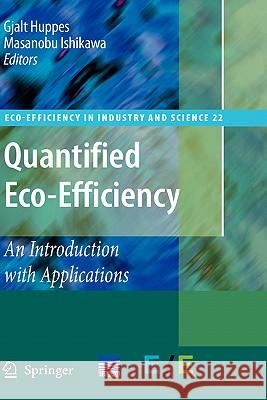
Gjalt Huppes; Masanobu Ishikawa
Quantified Eco-Efficiency: An Introduction with Applications Huppes, Gjalt 9781402053986 Springer - książkaWidoczna okładka, to zdjęcie poglądowe, a rzeczywista szata graficzna może różnić się od prezentowanej.

Quantified Eco-Efficiency: An Introduction with Applications

ISBN-13: 9781402053986 / Angielski / Twarda / 2007 / 332 str.

Gjalt Huppes; Masanobu Ishikawa
cena 887,69 zł
(netto: 845,42 VAT:  5%)

Najniższa cena z 30 dni: 848,19 zł
Termin realizacji zamówienia:
ok. 22 dni roboczych
Bez gwarancji dostawy przed świętami

Darmowa dostawa!

Eco-efficiency has long been a concept: the intention of reducing environmental impact while increasing environmental value. Its origins are with the World Business Council for Sustainable Development. However, in a globalized world with sustained economic growth environmental degradation is threatening. Macro level requirements on sustainability should be reflected in the eco-efficiency of choices at a micro level, like on technologies, supply chains and product systems. Eco-efficiency analysis has come to fruition as a fully quantified method for analysis, linking to specific domains of economic modelling, specific environmental models, and several methods for integrating these two domains into eco-efficiency scores. This eco-efficiency analysis can guide choices in policy, business, and consumptions activities, all from a single common background. A central asset of eco-efficiency analysis is that it does not depend on a specific evaluation of environmental impacts against economic effects, avoiding the often disputed results of neo-classical evaluation methods. For integrating the different environmental scores several evaluation methods may be used including those based on willingness-to-pay, panel procedures, and public statements on policy goals. Each may have advantages, but in line with the normative neutrality strived for in eco-efficiency, these preference and value choices may be avoided to some extent. This can be done either by taking a common denominator or by having less demanding objectives, for instance focusing on efficiency of measures only. A substantial Japanese paper on Maximum Abatement Cost method and a paper on revealed public preferences in The Netherlands comprise the first section on methods. Next, there are four sections on domains of application of eco-efficiency analysis. In the Agriculture section, a case on conservation agriculture in China is worked out, using input-output analysis. In the Industry section, cases range from supply chain management to waste water management and methods to speed up innovation. In the Products & Consumption section, cases refer to overall household performance, specific energy products and methods for upgradeable product design. Finally, in the Recycling section, cases relate to increasing the supply of secondary materials and to increasing secondary materials use.


Kategorie:
Nauka
Kategorie BISAC:
Science > Environmental Science (see also Chemistry - Environmental)
Business & Economics > Biznes i środowisko
Technology & Engineering > Environmental - General
Wydawca:
Springer
Seria wydawnicza:
Eco-Efficiency in Industry and Science
Język:
Angielski
ISBN-13:
9781402053986
Rok wydania:
2007
Wydanie:
2007
Numer serii:
000135514
Ilość stron:
332
Waga:
1.45 kg
Wymiary:
23.5 x 15.5
Oprawa:
Twarda
Wolumenów:
01
Dodatkowe informacje:
Bibliografia
Wydanie ilustrowane

Preface. List of corresponding authors. 1. An introduction to quantified eco-efficiency analysis; Gjalt Huppes and Masanobu Ishikawa. GENERAL METHODS. 2. Maximum abatement costs for calculating cost-effectiveness of green activities with multiple environmental effects; Tosihiro Oka, Yoshifumi Fujii, Masanobu Ishikawa, Yu Matsuno and Shu Susami. 3. From thermodynamic efficiency to eco-efficiency; Reinout Heijungs. 4. The price of toxicity. Methodology for the assessment of shadow prices for human toxicity, ecotoxicity and abiotic depletion; Toon van Harmelen, René Korenromp, Ceiloi van Deutekom, Tom Ligthart, Saskia van Leeuwen and René van Gijlswijk. CASES IN AGRICULTURE. 5. Conservation reconsidered: A modified input–output analysis of the economic impact of China’s land conversion policy; Fan Zhang. CASES IN INDUSTRY. 6. Eco-efficiency in redesigned extended supply chains: furniture as an example; Ottar Michelsen. 7. Practical experiences with reducing industrial use of water and chemicals in the galvanising industry; Johannes Fresner, Josef Mair, Hans Schnitzer, Christoph Brunner, Gernot Gwehenberger and Mikko Planasch. 8. Cost-efficient solutions can speed up ecological (and social) development – A proposal; Ernst-Josef Spindler. CASES IN PRODUCTION AND CONSUMPTION. 9. Environmental performance of households; Mette Wier, Line Block Christoffersen, Jesper Munksgaard, Trine S. Jensen, Ole G. Pedersen and Hans Keiding. 10. Eco-efficiency analysis of an electrochromic smart window prototype; Spiros Papaefthimiou, Elleni Syrrakou and Panayiotis Yianoulis. 11. Upgrade planning for upgradeable product design; Kentaro Watanabe, Yoshiki Shimomura and AkiraMatsuda. CASES IN RECYLING. 12. A strategic policy model for promoting secondary materials use; Nur Indrianti, Shinobu Matsuoka and Masaaki Muraki. 13. Eco-efficiency analysis of the plastic recovery systems in Hyogo eco-town project; Helmut Yabar and Tohru Morioka. Index.

Gjalt Huppes is head of the Industrial Ecology Department and associate professor of environmental system sciences at the Institute of Environmental Sciences (CML) at Leiden University in Leiden, the Netherlands.

Masanobu Ishikawa is a professor at the Graduate School of Economics at Kobe University in Kobe, Japan.

Eco-efficiency has long been a concept: the intention of reducing environmental impact while increasing environmental value. Its origins are with the World Business Council for Sustainable Development. However, in a globalized world with sustained economic growth environmental degradation is threatening. Macro level requirements on sustainability should be reflected in the eco-efficiency of choices at a micro level, like on technologies, supply chains and product systems. Eco-efficiency analysis has come to fruition as a fully quantified method for analysis, linking to specific domains of economic modelling, specific environmental models, and several methods for integrating these two domains into eco-efficiency scores. This eco-efficiency analysis can guide choices in policy, business, and consumptions activities, all from a single common background.

A central asset of eco-efficiency analysis is that it does not depend on a specific evaluation of environmental impacts against economic effects, avoiding the often disputed results of neo-classical evaluation methods. For integrating the different environmental scores several evaluation methods may be used including those based on willingness-to-pay, panel procedures, and public statements on policy goals. Each may have advantages, but in line with the normative neutrality strived for in eco-efficiency, these preference and value choices may be avoided to some extent.  This can be done either by taking a common denominator or by having less demanding objectives, for instance focusing on efficiency of measures only.

A substantial Japanese paper on Maximum Abatement Cost method and a paper on revealed public preferences in the Netherlands comprise the first section on methods. Next, there are four sections on domains of application of eco-efficiency analysis. In the Agriculture section, a case on conservation agriculture in China is worked out, using input-output analysis. In the Industry section,  cases range from supply chain management to waste water management and methods to speed up innovation. In the Products & Consumption section, cases refer to overall household performance, specific energy products and methods for upgradeable product design. Finally, in the Recycling section, cases relate to increasing the supply of secondary materials and to increasing secondary materials use.

Huppes, Gjalt Gjalt Huppes is head of the Industrial Ecology Dep... więcej >


Udostępnij

Facebook - konto krainaksiazek.pl


Opinie o Krainaksiazek.pl na Opineo.pl

Partner Mybenefit

Krainaksiazek.pl w programie rzetelna firma Krainaksiaze.pl - płatności przez paypal

Czytaj nas na:

Facebook - krainaksiazek.pl
  • książki na zamówienie
  • granty
  • książka na prezent
  • kontakt
  • pomoc
  • opinie
  • regulamin
  • polityka prywatności

Zobacz:

  • Księgarnia czeska

  • Wydawnictwo Książkowe Klimaty

1997-2025 DolnySlask.com Agencja Internetowa

© 1997-2022 krainaksiazek.pl
     
KONTAKT | REGULAMIN | POLITYKA PRYWATNOŚCI | USTAWIENIA PRYWATNOŚCI
Zobacz: Księgarnia Czeska | Wydawnictwo Książkowe Klimaty | Mapa strony | Lista autorów
KrainaKsiazek.PL - Księgarnia Internetowa

Polityka prywatnosci - link
Krainaksiazek.pl - płatnośc Przelewy24
Przechowalnia Przechowalnia




