• Wyszukiwanie zaawansowane
  • Kategorie
  • Kategorie BISAC
  • Książki na zamówienie
  • Promocje
  • Granty
  • Książka na prezent
  • Opinie
  • Pomoc
  • Załóż konto
  • Zaloguj się

Quality by Design for Biopharmaceutical Drug Product Development » książka


zaloguj się | załóż konto
Logo Krainaksiazek.pl

koszyk

konto

szukaj
topmenu
Księgarnia internetowa
Szukaj
Książki na zamówienie
Promocje
Granty
Książka na prezent
Moje konto
Pomoc
 
 
Wyszukiwanie zaawansowane
Pusty koszyk
Bezpłatna dostawa dla zamówień powyżej 20 złBezpłatna dostawa dla zamówień powyżej 20 zł

Kategorie główne

• Nauka
 [2949965]
• Literatura piękna
 [1857847]

  więcej...
• Turystyka
 [70818]
• Informatyka
 [151303]
• Komiksy
 [35733]
• Encyklopedie
 [23180]
• Dziecięca
 [617748]
• Hobby
 [139972]
• AudioBooki
 [1650]
• Literatura faktu
 [228361]
• Muzyka CD
 [398]
• Słowniki
 [2862]
• Inne
 [444732]
• Kalendarze
 [1620]
• Podręczniki
 [167233]
• Poradniki
 [482388]
• Religia
 [509867]
• Czasopisma
 [533]
• Sport
 [61361]
• Sztuka
 [243125]
• CD, DVD, Video
 [3451]
• Technologie
 [219309]
• Zdrowie
 [101347]
• Książkowe Klimaty
 [123]
• Zabawki
 [2362]
• Puzzle, gry
 [3791]
• Literatura w języku ukraińskim
 [253]
• Art. papiernicze i szkolne
 [7933]
Kategorie szczegółowe BISAC

Quality by Design for Biopharmaceutical Drug Product Development

ISBN-13: 9781493923151 / Angielski / Twarda / 2015 / 710 str.
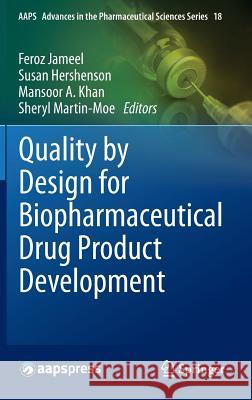
Feroz Jameel; Susan Hershenson; Mansoor A. Khan
Quality by Design for Biopharmaceutical Drug Product Development Feroz Jameel Susan Hershenson Mansoor A. Khan 9781493923151 Springer - książkaWidoczna okładka, to zdjęcie poglądowe, a rzeczywista szata graficzna może różnić się od prezentowanej.

Quality by Design for Biopharmaceutical Drug Product Development

ISBN-13: 9781493923151 / Angielski / Twarda / 2015 / 710 str.

Feroz Jameel; Susan Hershenson; Mansoor A. Khan
cena 887,69
(netto: 845,42 VAT:  5%)

Najniższa cena z 30 dni: 848,19
Termin realizacji zamówienia:
ok. 22 dni roboczych
Bez gwarancji dostawy przed świętami

Darmowa dostawa!

This volume explores the application of Quality by Design (QbD) to biopharmaceutical drug product development. Twenty-eight comprehensive chapters cover dosage forms, liquid and lyophilized drug products. The introductory chapters of this book define key elements of QbD and examine how these elements are integrated into drug product development. These chapters also discuss lessons learned from the FDA Office of Biotechnology Products pilot program. Following chapters demonstrate how QbD is used for formulation development ranging from screening of formulations to developability assessment to development of lyophilized and liquid formats. The next few chapters study the use of small-scale and surrogate models as well as QbD application to drug product processes such as drug substance freezing and thawing, mixing, sterile filtration, filling, lyophilization, inspection and shipping and handling. Later chapters describe more specialized applications of QbD in the drug product realm. This includes the use of QbD in primary containers, devices and combination product development. The volume also explores QbD applied to vaccine development, automation, mathematical modeling and monitoring, and controlling processes and defining control strategies. It concludes with a discussion on the application of QbD to drug product technology transfer as well as overall regulatory considerations and lifecycle management. Quality by Design for Biopharmaceutical Drug Product Development is an authoritative resource for scientists and researchers interested in expanding their knowledge on QbD principles and uses in creating better drugs.


Kategorie:
Nauka, Medycyna
Kategorie BISAC:
Medical > Farmakologia
Medical > Research
Wydawca:
Springer
Seria wydawnicza:
Aaps Advances in the Pharmaceutical Sciences
Język:
Angielski
ISBN-13:
9781493923151
Rok wydania:
2015
Wydanie:
2015
Numer serii:
000410912
Ilość stron:
710
Waga:
1.18 kg
Wymiary:
23.39 x 15.6 x 3.96
Oprawa:
Twarda
Wolumenów:
01
Dodatkowe informacje:
Bibliografia
Wydanie ilustrowane

.- 1 Challenges and Opportunities for Biotech Quality by Design

.- 2 Lessons Learned From Monoclonal Antibody Applications to the Office of Biotechnology Products Quality by Design Pilot Program

.- 3 Definitions and Scope of Key Elements of QbD

.- 4 An Overview of Quality by Design for Drug Product

.- 5 Development of Drug Product Formulations: Molecular Design and Early Candidates Screening

.- 6 Approaches for Early Developability Assessment of Proteins to Guide Quality by Design of Liquid Formulations

.- 7 Application of QbD Principles to Late-stage Formulation Development for Biological Liquid Products

.- 8 Application of QbD Principles for Lyophilized Formulation Development

.- 9 Drug Substance Frozen Storage and Thawing

.- 10 Quality by Design as Applied to Drug Substance Formulation using Ultrafiltration and Diafiltration

.- 11 A QbD Approach in the Development and Scale-up of Mixing Processes

.- 12 Application of QbD Elements in the Development and Scale-up of a Commercial Filtration Process

.- 13 Application of QbD Elements in the Development and Scale-up of Commercial Filling Process

.- 14 Lyophilization Process Design and Development Using QbD Principles

.- 15 Visible and Subvisible Protein Particle Inspection Within a QbD-based Strategy

.- 16 Quality by Design for Distribution of Environmentally Sensitive Pharmaceutical Products

.- 17 Quality by Design for Primary Container Components

.- 18 Devices and Combination Products for Biopharmaceuticals

.- 19 Applicability of QbD for Vaccine Drug Product Development

.- 20 Automation and High Throughput Technologies in Biopharmaceutical Drug Product Development with QbD Approaches

.- 21 Critical Quality Attributes, Specifications, and Control Strategy

.- 22 Multivariate Analysis for Process Understanding, Monitoring, Control and Optimization in Lyophilization Processes

.- 23 Using Mathematical Modeling and Prior Knowledge for QbD in Freeze-drying Processes

.- 24 Application of Multivariate Statistical Process Monitoring to Lyophilization Process

.- 25 Application of PAT in Real-time Monitoring and Controlling of Lyophilization Process

.- 26 Product Homogeneity Assessment during Validation of Biopharmaceutical Drug Product Manufacturing Processes

.- 27 Application of Quality by Design Principles to the Drug Product Technology Transfer Process

.- 28 Regulatory Considerations For Implementation of the QbD Paradigm for Biologics: Laying the Foundation for Product and Process Lifecycle Management.

Dr. Feroz Jameel is a Principal Scientist for Parenteral Product & Process Development at Amgen Inc., in Thousand Oaks, CA, where he is involved in the development, optimization, scale-up and transfer to manufacturing of biopharmaceutical products. Feroz received his Master’s degree in Pharmaceutics from the University of Delhi and his Ph.D in Pharmaceutics from the University of Connecticut. His publications include a co-edited book, several book chapters and more than 40 peer-reviewed manuscripts and presentations.  He has held multiple leadership positions at the American Association of Pharmaceutical Scientists (AAPS) including chair of the freezing and drying technologies group and lead of the industrial consortium for application of QbD to lyophilization. He is a recipient of two patents in lyophilization formulation and lyophiliztion process development.  Dr. Jameel has received several awards including the AAPS and Parental Drug Association’s Fred Simon Award for the best paper published in the Journal of Pharmaceutical Science and Technology. He has also chaired several symposia on the development of biological products.

Dr. Susan A. Hershenson is the Deputy Director of Chemistry, Manufacturing and Controls at the Bill and Melinda Gates Foundation, where her major responsibilities are to support the CMC development and drug delivery needs for therapeutic projects funded by the Foundation.  She has many years of experience in drug development, including biologics, small molecules, combination products and drug delivery systems. Prior to the Gates Foundation, she served as President of Pharmaceutical Transformations LLC, a consulting service for the pharmaceutical, biotechnology, drug delivery and related industries.  Her clients included a wide range of biotechnology, pharmaceutical and drug delivery companies, start-ups, venture capitals, university labs and non-profit organizations.  Before starting her own practice, she served in a number of positions in the biopharmaceutical industry, including Vice President of Pharmaceutical and Device Development at Genentech and Vice President of Pharmaceutics at Amgen. During her career, Dr. Hershenson has made significant contributions to the development and commercialization of numerous therapeutic products including BETASERON®, Stemgen®, Kepivance®, Aranesp®, Neulasta®, Sensipar®, Nplate®, Vectibix®, Prolia®, XGEVA® and Nutropin AQ NuSpin® and has supported the development of numerous clinical candidates. She received her Ph.D. in Biochemistry from Yale University and held a postdoctoral fellowship in the laboratory of Dr. Robert Stroud at the University of California, San Francisco.  Dr. Hershenson publishes and teaches actively and serves on multiple scientific advisory boards.

Dr. Mansoor A. Khan is the Director of Product Quality Research and a Senior Biomedical Research Scientist at the Center for Drug Evaluation and Research at the Food and Drug Administration (FDA), where he overseas research teams on biotech products, chemistry and stability, drug delivery systems and bioavailability/bioequivalence. Prior to joining the FDA, he was a Professor of Pharmaceutics and Director of the graduate program in the School of Pharmacy at Texas Tech University Health Sciences Center. He is a registered pharmacist and earned his Ph.D. in Industrial Pharmacy from the St. John's University School of Pharmacy. He has published more than 255 peer-reviewed manuscripts, four texts, 25 book chapters, 200 poster presentations, and more than 175 invited presentations worldwide. He has held several leadership positions at the American Association of Pharmaceutical Scientists (AAPS) including elected chair of pharmaceutics and drug delivery (PDD) and the founding chair of formulations design and development (FDD).  He serves on the editorial board of Pharmaceutical Technology, the International Journal of Pharmaceutics, AAPS PharmsciTech, and Drug Delivery and Translational Research.  He has received the AAPS Research Achievement Award in Formulations Design and Development and is an AAPS Fellow.

Dr. Sheryl Martin-Moe is an Executive Vice President at Enterprise Catalyst Group in Palo Alto, CA, where she consults for biotechnology, pharmaceutical and related companies and serves on scientific advisory boards. She has managed the development of more than 90 diverse drugs and combination products. She received her Ph.D. in Cell Biology from the University of Vermont and was a postdoctoral fellow in Biochemistry at the University of California, Berkeley. She worked at Sterling Drug in its research division and held management positions in various Development and Operation areas at Centocor, Bayer, and Genentech and was most recently Global Head of Pharmaceutical Development at Novartis Biologics in Basel, Switzerland. Her publications include two patents, two book chapters and 21 publications and invited presentations, including a publication that won the Parenteral Drug Association’s Fred Simon Award. Dr. Martin-Moe was a member of the CMC Biotech Working Group and co-authored its A-Mab case study for QbD.

This volume explores the application of Quality by Design (QbD) to biopharmaceutical drug product development. Twenty-eight comprehensive chapters cover dosage forms, liquid and lyophilized drug products. The introductory chapters of this book define key elements of QbD and examine how these elements are integrated into drug product development. These chapters also discuss lessons learned from the FDA Office of Biotechnology Products pilot program. Following chapters demonstrate how QbD is used for formulation development ranging from screening of formulations to developability assessment to development of lyophilized and liquid formats. The next few chapters study the use of small-scale and surrogate models as well as QbD application to drug product processes such as drug substance freezing and thawing, mixing, sterile filtration, filling, lyophilization, inspection and shipping and handling.


Later chapters describe more specialized applications of QbD in the drug product realm. This includes the use of QbD in primary containers, devices and combination product development. The volume also explores QbD applied to vaccine development, automation, mathematical modeling and monitoring, and controlling processes and defining control strategies. It concludes with a discussion on the application of QbD to drug product technology transfer as well as overall regulatory considerations and lifecycle management. Quality by Design for Biopharmaceutical Drug Product Development is an authoritative resource for scientists and researchers interested in expanding their knowledge on QbD principles and uses in creating better drugs.




Udostępnij

Facebook - konto krainaksiazek.pl


Opinie o Krainaksiazek.pl na Opineo.pl

Partner Mybenefit

Krainaksiazek.pl w programie rzetelna firma Krainaksiaze.pl - płatności przez paypal

Czytaj nas na:

Facebook - krainaksiazek.pl
  • książki na zamówienie
  • granty
  • książka na prezent
  • kontakt
  • pomoc
  • opinie
  • regulamin
  • polityka prywatności

Zobacz:

  • Księgarnia czeska

  • Wydawnictwo Książkowe Klimaty

1997-2025 DolnySlask.com Agencja Internetowa

© 1997-2022 krainaksiazek.pl
     
KONTAKT | REGULAMIN | POLITYKA PRYWATNOŚCI | USTAWIENIA PRYWATNOŚCI
Zobacz: Księgarnia Czeska | Wydawnictwo Książkowe Klimaty | Mapa strony | Lista autorów
KrainaKsiazek.PL - Księgarnia Internetowa

Polityka prywatnosci - link
Krainaksiazek.pl - płatnośc Przelewy24
Przechowalnia Przechowalnia



