• Wyszukiwanie zaawansowane
  • Kategorie
  • Kategorie BISAC
  • Książki na zamówienie
  • Promocje
  • Granty
  • Książka na prezent
  • Opinie
  • Pomoc
  • Załóż konto
  • Zaloguj się

Quadri-syllabic Schematic Idioms in Chinese: Description and Acquisition » książka


zaloguj się | załóż konto
Logo Krainaksiazek.pl

koszyk

konto

szukaj
topmenu
Księgarnia internetowa
Szukaj
Książki na zamówienie
Promocje
Granty
Książka na prezent
Moje konto
Pomoc
 
 
Wyszukiwanie zaawansowane
Pusty koszyk
Bezpłatna dostawa dla zamówień powyżej 20 złBezpłatna dostawa dla zamówień powyżej 20 zł

Kategorie główne

• Nauka
 [2952079]
• Literatura piękna
 [1850969]

  więcej...
• Turystyka
 [71058]
• Informatyka
 [151066]
• Komiksy
 [35579]
• Encyklopedie
 [23181]
• Dziecięca
 [620496]
• Hobby
 [139036]
• AudioBooki
 [1646]
• Literatura faktu
 [228729]
• Muzyka CD
 [379]
• Słowniki
 [2932]
• Inne
 [445708]
• Kalendarze
 [1409]
• Podręczniki
 [164793]
• Poradniki
 [480107]
• Religia
 [510956]
• Czasopisma
 [511]
• Sport
 [61267]
• Sztuka
 [243299]
• CD, DVD, Video
 [3411]
• Technologie
 [219640]
• Zdrowie
 [100984]
• Książkowe Klimaty
 [124]
• Zabawki
 [2281]
• Puzzle, gry
 [3363]
• Literatura w języku ukraińskim
 [258]
• Art. papiernicze i szkolne
 [8020]
Kategorie szczegółowe BISAC

Quadri-syllabic Schematic Idioms in Chinese: Description and Acquisition

ISBN-13: 9789811972010 / Angielski / Twarda / 2023 / 227 str.
Liu Li
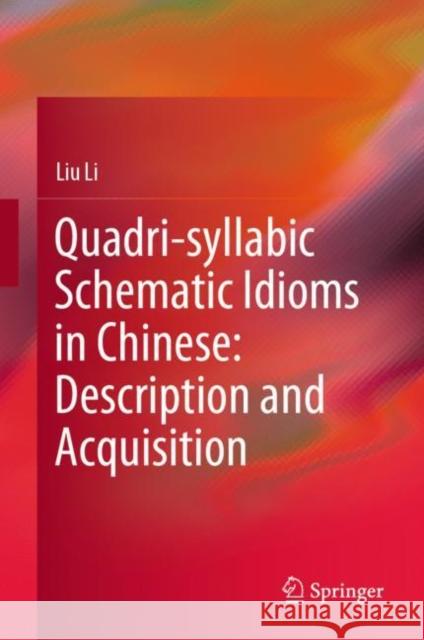
Quadri-syllabic Schematic Idioms in Chinese: Description and Acquisition Liu Li 9789811972010 Springer - książkaWidoczna okładka, to zdjęcie poglądowe, a rzeczywista szata graficzna może różnić się od prezentowanej.

Quadri-syllabic Schematic Idioms in Chinese: Description and Acquisition

ISBN-13: 9789811972010 / Angielski / Twarda / 2023 / 227 str.

Liu Li
cena 726,29
(netto: 691,70 VAT:  5%)

Najniższa cena z 30 dni: 693,97
Termin realizacji zamówienia:
ok. 22 dni roboczych.

Darmowa dostawa!
inne wydania

This book offers an insightful description of the productive behavior of four-character schematic idiomatic expressions (SIEs) in Mandarin and explores from a usage-based perspective the issue of how young learners acquire the partial productivity of these expressions. The beginning chapters contribute to a constructional understanding of the quadri-syllabic SIEs and an in-depth distributional analysis of three typical schematic patterns based on natural corpus data. The following chapters present detailed reports on four experimental studies to account for the factors that play significant roles in the learning process of SIEs from adolescence to adulthood. In the final chapter, the author concludes that acquisition of SIEs is as an interactive process shaped by input frequency, structural complexity, internal semantic relation, and chunking effect of open morphemes at different age levels.These findings enrich current understandings on constructional idioms and the emergentist model in idiom learning with a cross-linguistic focus on Mandarin unique quadri-syllabic SIEs. Language teachers, researchers, and postgraduate students who are interested in studies of idiomaticity. Construction grammar and usage-based learning model will find this book sufficiently informative and intriguing.


This book offers an insightful description of the productive behavior of four-character schematic idiomatic expressions (SIEs) in Mandarin and explores from a usage-based perspective the issue of how young learners acquire the partial productivity of these expressions. The beginning chapters contribute to a constructional understanding of the quadri-syllabic SIEs and an in-depth distributional analysis of three typical schematic patterns based on natural corpus data. The following chapters present detailed reports on four experimental studies to account for the factors that play significant roles in the learning process of SIEs from adolescence to adulthood. In the final chapter, the author concludes that acquisition of SIEs is as an interactive process shaped by input frequency, structural complexity, internal semantic relation, and chunking effect of open morphemes at different age levels.These findings enrich current understandings on constructional idioms and the emergentist model in idiom learning with a cross-linguistic focus on Mandarin unique quadri-syllabic SIEs. Language teachers, researchers, and postgraduate students who are interested in studies of idiomaticity. Construction grammar and usage-based learning model will find this book sufficiently informative and intriguing.

Kategorie:
Nauka, Językoznawstwo
Kategorie BISAC:
Language Arts & Disciplines > Linguistics - General
Psychology > Developmental - Child
Wydawca:
Springer
Język:
Angielski
ISBN-13:
9789811972010
Rok wydania:
2023
Dostępne języki:
Ilość stron:
227
Oprawa:
Twarda
Dodatkowe informacje:
Wydanie ilustrowane

Chapter 1

Introduction 

1.1 Schematic idioms 

1.2 Research Significance 

1.3 Organization of the Book 

Chapter 2 

From Idioms to Constructions 

2.1 Studies on English Idioms 

2.1.1 Traditional Non-compositional View 

2.1.2 Compositional/Multidimentional View 

2.1.3 Constructional View on Idiomaticity 

2.1.3.1 Idioms as Constructions 

2.1.3.2 Constructions as Basic Linguistic Unit

2.1.3.3 Features of Construction Grammar

2.1.3.4 Psychological Reality of Constructions in Language Processing 

2.1.3.5 Schematic Idioms as Constructional Idioms 

2.2 Studies on Chinese Idioms 

2.2.1 Features of Chinese Idioms 

2.2.1.1 Internal Structure of Chinese Idioms 

2.2.1.2 Semantic Opacity of Chinese Idioms 

2.2.1.3 Functions of Chinese Idioms 

2.2.1.4 Weakness in Current Chinese Idiom Definitions 

2.2.2 Studies on Chinese schematic idioms as Constructions 

2.2.3 Redefining Chinese idioms 

2.3 Summary 

Chapter 3 

Idiom Acquisition and Usage-Based 

Language Learning Theory 

3.1 Models on Idiom Representation 

3.1.1 The Direct Access Model

3.1.2 The Compositional Model

3.2 Factors in L1 Idiom Comprehension 

3.3 Empirical Studies on Chinese Idiom Learning 

3.4 A Critique on Current Studies of Idiom Learning 

3.5 Usage-based Language Learning Theory --- How Constructions are learned? 

3.5.1Schematization and Entrenchment --- Item-based Learning 

3.5.2Explanation on Overgeneralization---Entrenchment and Preemption 

3.5.3Research Methods in Usage-based Model

3.5.4 Important Factors in Usage-based Model

3.5.4.1 Frequency 

3.5.4.2 Complexity 

3.5.4.3 Consistency 

3.5.4.4 Age 

3.6 Summary 

Chapter 4 

Chinese Schematic Idioms 

---Productivity and Constraints 

4.1 Semi-fixed Patterns in Chinese Idioms 

4.2 Distributional Analysis of XAXB Construction 

4.2.1 Types of Relations in Chinese Lexical Words 

4.2.2 Features of the Fixed Morpheme X in XAXB Construction 

4.2.3 Constraints on Open Morphemes A, B in XAXB construction 

4.2.4 Case Study of bu-A-bu-B Schema 

4.2.5 Interpretations of XAXB Construction and the Distributional Statistics 

4.2.6 Statistical Distribution of XAXB Expressions 

4.2.7 Senses of bu-A-bu-B Expressions and the Natural Distribution 

4.2.8 Statistical Distribution of bu-A-bu-B Expression in Corpus 

4.3 Distributional Analysis of XAYB and AXBY Constructions 

4.3.1 Productivity of XAYB construction 

4.3.2 Interpretations of XAYB and the statistical distribution 

4.3.3 Statistical Distribution of XAYB Expressions in Corpus 

4.3.4 Productivity of AXBY Construction 

4.3.5 Interpretations of AXBY and the distributional statistics 

4.3.6 ABs across the schemas 

4.4 Summary of Distributional Analysis 

4.5 Research Questions and Design 

4.5.1 Research Questions 

4.5.2 Age Factor

4.5.3 Instruments 

4.5.4 A Summary of Experimental Studies 

4.6 Summary 

Chapter 5 

Study One 

5.1 Experimental Design and Materials 

5.2 Participants 

5.3 Procedures 

5.4 Scoring 

5.5 Results of Study One 

5.6 Discussions 

Chapter 6 

Study Two 

6.1 Experimental Design and Materials 

6.2 Participants 

6.3 Procedure 

6.4 Scoring 

6.5 Results 

6.6 Discussions on Study Two 

Chapter 7 

Study Three 

7.1 Research Instrument

7.2 Design and Materials 

7. 3 Participants 

7.4 Materials and Procedure 

7.5 Results of Study Three 

7.6 Summary and Discussions of Study Three 

Chapter 8 

Study Four

8.1 Research Instrument

8.2 Design and materials 

8.3 Participants 

8.4 Procedure 

8.5 Results of Study Four

8.6 Summary of Study Four

8.7 Summary of Four Experimental Studies 

Chapter 9 

Error Analysis in Sentence Production Tasks 

9.1 Classification of Error Types 

9.2 Overall Error Distribution in Sentence Productions 

9. 2.1 Syntactic Restriction Violations 

9.2.2 Semantic Restriction Violations 

9.2.3 Sense Disagreement

9. 2.4 Incomplete Responses 

9.3 Patterns in Error Type Distribution 

9.4 Summary 

Chapter 10 

Discussion and Conclusion 

10.1 General Results 

10.2 Effects of Identified Factors 

10.2.1 Input Frequency 

10.2.2 Structural Complexity and Internal Semantic Relation 

10.2.3 Chunk Selection of Open Morphemes 

10.2.4 Age 

10.3 Empirical Evidence of Schematic Idioms as Constructions 

10.4 Representations of Schematic Idioms 

10.4.1 Entrenchment, Schematization and Pre-emption 

10.4.2 Emergentist Model on Idiom Learning 

10.3.3 Whole-form Frequency Effect

10.4 Implications and limitations 

10.5 Conclusion 

References 


Liu Li is currently an associate professor in the faculty of English Education, Guangdong University of Foreign Studies. She completed her PhD degree in linguistics in the Education University of Hong Kong. Her research interests include language acquisition, cognitive linguistics and language pedagogy. She has published extensively in journals such as Cognitive Linguistics, Language and Linguistics, First Language, etc.

This book offers an insightful description of the productive behavior of four-character schematic idiomatic expressions (SIEs) in Mandarin and explores from a usage-based perspective the issue of how young learners acquire the partial productivity of these expressions. The beginning chapters contribute to a constructional understanding of the quadri-syllabic SIEs and an in-depth distributional analysis of three typical schematic patterns based on natural corpus data. The following chapters present detailed reports on four experimental studies to account for the factors that play significant roles in the learning process of SIEs from adolescence to adulthood. In the final chapter, the author concludes that acquisition of SIEs is as an interactive process shaped by input frequency, structural complexity, internal semantic relation, and chunking effect of open morphemes at different age levels.

These findings enrich current understandings on constructional idioms and the emergentist model in idiom learning with a cross-linguistic focus on Mandarin unique quadri-syllabic SIEs. Language teachers, researchers, and postgraduate students who are interested in studies of idiomaticity. Construction grammar and usage-based learning model will find this book sufficiently informative and intriguing.




Udostępnij

Facebook - konto krainaksiazek.pl


Opinie o Krainaksiazek.pl na Opineo.pl

Partner Mybenefit

Krainaksiazek.pl w programie rzetelna firma Krainaksiaze.pl - płatności przez paypal

Czytaj nas na:

Facebook - krainaksiazek.pl
  • książki na zamówienie
  • granty
  • książka na prezent
  • kontakt
  • pomoc
  • opinie
  • regulamin
  • polityka prywatności

Zobacz:

  • Księgarnia czeska

  • Wydawnictwo Książkowe Klimaty

1997-2026 DolnySlask.com Agencja Internetowa

© 1997-2022 krainaksiazek.pl
     
KONTAKT | REGULAMIN | POLITYKA PRYWATNOŚCI | USTAWIENIA PRYWATNOŚCI
Zobacz: Księgarnia Czeska | Wydawnictwo Książkowe Klimaty | Mapa strony | Lista autorów
KrainaKsiazek.PL - Księgarnia Internetowa

Polityka prywatnosci - link
Krainaksiazek.pl - płatnośc Przelewy24
Przechowalnia Przechowalnia




