• Wyszukiwanie zaawansowane
  • Kategorie
  • Kategorie BISAC
  • Książki na zamówienie
  • Promocje
  • Granty
  • Książka na prezent
  • Opinie
  • Pomoc
  • Załóż konto
  • Zaloguj się

Psychological Selection and Optimal Experience Across Cultures: Social Empowerment Through Personal Growth » książka


zaloguj się | załóż konto
Logo Krainaksiazek.pl

koszyk

konto

szukaj
topmenu
Księgarnia internetowa
Szukaj
Książki na zamówienie
Promocje
Granty
Książka na prezent
Moje konto
Pomoc
 
 
Wyszukiwanie zaawansowane
Pusty koszyk
Bezpłatna dostawa dla zamówień powyżej 20 złBezpłatna dostawa dla zamówień powyżej 20 zł

Kategorie główne

• Nauka
 [2944077]
• Literatura piękna
 [1814251]

  więcej...
• Turystyka
 [70679]
• Informatyka
 [151074]
• Komiksy
 [35590]
• Encyklopedie
 [23169]
• Dziecięca
 [611005]
• Hobby
 [136031]
• AudioBooki
 [1718]
• Literatura faktu
 [225599]
• Muzyka CD
 [379]
• Słowniki
 [2916]
• Inne
 [443741]
• Kalendarze
 [1187]
• Podręczniki
 [166463]
• Poradniki
 [469211]
• Religia
 [506887]
• Czasopisma
 [481]
• Sport
 [61343]
• Sztuka
 [242115]
• CD, DVD, Video
 [3348]
• Technologie
 [219293]
• Zdrowie
 [98602]
• Książkowe Klimaty
 [124]
• Zabawki
 [2385]
• Puzzle, gry
 [3504]
• Literatura w języku ukraińskim
 [260]
• Art. papiernicze i szkolne
 [7151]
Kategorie szczegółowe BISAC

Psychological Selection and Optimal Experience Across Cultures: Social Empowerment Through Personal Growth

ISBN-13: 9789400734548 / Angielski / Miękka / 2013 / 369 str.
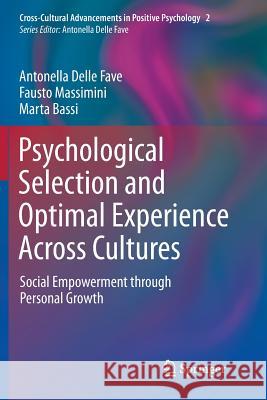
Antonella Delle Fave; Fausto Massimini; Marta Bassi
Psychological Selection and Optimal Experience Across Cultures: Social Empowerment Through Personal Growth Delle Fave, Antonella 9789400734548 Springer - książkaWidoczna okładka, to zdjęcie poglądowe, a rzeczywista szata graficzna może różnić się od prezentowanej.

Psychological Selection and Optimal Experience Across Cultures: Social Empowerment Through Personal Growth

ISBN-13: 9789400734548 / Angielski / Miękka / 2013 / 369 str.

Antonella Delle Fave; Fausto Massimini; Marta Bassi
cena 603,81
(netto: 575,06 VAT:  5%)

Najniższa cena z 30 dni: 578,30
Termin realizacji zamówienia:
ok. 22 dni roboczych.

Darmowa dostawa!
inne wydania

Studies on subjective well-being derive from two main perspectives: hedonism and eudaimonism. The former emphasizes human search for pleasure and satisfaction The latter stems from Aristotle's concept of eudaimonia as the fulfilment of one's true nature, that includes both self-actualization and commitment to socially shared goals. The framework adopted in this book belongs to the eudaimonic approach, and it is grounded in the scientific tradition of bio-cultural studies. Most researchers agree that humans are living systems equipped with biological and cultural features. Theoretical approaches however differ in their emphasis on the role and relevance of biology and culture in influencing human behavior. In particular, the impact of culture and social norms on individual behavior and quality of life can hardly be overestimated. Day by day, people acquire cultural information from their social contexts by means of various forms of learning, and they subsequently replicate and transmit it. These cultural constraints can be used as objective indicators to evaluate quality of life and well-being, but they are not sufficient to grasp the real life conditions of an individual. This book introduces a third perspective in this debate: it emphasizes the role of individuals as active agents in shaping their cultural environment and in promoting both their own development and culture complexity. Each person within her culture has a more or less wide extent of autonomy and freedom in facing challenges and in discovering opportunities in daily activities, in interpreting life events and in setting self-selected goals. Far from simply being recipients and vehicles of cultural information, human beings actively take part in the process of cultural transmission and change. A process of psychological selection takes place at the individual level, promoting the differential reproduction of cultural information units. A great number of cross-cultural studies have been conducted, in order to detect the basic criterion which guides this process. Results show the paramount role played by the quality of experience people associate with their daily activities and social contexts. In particular, individuals preferentially select and cultivate activities connected with optimal experience, or Flow, in which individuals describe themselves as active and deeply involved in the task at hand, excited and relaxed at the same time. In optimal experience people perceive high challenges in the activity, and adequate personal skills in facing them. They report engagement, activation, enjoyment, and autonomy. However, provided that individuals play a central role in the process of cultural transmission and change, they should be supported in finding in meaningful and socially relevant challenges. From childhood, citizens should be exposed to opportunities for engagement, enjoyment and optimal experiences in socially useful activities. They should be taught to appreciate the development potential embedded in agency and co-operation towards community objectives. Intrinsic motivation and the autonomous search for meanings and goals should be sustained. The individual effort and ability to find a personalized way toward well-being and complexity have to be primarily supported. At the social level, the individual tendency to pursue self-selected goals and personal wellbeing could be channelled to foster at the same time co-operation and community empowerment. In this historical period it is of paramount importance for positive psychology to contextualize the study of individual well-being within the broader perspective of social empowerment and cultures' cooperation. Following the long tradition initiated by Aristotle with his studies on virtues and ethics, we strongly believe in the human potential to match the pursuit of optimal experiences and personal wellbeing with agency and the active contribution to the empowerment of societies.


Kategorie:
Nauka, Psychologia
Kategorie BISAC:
Social Science > Socjologia
Psychology > Psychotherapy - General
Medical > Allied Health Services - General
Wydawca:
Springer
Seria wydawnicza:
Cross-Cultural Advancements in Positive Psychology
Język:
Angielski
ISBN-13:
9789400734548
Rok wydania:
2013
Wydanie:
2011
Numer serii:
000408427
Ilość stron:
369
Waga:
0.54 kg
Wymiary:
23.39 x 15.6 x 2.03
Oprawa:
Miękka
Wolumenów:
01
Dodatkowe informacje:
Wydanie ilustrowane

From the reviews:

"This book will have much interest for the general reader. It contains extensive detail about a wide range of cultural experiences. Moreover, the research results and data analyses are easily understood through tables and clear explanations. The volume will be of particular interest to those researchers and theorists working in the emerging field of positive psychology. Those working in the specific areas covered in the final eight chapters will also find much material to stimulate ideas for further research." (John M. Davis, PsycCRITIQUES, Vol. 57 (20), May, 2012)

Introduction Part I Theory and methods Chapter 1: Hedonism and eudaimonism in positive psychology 1.1 Positive psychology: past and present 1.2 The pursuit of happiness: two philosophical traditions 1.2.1 Hedonia and eudaimonia in psychology 1.2.1.1 The hedonic view 1.2.1.2 The eudaimonic view 1.3 Happiness: the on-going debate 1.3.1 Integrating perspectives 1.3.2 Happiness and diversity References Chapter 2: Biology, culture and human behavior 2.1 Genetic and epigenetic transmission: a new perspective 2.2 The emergence of culture 2.2.1 Cultural evolution 2.2.2 Cultural differentiation and inter-cultural relations 2.2.3 Social norms and their analysis: The cultural network 2.3 The role of individuals References Chapter 3: Psychological selection and optimal experience 3.1 Human beings and complexity 3.2 Mind, consciousness and human agency 3.3 Attention and the stream of subjective experience 3.4 Optimal experience and order in consciousness 3.5 Optimal experience, complexity, and psychological selection 3.6 The neurophysiological underpinnings of optimal experience 3.7 Optimal experience and positive human functioning: A contribution to eudaimonia References Chapter 4: Instruments and methods in flow research 4.1 The assessment of optimal experience 4.2 Interviews and direct observation 4.3 Single-administration questionnaires 4.3.1 Flow Questionnaire and the measurement of psychological selection 4.3.2 The Flow Short Scale 4.3.3 The Flow State Scale and the Dispositional Flow Scale 4.3.4 The WOrk-reLated Flow Inventory 4.3.5 Optimal Experience Survey 4.3.5 Choosing between questionnaires 4.4 Experimental studies 4.5 Experience Sampling Method 4.5.1 ESM data coding and analysis 4.5.2 The advantages and disadvantages of online measurement 4.6 The Experience Fluctuation Model 4.7 Challenges and skills in the flow construct 4.8 Latest directions in flow methodology Appendix References Chapter 5: The phenomenology of optimal experience in daily life 5.1 The family of optimal experiences 5.2 The motivational dimension of optimal experience 5.3 Factors favoring optimal experience 5.3.1 Individual characteristics 5.3.2 Cultural and contextual features 5.4 Optimal experience and related constructs: similarities and differences 5.4.1 Peak experience 5.4.2 Enduring and situational involvement 5.4.3 Hedonic and eudaimonic constructs References Chapter 6: Optimal experience and meditation: Western and Asian approaches to well-being 6.1 Flow and meditation: a controversial issue 6.2 Consciousness studies in the Indian tradition 6.2.1 Levels of consciousness and mind functioning 6.3 Flow and meditation: differences and analogies 6.3.1 The epistemological perspective 6.3.2 The neurophysiological perspective 6.3.3 The phenomenological perspective 6.4 Meditation, flow and human development References Part II Applications Chapter 7: Optimal experience across cultures 7.1 Psychology and cultures 7.1.1 Cultural dimensions of psychological processes 7.2 Flow and psychological selection across cultures 7.2.1 Optimal activities across cultures 7.2.2 Optimal experience across activities and cultures 7.2.2.1 Flow in productive activities 7.2.2.2 Flow in leisure 7.2.2.3 Flow in interactions 7.2.2.4 Flow and psychological selection 7.3 Adolescence across cultures: finding flow, building the future 7.4 Culture and optimal experience: some general remarks References Chapter 8 Work: A paradox in flow research 81 Work and leisure: Two separate domains? 8.2 The quality of experience associated with work: a persistent paradox 8.2.1 Optimal experience between work and leisure across professions 8.3 Individual characteristics, job resources and cultures 8.4 Flow at work and individuals’ and organizations’ well-being 8.5 Work as core of psychological selection 8.5.1 Career building: The case of musicians 8.5.2 Teachers and cultural transmission: The centrality of relationships References Chapter 9: Free time: an opportunity for growth, recreation, or stagnation 9.1 Conceptualizing free time 9.2 The quality of experience of leisure activities 9.2.1 Sports and hobbies as opportunities for serious leisure 9.2.2 The television paradox and media use 9.3 Individual characteristics, cultural features and optimal experience in leisure 9.4 Free time and well-being: what you do and how long you do it 9.5 Leisure and psychological selection 9.5.1 The experience of rock climbing and mountaineering 9.5.2 Track-and-field: amateurs and professionals References Chapter 10: Relationships: safe harbor for flow explorers 10.1 Introduction 10.2 Family relationships and well-being 10.2.1 Parenting: biology, culture, and subjective experience 10.2.2 Adolescents and family: constraints and opportunities 10.2.3 Sibling relations: a case study on twins 10.3 Friendship construction through shared experiences 10.4 Relationships across cultures: daily experience and lifelong perspectives 10.4.1 Relationships as the core of Gypsy culture 10.4.2. Solitude across cultures and among Navajos 10.5 Concluding remarks References Chapter 11: Education, learning and cultural transmission 11.1 Education across cultures 11.2 The quality of experience of learning activities 11.2.1 Unraveling cultural differences 11.3 Flow and learning: the influence of individual and contextual factors 11.3.1 Individual characteristics 11.3.2 Cultural and contextual features 11.4 The impact of optimal experience on students’ well-being and development 11.5 Learning activities and psychological selection: a comparison between Italy and Nepal 11.6 Concluding remarks References Chapter 12: Optimal experience and religious practice 12.1 Religiousness and spirituality: looking for definitions 12.1.1 Religion and well-being: empirical evidence 12.2 Religious practice and optimal experience across cultures 12.2.1 Religious practice and flow: an infrequent association 12.2.2 Religion in Asian cultures: Indonesia, India, and Thailand 12.2.3 Religious ceremonies and Navajo identity 12.2.4 Migration from Africa and religious practice 12.3 Religion and faith as the core of psychological selection 12.4 Believers and followers, disciples and explorers References Chapter 13: Acculturation and optimal experience 13.1 Acculturation 13.2 Optimal experience and migration 13.2.1 Living in India and living abroad 13.2.2 The daily life of East European women in Italy 13.3 Navajos: the bicultural people 13.4 Concluding remarks References Chapter 14: Flow and health: a bio-psycho-social perspective 14.1 Introduction 14.2 The three dimensions of health 14.3 A positive perspective on health and disease 14.4 Retrieving optimal experience in extraordinary circumstances 14.4.1 Living with chronic disease 14.4.2 Positive growth after trauma 14.4.3 Body image and eating disorders 14.4.4 Mental health 14.4.5 Contextual influences and cultural differences References Chapter 15: Psychosocial maladjustment and mimetic flow 15.1 Introduction 15.2 Cultural change and its impact on children 15.2.1 Child work: resources or exploitation? 15.2.2 From villages to cities, from home to the streets 15.2.3 Street children in Western countries 15.2.4 Successful intervention: a major challenge 15.2.5 Investigation children’s experience and expectation 15.2.5.1 Italy: adolescents on the street 15.2.5.2 Italy: girls living in institution 15.2.5.3 Kenya: the children of Kivuli 15.2.5.4 Brazil: Camihos de vida 15.2.6 Matching opportunities with expectations: a crucial issue 15.3 Can flow be maladaptive? 15.3.1 Drug intake and mimetic optimal experiences 15.3.2 Detoxification programs: the role of challenges and meanings 15.4 Building positive identities References Epilogue   

Antonella Delle Fave, MD specialized in Clinical Psychology, is professor of Psychology at the University of Milano, Italy. Her studies concern optimal experience and individual psychological selection, that is the lifelong process of differential replication and cultivation of activities and competencies. Her cross-cultural studies have produced the largest international data bank on these topics. On the basis of research findings, she has developed and supervised intervention projects in the domains of health and education, disability and social maladjustment. She is author of 120 articles and chapters in peer-reviewed books, author/editor of 10 books and 2 special journal issues, member of several Editorial Boards and Boards of Reviewers. She is presently President of the European Network of Positive Psychology (ENPP) and member of the Board of Directors of the International Positive Psychology Association (IPPA).

Studies on well-being derive from two main perspectives: hedonism and eudaimonism. The former emphasizes the human search for pleasure and satisfaction while the latter focuses on fulfillment of one’s true nature that includes both self-actualization and commitment to socially shared goals. Operating under the eudaimonic approach, Psychological Selection and Optimal Experience Across Cultures uses recent advancements in positive psychology to explore the connections between personal well-being and social welfare. People grow and live in cultures that deeply influence their values, aspirations and behaviors. However, individuals in their turn play an active role in building their own goals, growth trajectories and social roles while at the same time influencing culture trends. This process, known as psychological selection, is related to the individual pursuit of well-being. People preferentially select and cultivate in their lives activities, interests and relationships associated with optimal experience—a state of deep engagement, concentration and enjoyment. Several cross-cultural studies confirm the positive and rewarding features of optimal experience, and based on these evidences this book highlights the interplay between individual and cultural growth trajectories, ultimately conveying the core message that educating people to enjoy engagement and involvement in activities that can be relevant and meaningful for social welfare is a premise to foster the harmonious development of human communities and the peaceful cohabitation of cultures. Interest in eudaimonia has grown rapidly, especially in the past five years. Given this book’s emphasis on the role of individuals as active agents in shaping their cultural environment and in promoting both their own development and cultural complexity, it fills a unique place in the increasing demand for studies in the field. Aimed at researchers and students in Psychology, Education, Health and the Social Sciences, it is useful for anyone interested in the promotion of individual happiness and well-being.  


Udostępnij

Facebook - konto krainaksiazek.pl


Opinie o Krainaksiazek.pl na Opineo.pl

Partner Mybenefit

Krainaksiazek.pl w programie rzetelna firma Krainaksiaze.pl - płatności przez paypal

Czytaj nas na:

Facebook - krainaksiazek.pl
  • książki na zamówienie
  • granty
  • książka na prezent
  • kontakt
  • pomoc
  • opinie
  • regulamin
  • polityka prywatności

Zobacz:

  • Księgarnia czeska

  • Wydawnictwo Książkowe Klimaty

1997-2026 DolnySlask.com Agencja Internetowa

© 1997-2022 krainaksiazek.pl
     
KONTAKT | REGULAMIN | POLITYKA PRYWATNOŚCI | USTAWIENIA PRYWATNOŚCI
Zobacz: Księgarnia Czeska | Wydawnictwo Książkowe Klimaty | Mapa strony | Lista autorów
KrainaKsiazek.PL - Księgarnia Internetowa

Polityka prywatnosci - link
Krainaksiazek.pl - płatnośc Przelewy24
Przechowalnia Przechowalnia





