• Wyszukiwanie zaawansowane
  • Kategorie
  • Kategorie BISAC
  • Książki na zamówienie
  • Promocje
  • Granty
  • Książka na prezent
  • Opinie
  • Pomoc
  • Załóż konto
  • Zaloguj się

Project Risk Management » książka

zaloguj się | załóż konto
Logo Krainaksiazek.pl

koszyk

konto

szukaj
topmenu
Księgarnia internetowa
Szukaj
Książki na zamówienie
Promocje
Granty
Książka na prezent
Moje konto
Pomoc
 
 
Wyszukiwanie zaawansowane
Pusty koszyk
Bezpłatna dostawa dla zamówień powyżej 20 złBezpłatna dostawa dla zamówień powyżej 20 zł

Kategorie główne

• Nauka
 [2946912]
• Literatura piękna
 [1852311]

  więcej...
• Turystyka
 [71421]
• Informatyka
 [150889]
• Komiksy
 [35717]
• Encyklopedie
 [23177]
• Dziecięca
 [617324]
• Hobby
 [138808]
• AudioBooki
 [1671]
• Literatura faktu
 [228371]
• Muzyka CD
 [400]
• Słowniki
 [2841]
• Inne
 [445428]
• Kalendarze
 [1545]
• Podręczniki
 [166819]
• Poradniki
 [480180]
• Religia
 [510412]
• Czasopisma
 [525]
• Sport
 [61271]
• Sztuka
 [242929]
• CD, DVD, Video
 [3371]
• Technologie
 [219258]
• Zdrowie
 [100961]
• Książkowe Klimaty
 [124]
• Zabawki
 [2341]
• Puzzle, gry
 [3766]
• Literatura w języku ukraińskim
 [255]
• Art. papiernicze i szkolne
 [7810]
Kategorie szczegółowe BISAC

Project Risk Management

ISBN-13: 9781118482438 / Angielski / Twarda / 2013 / 400 str.
Y Raydugin
Project Risk Management Raydugin, Yuri 9781118482438  - książkaWidoczna okładka, to zdjęcie poglądowe, a rzeczywista szata graficzna może różnić się od prezentowanej.

Project Risk Management

ISBN-13: 9781118482438 / Angielski / Twarda / 2013 / 400 str.

Y Raydugin
cena 330,33
(netto: 314,60 VAT:  5%)

Najniższa cena z 30 dni: 330,33
Termin realizacji zamówienia:
ok. 30 dni roboczych
Bez gwarancji dostawy przed świętami

Darmowa dostawa!

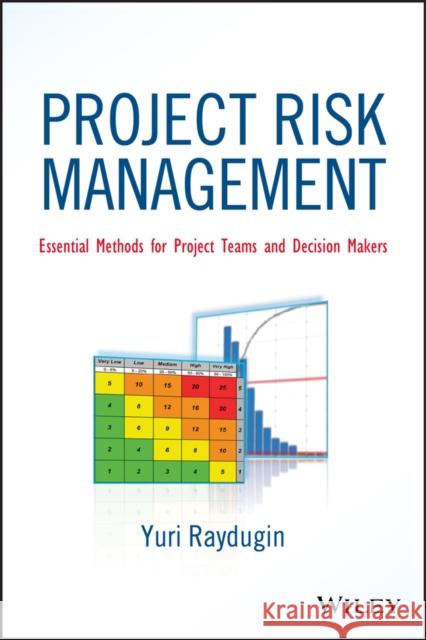
An easy to implement, practical, and proven risk management methodology for project managers and decision makers Drawing from the author's work with several major and mega capital projects for Royal Dutch Shell, TransCanada Pipelines, TransAlta, Access Pipeline, MEG Energy, and SNC-Lavalin, Project Risk Management: Essential Methods for Project Teams and Decision Makers reveals how to implement a consistent application of risk methods, including probabilistic methods. It is based on proven training materials, models, and tools developed by the author to make risk management plans accessible and easily implemented.

  • Written by an experienced risk management professional
  • Reveals essential risk management methods for project teams and decision makers
  • Packed with training materials, models, and tools for project management professionals
Risk Management has been identified as one of the nine content areas for Project Management Professional (PMP(R)) certification. Yet, it remains an area that can get bogged down in the real world of project management. Practical and clearly written, Project Risk Management: Essential Methods for Project Teams and Decision Makers equips project managers and decision makers with a practical understanding of the basics of risk management as they apply to project management. (PMP and Project Management Professional are registered marks of the Project Management Institute, Inc.)

Kategorie:
Nauka, Ekonomia i biznes
Kategorie BISAC:
Business & Economics > Zarządzanie projektami
Język:
Angielski
ISBN-13:
9781118482438
Rok wydania:
2013
Ilość stron:
400
Waga:
0.59 kg
Wymiary:
23.11 x 16.26 x 3.3
Oprawa:
Twarda
Wolumenów:
01
Dodatkowe informacje:
Bibliografia
Obwoluta

Foreword xv

Preface xix

Acknowledgments xxix

PART I: FUNDAMENTAL UNCERTAINTY OF A PROJECT OUTCOME

Chapter 1: Nature of Project Uncertainties 3

Phases of Project Development and Project Objectives 4

Quest for Predictability of Project Outcome 5

Sources and Types of Deviations from Project Objectives 7

Key Objects of Risk (or Uncertainty) Management: Do We Really Know What We Try to Manage? 15

Uncertainty Exposure Changers 24

Conclusion 26

Notes 26

Chapter 2: Main Components of a Risk Management System 29

Risk Management Plan 30

Organizational Framework 32

Risk Management Process 39

Risk Management Tools 52

Conclusion 59

Notes 60

Chapter 3: Adequacy of Methods to Assess Project Uncertainties 61

Review of Deterministic Qualitative (Scoring) Methods 62

Review of Deterministic Quantitative Methods 68

Review of Probabilistic Qualitative Methods 76

Review of Probabilistic Quantitative Methods 80

Conclusion 87

Notes 88

PART II: DETERMINISTIC METHODS

Chapter 4: Uncertainty Identification 91

When Risk Management Becomes Boring 92

Three Dimensions of Risk Management and Uncertainty Identification 93

Risk Identification Workshops 95

Sources of Uncertainties and Risk Breakdown Structure 98

Bowtie Diagrams for Uncertainty Identification 101

Three–Part Uncertainty Naming 107

Role of Bias in Uncertainty Identification 110

Room for Unknown Unknowns 113

Conclusion 118

Notes 118

Chapter 5: Risk Assessment and Addressing 119

Developing a Risk Assessment Matrix 120

Using a Risk Assessment Matrix for Assessment As–Is 129

Five Addressing Strategies 136

Assessment after Addressing 141

Project Execution through Risk Addressing (PETRA) 145

Role of Bias in Uncertainty Assessment 147

Conclusion 149

Notes 150

Chapter 6: Response Implementation and Monitoring 151

Merging Risk Management with Team Work Plans 152

Monitor and Appraise 153

When Uncertainties Should Be Closed 154

When Should Residual Uncertainties Be Accepted? 155

Conclusion 155

Note 156

Chapter 7: Risk Management Governance and Organizational Context 157

Risk Management Deliverables for Decision Gates 158

Ownership of Uncertainties and Addressing Actions 160

Management of Supercritical Risks 162

Risk Reviews and Reporting 164

Bias and Organizational Context 168

Conclusion 175

Notes 175

Chapter 8: Risk Management Tools 177

Three Dimensions of Risk Management and Structure of the Uncertainty Repository 178

Risk Database Software Packages 181

Detailed Design of a Risk Register Template in MS Excel 184

Commercial Tools for Probabilistic Risk Analyses 185

Conclusion 191

Notes 192

Chapter 9: Risk–Based Selection of Engineering Design Options 193

Criteria for Engineering Design Option Selection 194

Scoring Risk Method for Engineering Design Option Selection 195

Decision Tree for Engineering Design Option Selection (Controlled Options) 199

Conclusion 202

Note 202

Chapter 10: Addressing Uncertainties through Procurement 203

Sources of Procurement Risks 204

Quantitative Bid Evaluation 207

Package Risk Management Post–Award 209

Conclusion 209

Notes 210

Chapter 11: Cost Escalation Modeling 211

Overview of the Cost Escalation Approach 211

Example of Cost Escalation Modeling 219

Selecting the Right Time to Purchase 223

Conclusion 224

Notes 224

PART III: PROBABILISTIC MONTE CARLO METHODS

Chapter 12: Applications of Monte Carlo Methods in Project Risk Management 227

Features, Value, and Power of Monte Carlo Methods 228

Integration of Deterministic and Probabilistic Assessment Methods 230

Uncertainty Objects Influencing Outcome of Probabilistic Analyses 231

Origin and Nature of Uncertainties 233

Role of Correlations in Cost and Schedule Risk Analyses 240

Project Cost Reserve 242

Project Schedule Reserve 244

Anatomy of Input Distributions 246

Probabilistic Branching 250

Merge Bias as an Additional Reason Why Projects Are Often Late 251

Integrated Cost and Schedule Risk Analysis 253

Including Unknown–Unknown Allowance in Probabilistic Models 256

Conclusion 259

Notes 260

Chapter 13: Preparations for Probabilistic Analysis 261

Typical Workflows of Probabilistic Cost and Schedule Analyses 262

Planning Monte Carlo Analysis 264

Baselines and Development of Proxies 267

Why Using Proxies Is the Right Method 271

Mapping of Uncertain Events 272

Building and Running Monte Carlo Models 277

Conclusion 277

Notes 278

Chapter 14: Using Outputs of Monte Carlo Analyses in Decision Making 279

Anatomy of Output Distributions 280

Overall Project Uncertainty and Confidence Levels of Baselines 283

Project Reserve Criteria 287

Uncertainty of Cost Outcome and Classes of Base Estimates 291

Cost Reserve Drawdown 296

Sensitivity Analysis 298

Using What–if Scenarios for Advanced Sensitivity Analysis 304

Are We Ready for Construction, Logistics, or Turnaround Windows? 305

Validating Results and Closing Probabilistic Analysis 306

Conclusion 308

Notes 308

PART IV: RISK MANAGEMENT CASE STUDY: PROJECT CURIOSITY

Chapter 15: Putting Together the Project Curiosity Case Study 311

Scope of the Case Study 312

Project Curiosity Baselines 313

Project Risk Management System Adopted by Project Curiosity 319

Overview of Project Uncertainty Exposure of Project Curiosity 326

Templates for Probabilistic Cost and Schedule Analyses 330

Building and Running Project Probabilistic Cost and Schedule Models 331

Three What–If Scenarios 333

Conclusion 334

Notes 335

Chapter 16: Decision Making 337

Key Points of the Probabilistic Analysis Report 338

Decision Gate Review Board Findings and Recommendations 350

Conclusion 352

Note 353

About the Author 355

Index 357

Dr. YURI RAYDUGIN is an experienced risk management professional who has developed and implemented successful risk systems for several major energy companies, including Royal Dutch Shell, SNC–Lavalin, and TransCanada Pipelines. He provides risk management coaching and training as well as risk assessment services and has published white papers and articles for a number of journals, including the International Journal of Risk and Contingency Management.

From the Foreword:
"A practical ′recipe book′ for the non–expert who is a decision maker or a project team member to understand how to conduct a robust risk management process while avoiding the many pitfalls."
Dr. Bill Gunter, Honorary Nobel Laureate, Alberta Innovates–Technology Futures

Praise for Project Risk Management

"The paramount importance of risk management for project success is rarely challenged. The preeminent significance of selection and implementation of the most efficient and practical risk methods is often overlooked though. Yuri shares his real–life mega–project risk experience to bridge this alarming gap. This is a fresh look at existing risk standards, practices, and tools from the angle of adequacy and practicality. Project practitioners who are interested in avoiding outdated, fancy, or impractical risk methods, as well as risk ′ritual dances′ and other common pitfalls, should read this book."
Alfy Hanna, Senior VP, Mega–projects, SNC–Lavalin

"Risk is that four–letter word that haunts those of us who strive year over year to create value from capital infrastructure investments. It is difficult to understand, tough to quantify in simple terms, and even more difficult to boil down into financial dollars, which is what we need to make decisions. But the risks are there, and we can or should do something about them. In his book, Yuri lays out fundamentals, practices, and tools that can take risk from a ′gut–feel reactive approach′ to one where it is quantified, actionable, and result–focused. A recommended read for any decision maker or project manager responsible for capital projects where, at any time, labor, technology, people, financial markets, regulations, politics . . . will affect long–term value creation. Choose to be prepared."
Mark Mackay, PEng, VP, Engineering & Construction, TransAlta

"Very early in the book, Yuri focuses on an essential enabler of any successful project risk management program the Project Risk Management Plan. Quite often, this tactical road map is omitted by a project team, as focus is distracted by populating risk registers and implementing complex modeling programs. Yuri rightly provides core insight on both the purpose and content to enable any new or existing project team to develop a solid risk management plan that will serve to guide risk management activities throughout the project′s life cycle."
Jason R. Kean, Principal, Project Solutions Inc.

"Project Risk Management provides an excellent and highly accessible summary of the key aspects of risk management this book should be of interest to those both familiar with and new to the field of project risk management."
Dr. Titus Fossgard–Moser, non–technical risk specialist


Udostępnij

Facebook - konto krainaksiazek.pl


Opinie o Krainaksiazek.pl na Opineo.pl

Partner Mybenefit

Krainaksiazek.pl w programie rzetelna firma Krainaksiaze.pl - płatności przez paypal

Czytaj nas na:

Facebook - krainaksiazek.pl
  • książki na zamówienie
  • granty
  • książka na prezent
  • kontakt
  • pomoc
  • opinie
  • regulamin
  • polityka prywatności

Zobacz:

  • Księgarnia czeska

  • Wydawnictwo Książkowe Klimaty

1997-2025 DolnySlask.com Agencja Internetowa

© 1997-2022 krainaksiazek.pl
     
KONTAKT | REGULAMIN | POLITYKA PRYWATNOŚCI | USTAWIENIA PRYWATNOŚCI
Zobacz: Księgarnia Czeska | Wydawnictwo Książkowe Klimaty | Mapa strony | Lista autorów
KrainaKsiazek.PL - Księgarnia Internetowa

Polityka prywatnosci - link
Krainaksiazek.pl - płatnośc Przelewy24
Przechowalnia Przechowalnia







