• Wyszukiwanie zaawansowane
  • Kategorie
  • Kategorie BISAC
  • Książki na zamówienie
  • Promocje
  • Granty
  • Książka na prezent
  • Opinie
  • Pomoc
  • Załóż konto
  • Zaloguj się

Programming in PROLOG: Using the ISO Standard » książka


zaloguj się | załóż konto
Logo Krainaksiazek.pl

koszyk

konto

szukaj
topmenu
Księgarnia internetowa
Szukaj
Książki na zamówienie
Promocje
Granty
Książka na prezent
Moje konto
Pomoc
 
 
Wyszukiwanie zaawansowane
Pusty koszyk
Bezpłatna dostawa dla zamówień powyżej 20 złBezpłatna dostawa dla zamówień powyżej 20 zł

Kategorie główne

• Nauka
 [2946912]
• Literatura piękna
 [1852311]

  więcej...
• Turystyka
 [71421]
• Informatyka
 [150889]
• Komiksy
 [35717]
• Encyklopedie
 [23177]
• Dziecięca
 [617324]
• Hobby
 [138808]
• AudioBooki
 [1671]
• Literatura faktu
 [228371]
• Muzyka CD
 [400]
• Słowniki
 [2841]
• Inne
 [445428]
• Kalendarze
 [1545]
• Podręczniki
 [166819]
• Poradniki
 [480180]
• Religia
 [510412]
• Czasopisma
 [525]
• Sport
 [61271]
• Sztuka
 [242929]
• CD, DVD, Video
 [3371]
• Technologie
 [219258]
• Zdrowie
 [100961]
• Książkowe Klimaty
 [124]
• Zabawki
 [2341]
• Puzzle, gry
 [3766]
• Literatura w języku ukraińskim
 [255]
• Art. papiernicze i szkolne
 [7810]
Kategorie szczegółowe BISAC

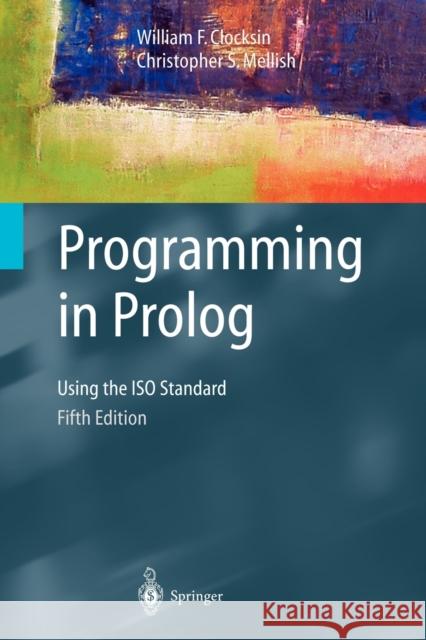
Programming in PROLOG: Using the ISO Standard

ISBN-13: 9783540006787 / Angielski / Miękka / 2003 / 300 str.
C.S. Mellish
Programming in PROLOG: Using the ISO Standard Clocksin, William F. 9783540006787  - książkaWidoczna okładka, to zdjęcie poglądowe, a rzeczywista szata graficzna może różnić się od prezentowanej.

Programming in PROLOG: Using the ISO Standard

ISBN-13: 9783540006787 / Angielski / Miękka / 2003 / 300 str.

C.S. Mellish
cena 281,76
(netto: 268,34 VAT:  5%)

Najniższa cena z 30 dni: 269,85
Termin realizacji zamówienia:
ok. 22 dni roboczych
Bez gwarancji dostawy przed świętami

Darmowa dostawa!

Originally published in 1981, this was the first textbook on programming in the Prolog language and is still the definitive introductory text on Prolog. Though many Prolog textbooks have been published since, this one has withstood the test of time because of its comprehensiveness, tutorial approach, and emphasis on general programming applications. Prolog has continued to attract a great deal of interest in the computer science community, and has turned out to be a basis for an important new generation of programming languages and systems for Artificial Intelligence. Since the previous edition of Programming in Prolog, the language has been standardised by the International Organization for Standardization (ISO) and this book has been updated accordingly. The authors have also introduced some new material, clarified some explanations, corrected a number of minor errors, and removed appendices about Prolog systems that are now obsolete.


Kategorie:
Informatyka, Programowanie
Kategorie BISAC:
Computers > Languages - General
Computers > Programming - Compilers
Computers > Artificial Intelligence - General
Język:
Angielski
ISBN-13:
9783540006787
Rok wydania:
2003
Ilość stron:
300
Waga:
0.51 kg
Wymiary:
23.8 x 16.0 x 1.9
Oprawa:
Miękka
Wolumenów:
01

From the reviews of the fifth edition:

"This is the fifth and the most recent edition of a legendary book ... . It was probably the first introductory Prolog book and it is still the most gentle introduction to Prolog for everyone, including non-computer scientists. ... the book is as great as ever as an introductory text for Prolog. When a newbie asks for an introduction to Prolog, the best advice is still Clocksin & Mellish." (Bart Demoen, TLP-Theory and Practice of Logic Programming, Vol. 5 (3), 2005)

1 Tutorial Introduction.- Gives the student a feel for what it is like to program in Prolog. Introduces objects, relationships, facts, rules, variables.- 1.1 Prolog.- 1.2 Objects and Relationships.- 1.3 Programming.- 1.4 Facts.- 1.5 Questions.- 1.6 Variables.- 1.7 Conjunctions.- 1.8 Rules.- 1.9 Summary and Exercises.- 2 A Closer Look.- More detailed presentation of Prolog syntax and data structures.- 2.1 Syntax.- 2.1.1 Constants.- 2.1.2 Variables.- 2.1.3 Structures.- 2.2 Characters.- 2.3 Operators.- 2.4 Equality and Unification.- 2.5 Arithmetic.- 2.6 Summary of Satisfying Goals.- 2.6.1 Successful satisfaction of a conjunction of goals.- 2.6.2 Consideration of goals in backtracking.- 2.6.3 Unification.- 3 Using Data Structures.- Representing objects and relationships by using trees and lists. Developing several standard Prolog programming techniques.- 3.1 Structures and Trees.- 3.2 Lists.- 3.3 Recursive Search.- 3.4 Mapping.- 3.5 Recursive Comparison.- 3.6 Joining Structures Together.- 3.7 Accumulators.- 3.8 Difference Structures.- 4 Backtracking and the “Cut”.- How a set of clauses generates a set of solutions. Using “cut” to modify the control sequence of running Prolog programs.- 4.1 Generating Multiple Solutions.- 4.2 The “Cut”.- 4.3 Common Uses of the Cut.- 4.3.1 Confirming the Choice of a Rule.- 4.3.2 The “cut-fail” Combination.- 4.3.3 Terminating a “generate and test”.- 4.4 Problems with the Cut.- 5 Input and Output.- Facilities available for the input and output of characters and structures. Developing a program to read sentences from the user and represent the structure as a list of words, which can be used with the Grammar Rules of Chapter.- 5.1 Reading and Writing Terms.- 5.1.1 Reading Terms.- 5.1.2 Writing Terms.- 5.2 Reading and Writing Characters.- 5.2.1 Reading Characters.- 5.2.2 Writing Characters.- 5.3 Reading English Sentences.- 5.4 Reading and Writing Files.- 5.4.1 Opening and closing streams.- 5.4.2 Changing the current input and output.- 5.4.3 Consulting.- 5.5 DeclaringOperators.- 6 Built-in Predicates.- Definition of the “core” built-in predicates, with sensible examples of how each one is used. By this point, the reader should be able to read reasonably complex programs, and should therefore be able to absorb the built-in predicates by seeing them in use.- 6.1 EnteringNew Clauses.- 6.2 Success and Failure.- 6.3 Classifying Terms.- 6.4 Treating Clauses as Terms.- 6.5 Constructing and Accessing Components of Structures.- 6.6 Affecting Backtracking.- 6.7 Constructing Compound Goals.- 6.8 Equality.- 6.9 Input and Output.- 6.10 Handling Files.- 6.11 Evaluating Arithmetic Expressions.- 6.12 Comparing Terms.- 6.13 Watching Prolog atWork.- 7 More Example Programs.- Many example programs are given, covering a wide range of interests. Examples include list processing, set operations, symbolic differentiation and simplification of formula.- 7.1 A Sorted Tree Dictionary.- 7.2 Searching a Maze.- 7.3 The Towers of Hanoi.- 7.4 Parts Inventory.- 7.5 List Processing.- 7.6 Representing andManipulating Sets.- 7.7 Sorting.- 7.8 Using the Database.- 7.8.1 Random.- 7.8.2 Gensym.- 7.8.3 Findall.- 7.9 SearchingGraphs.- 7.10 Sift the Two’s and Sift the Three’s.- 7.11 Symbolic Differentiation.- 7.12 Mapping Structures and Transforming Trees.- 7.13 Manipulating Programs.- 7.14 Bibliographic Notes.- 8 Debugging Prolog Programs.- By this point, the reader will be able to write reasonable programs, and so the problem of debugging will be relevant. Flow of control model, hints about common bugs, techniques of debugging..- 8.1 Laying out Programs.- 8.2 Common Errors.- 8.3 The Tracing Model.- 8.4 Tracing and Spy Points.- 8.4.1 Examining the Goal.- 8.4.2 Examining the Ancestors.- 8.4.3 Altering the Degree of Tracing.- 8.4.4 Altering the Satisfaction of the Goal.- 8.4.5 Other Options.- 8.4.6 Summary.- 8.5 Fixing Bugs.- 9 Using Prolog Grammar Rules.- Applications of existing techniques. Using Grammar Rules. Examining the design decisions for some aspects of analysing natural language with Grammar Rules.- 9.1 The Parsing Problem.- 9.2 Representing the Parsing Problemin Prolog.- 9.3 The Grammar Rule Notation.- 9.4 Adding ExtraArguments.- 9.5 Adding Extra Tests.- 9.6 Summary.- 9.7 Translating Language into Logic.- 9.8 More General Use of Grammar Rules.- 10 The Relation of Prolog to Logic.- Predicate Calculus, clausal form, resolution theorem proving, logic programming.- 10.1 Brief Introduction to Predicate Calculus.- 10.2 Clausal Form.- 10.3 A Notation for Clauses.- 10.4 Resolution and Proving Theorems.- 10.5 Horn Clauses.- 10.6 Prolog.- 10.7 Prolog and Logic Programming.- 11 Projects in Prolog.- A selection of suggested exercises, projects and problems.- 11.1 Easier Projects.- 11.2 Advanced Projects.- A Answers to Selected Exercises.- B Clausal Form Program Listings.- C Writing Portable Standard Prolog Programs.- The Prolog standard, writing portable programs and dealing with different Prolog implementations.- C.1 Standard Prolog for Portability.- C.2 Different Prolog Implementations.- C.3 Issues to LookOut For.- C.4 Definitions of some Standard Predicates.- C.4.1 Character Processing.- C.4.2 Directives.- C.4.3 Stream Input/Output.- C.4.4 Miscellaneous.- D CodetoSupport DCGs.- D.1 DCG Support Code.

Originally published in 1981, this was the first textbook on programming in the Prolog language and is still the definitive introductory text on Prolog. Though many Prolog textbooks have been published since, this one has withstood the test of time because of its comprehensiveness, tutorial approach, and emphasis on general programming applications.

Prolog has continued to attract a great deal of interest in the computer science community, and has turned out to be the basis for an important new generation of programming languages and systems for Artificial Intelligence. Since the previous edition of Programming in Prolog, the language has been standardised by the International Organization for Standardization (ISO) and this book has been updated accordingly. The authors have also introduced some new material, clarified some explanations, corrected a number of minor errors, and removed appendices about Prolog systems that are now obsolete.




Udostępnij

Facebook - konto krainaksiazek.pl


Opinie o Krainaksiazek.pl na Opineo.pl

Partner Mybenefit

Krainaksiazek.pl w programie rzetelna firma Krainaksiaze.pl - płatności przez paypal

Czytaj nas na:

Facebook - krainaksiazek.pl
  • książki na zamówienie
  • granty
  • książka na prezent
  • kontakt
  • pomoc
  • opinie
  • regulamin
  • polityka prywatności

Zobacz:

  • Księgarnia czeska

  • Wydawnictwo Książkowe Klimaty

1997-2025 DolnySlask.com Agencja Internetowa

© 1997-2022 krainaksiazek.pl
     
KONTAKT | REGULAMIN | POLITYKA PRYWATNOŚCI | USTAWIENIA PRYWATNOŚCI
Zobacz: Księgarnia Czeska | Wydawnictwo Książkowe Klimaty | Mapa strony | Lista autorów
KrainaKsiazek.PL - Księgarnia Internetowa

Polityka prywatnosci - link
Krainaksiazek.pl - płatnośc Przelewy24
Przechowalnia Przechowalnia



