• Wyszukiwanie zaawansowane
  • Kategorie
  • Kategorie BISAC
  • Książki na zamówienie
  • Promocje
  • Granty
  • Książka na prezent
  • Opinie
  • Pomoc
  • Załóż konto
  • Zaloguj się

Programming Languages for Industrial Robots » książka


zaloguj się | załóż konto
Logo Krainaksiazek.pl

koszyk

konto

szukaj
topmenu
Księgarnia internetowa
Szukaj
Książki na zamówienie
Promocje
Granty
Książka na prezent
Moje konto
Pomoc
 
 
Wyszukiwanie zaawansowane
Pusty koszyk
Bezpłatna dostawa dla zamówień powyżej 20 złBezpłatna dostawa dla zamówień powyżej 20 zł

Kategorie główne

• Nauka
 [2949965]
• Literatura piękna
 [1857847]

  więcej...
• Turystyka
 [70818]
• Informatyka
 [151303]
• Komiksy
 [35733]
• Encyklopedie
 [23180]
• Dziecięca
 [617748]
• Hobby
 [139972]
• AudioBooki
 [1650]
• Literatura faktu
 [228361]
• Muzyka CD
 [398]
• Słowniki
 [2862]
• Inne
 [444732]
• Kalendarze
 [1620]
• Podręczniki
 [167233]
• Poradniki
 [482388]
• Religia
 [509867]
• Czasopisma
 [533]
• Sport
 [61361]
• Sztuka
 [243125]
• CD, DVD, Video
 [3451]
• Technologie
 [219309]
• Zdrowie
 [101347]
• Książkowe Klimaty
 [123]
• Zabawki
 [2362]
• Puzzle, gry
 [3791]
• Literatura w języku ukraińskim
 [253]
• Art. papiernicze i szkolne
 [7933]
Kategorie szczegółowe BISAC

Programming Languages for Industrial Robots

ISBN-13: 9783642827471 / Angielski / Miękka / 2011 / 376 str.
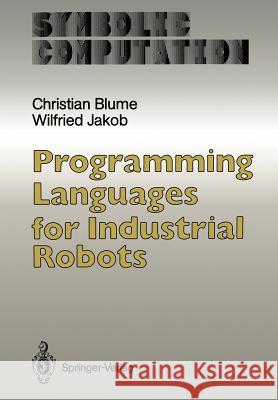
Christian Blume; Wilfried Jakob; K. Selke
Programming Languages for Industrial Robots Christian Blume Wilfried Jakob K. Selke 9783642827471 Springer - książkaWidoczna okładka, to zdjęcie poglądowe, a rzeczywista szata graficzna może różnić się od prezentowanej.

Programming Languages for Industrial Robots

ISBN-13: 9783642827471 / Angielski / Miękka / 2011 / 376 str.

Christian Blume; Wilfried Jakob; K. Selke
cena 201,72 zł
(netto: 192,11 VAT:  5%)

Najniższa cena z 30 dni: 192,74 zł
Termin realizacji zamówienia:
ok. 22 dni roboczych
Bez gwarancji dostawy przed świętami

Darmowa dostawa!

Previous works on industrial robots dealt with "programming" and "programming languages" only in passing; no comparison was made between characteristics of the individual programming lan guages. This book, therefore, gives a detailed account of industrial robot programming and its environment. Mter introducing basic concepts special attention is paid to the language constructs relevant to robot programming. The features of various elements of the languages ex amined are compared. The languages are based on the following concepts: SRL - high-level programming language based on AL with PASCAL elements (University of Karlsruhe, F. R G. ) PASRO - integrated into PASCAL, based on the geometrical data types of SRL (I. I. -BIOMATIC Informatics Institute, Freiburg, F. RG. ) AL - derived from the high-level programming language ALGOL (Stanford University, U. S. A., and University of Karls ruhe, F. RG. ) AML - high-level programming language, influenced by PL/1 (IBM, U. S. A. ) VAL - language specifically developed for robots (Unimation, U. S. A. ) HELP - mixture of high-level language elements and robot l- guage elements and real-time processing (DEA, Italy) SIGLA - a simple machine language (Olivetti, Italy) ROBEX - based on NC programming (Technical College (RWTH), Aachen, F. RG. ) RAIL - high-level programming language for industrial robots with elements for graphic processing (Automatix, U. S. A. ) IRDATA - general software interface between programming and robot controller (Association of German Engineers (VDI), F. R G."


Kategorie:
Informatyka, Bazy danych
Kategorie BISAC:
Computers > Design, Graphics & Media - CAD-CAM
Computers > Artificial Intelligence - General
Computers > Languages - General
Wydawca:
Springer
Seria wydawnicza:
Symbolic Computation / Artificial Intelligence
Język:
Angielski
ISBN-13:
9783642827471
Rok wydania:
2011
Wydanie:
Softcover Repri
Numer serii:
000307844
Ilość stron:
376
Waga:
0.62 kg
Wymiary:
24.41 x 16.99 x 2.06
Oprawa:
Miękka
Wolumenów:
01

1 Introduction.- 2 Fundamentals.- 2.1 Terminology.- 2.2 Concepts in Computer Science.- 2.2.1 Variables.- 2.2.1.1 Treatment of Variables from a Programmer’s Viewpoint.- 2.2.1.2 Treatment of Variables During Program Execution.- 2.2.1.3 Evaluation of Variable Addresses.- 2.2.1.4 Representation of Variable Addresses.- 2.2.2 Principle of Stack Operation.- 2.2.3 Block Structuring.- 2.2.3.1 Scope and Life Span of Variables.- 2.2.3.2 Block Structures and Memory Allocation.- 2.2.3.3 Memory Organization on the Stack.- 2.2.4 Subroutines, Procedures, Functions and Macros.- 2.2.4.1 Subroutines.- 2.2.4.2 Procedures and Functions.- 2.2.4.3 Macros.- 2.2.5 Recursion.- 2.2.6 Processes, Tasks and Coroutines.- 2.2.7 Synchronization.- 2.3 Concepts for Robot Languages.- 2.3.1 The Concepts of Frames.- 2.3.2 Coordinate Transformations and Trajectory Planning.- 2.3.3 Types of Move Control for Industrial Robots.- 2.3.4 Programming Languages on Mainframe Computers..- 2.3.5 Robot-Specific Programming Languages.- 2.3.6 NC Programming.- 2.3.7 Production Schedules, Colloquial Language.- 2.3.8 World Models.- 3 Data Structures.- 3.1 Data Objects.- 3.1.1 Declarations.- 3.1.2 Definitions of Constants.- 3.1.3 Standard Data Types.- 3.1.4 Geometric Data Types.- 3.1.5 Structured Data Types.- 3.1.5.1 Arrays.- 3.1.5.2 Records.- 3.1.5.3 Files.- 3.1.5.4 Aggregates.- 3.1.6 Pointer Type and Word Model.- 3.2 Manipulation of Data.- 3.2.1 Operators.- 3.2.1.1 Arithmetic Operators.- 3.2.1.2 Geometric Operators.- 3.2.1.3 Comparing Operators.- 3.2.1.4 Logical Operators.- 3.2.2 Standard Functions.- 3.2.3 Complex Expressions.- 3.3 Assignments.- 3.3.1 Value Assignments.- 3.3.2 Inputs.- 3.3.2.1 User Inputs.- 3.3.2.2 Reading of Current Robot Position and Orientation.- 3.3.3 Assignments to Pointers.- 3.4 Output of Text and Numbers.- 4 Instructions.- 4.1 Instructions for World Models.- 4.2 Motion Instructions.- 4.2.1 Implicit Motion Instructions.- 4.2.2 Explicit Motion Instructions.- 4.2.3 Simple Motion Instructions.- 4.2.4 Motion Instructions with Parameters.- 4.2.5 Motion Instructions with Sensor Integration.- 4.2.5.1 Motion Instructions with Sensory Monitoring.- 4.2.5.2 Motion Instructions with Sensor-Monitored Parameters.- 4.2.6 Motion Instructions with Event Monitoring.- 4.2.7 Motion Instructions with Time-Out Monitoring.- 4.2.8 Parallel Processing.- 4.2.9 Moving to a Home Position.- 4.3 Effector Instructions.- 4.3.1 Simple Effector Instructions.- 4.3.2 Effector Instructions with Parameters.- 4.3.3 Effector Instructions with Sensory Monitoring.- 4.3.4 Effector Instructions with Sensor-Monitored Parameters.- 4.4 Stopping a Robot or Effector Movement.- 4.5 Sensor Instructions.- 4.5.1 Program Branching Subject to Sensory Information..- 4.5.2 Input of Sensory Information.- 4.5.3 Sensory Monitoring.- 4.5.4 Sensor Instructions for Vision Systems.- 4.6 Block Structuring and Instruction Sequencing.- 4.7 Program Flow Control.- 4.7.1 Program Branches.- 4.7.1.1 Conditional Branches.- 4.7.1.2 Case Statements.- 4.7.2 Loops.- 4.7.2.1 Counting Loops.- 4.7.2.2 Conditional Loops.- 4.7.3 Synchronization Commands.- 4.7.4 Wait Instructions.- 4.8 System Switches and Status Report.- 4.9 Treatment of Exceptional Situations.- 5 Integration of a Teach-In Procedure.- 6 Subroutines, Procedures and Functions.- 6.1 Subroutines.- 6.2 Procedures.- 6.3 Functions.- 6.4 Recursive Procedures and Functions.- 7 Multitasking and Synchronization.- 7.1 Parallel Blocks.- 7.2 Tasks.- 7.3 Coroutines.- 8 Programming and Run-Time Systems.- 8.1 Editor.- 8.2 Compiler and Processor.- 8.3 Interactive Component.- 8.4 Run-Time System.- 8.4.1 Interpreter.- 8.4.2 Motion Control.- 8.5 Software Interface IRDATA.- 8.5.1 Different Levels of Programming and Control.- 8.5.1.1 Descriptive Elements in Software Interfaces.- 8.5.1.2 Action Elements in Software Interfaces.- 8.5.2 Intention and Structure of IRDATA.- 8.5.3 IRDATA Interpreter and Move Control Interface.- 8.6 Simulators and Program Test.- 8.7 Implementation.- References.- Appendix A: SRL.- I. Main Elements of SRL.- II. Syntax Diagrams.- Appendix B: PASRO.- I. Summary of PASRO Procedures.- II. Predefined Datatypes and Variables of PASRO.- Appendix C: PASCAL.- Appendix D: AL.- Appendix E: AML.- I. Motion Control.- II. Safety Instructions.- III. Sensor Instructions.- IV. Arithmetic.- V. Data Manipulation.- VI. Calibration.- Appendix F: VAL-II.- I. Monitor Commands.- II. Program Instructions.- III. Real-Value Functions.- IV. Location Functions.- Appendix G: HELP.- Appendix H: SIGLA.- Appendix I: ROBEX.- I. Short Reference Manual.- II. Addendum: Planned or Realized Extensions to ROBEX.- III. ROBEX-M-(Quick Reference).- Appendix J: RAIL.- Appendix K: IRDATA.- Appendix L: Table of Comparison.


Udostępnij

Facebook - konto krainaksiazek.pl


Opinie o Krainaksiazek.pl na Opineo.pl

Partner Mybenefit

Krainaksiazek.pl w programie rzetelna firma Krainaksiaze.pl - płatności przez paypal

Czytaj nas na:

Facebook - krainaksiazek.pl
  • książki na zamówienie
  • granty
  • książka na prezent
  • kontakt
  • pomoc
  • opinie
  • regulamin
  • polityka prywatności

Zobacz:

  • Księgarnia czeska

  • Wydawnictwo Książkowe Klimaty

1997-2025 DolnySlask.com Agencja Internetowa

© 1997-2022 krainaksiazek.pl
     
KONTAKT | REGULAMIN | POLITYKA PRYWATNOŚCI | USTAWIENIA PRYWATNOŚCI
Zobacz: Księgarnia Czeska | Wydawnictwo Książkowe Klimaty | Mapa strony | Lista autorów
KrainaKsiazek.PL - Księgarnia Internetowa

Polityka prywatnosci - link
Krainaksiazek.pl - płatnośc Przelewy24
Przechowalnia Przechowalnia





