• Wyszukiwanie zaawansowane
  • Kategorie
  • Kategorie BISAC
  • Książki na zamówienie
  • Promocje
  • Granty
  • Książka na prezent
  • Opinie
  • Pomoc
  • Załóż konto
  • Zaloguj się

Processor Architecture: From Dataflow to Superscalar and Beyond » książka


zaloguj się | załóż konto
Logo Krainaksiazek.pl

koszyk

konto

szukaj
topmenu
Księgarnia internetowa
Szukaj
Książki na zamówienie
Promocje
Granty
Książka na prezent
Moje konto
Pomoc
 
 
Wyszukiwanie zaawansowane
Pusty koszyk
Bezpłatna dostawa dla zamówień powyżej 20 złBezpłatna dostawa dla zamówień powyżej 20 zł

Kategorie główne

• Nauka
 [2946600]
• Literatura piękna
 [1856966]

  więcej...
• Turystyka
 [72221]
• Informatyka
 [151456]
• Komiksy
 [35826]
• Encyklopedie
 [23190]
• Dziecięca
 [619653]
• Hobby
 [140543]
• AudioBooki
 [1577]
• Literatura faktu
 [228355]
• Muzyka CD
 [410]
• Słowniki
 [2874]
• Inne
 [445822]
• Kalendarze
 [1744]
• Podręczniki
 [167141]
• Poradniki
 [482898]
• Religia
 [510455]
• Czasopisma
 [526]
• Sport
 [61590]
• Sztuka
 [243598]
• CD, DVD, Video
 [3423]
• Technologie
 [219201]
• Zdrowie
 [101638]
• Książkowe Klimaty
 [124]
• Zabawki
 [2473]
• Puzzle, gry
 [3898]
• Literatura w języku ukraińskim
 [254]
• Art. papiernicze i szkolne
 [8170]
Kategorie szczegółowe BISAC

Processor Architecture: From Dataflow to Superscalar and Beyond

ISBN-13: 9783540647980 / Angielski / Miękka / 1999 / 416 str.
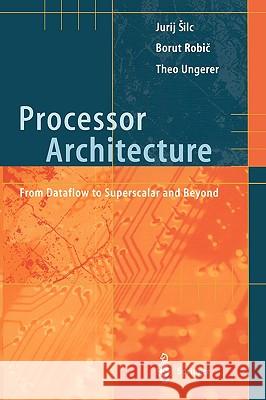
Borut Robic; Jurij Silc; Theo Ungerer
Processor Architecture: From Dataflow to Superscalar and Beyond Silc, Jurij 9783540647980 Springer - książkaWidoczna okładka, to zdjęcie poglądowe, a rzeczywista szata graficzna może różnić się od prezentowanej.

Processor Architecture: From Dataflow to Superscalar and Beyond

ISBN-13: 9783540647980 / Angielski / Miękka / 1999 / 416 str.

Borut Robic; Jurij Silc; Theo Ungerer
cena 363,12 zł
(netto: 345,83 VAT:  5%)

Najniższa cena z 30 dni: 346,96 zł
Termin realizacji zamówienia:
ok. 22 dni roboczych
Bez gwarancji dostawy przed świętami

Darmowa dostawa!

Today's microprocessors are the powerful descendants of the von Neumann 1 computer dating back to a memo of Burks, Goldstine, and von Neumann of 1946. The so-called von Neumann architecture is characterized by a se quential control flow resulting in a sequential instruction stream. A program counter addresses the next instruction if the preceding instruction is not a control instruction such as, e. g., jump, branch, subprogram call or return. An instruction is coded in an instruction format of fixed or variable length, where the opcode is followed by one or more operands that can be data, addresses of data, or the address of an instruction in the case of a control instruction. The opcode defines the types of operands. Code and data are stored in a common storage that is linear, addressed in units of memory words (bytes, words, etc. ). The overwhelming design criterion of the von Neumann computer was the minimization of hardware and especially of storage. The most simple implementation of a von Neumann computer is characterized by a microar chitecture that defines a closely coupled control and arithmetic logic unit (ALU), a storage unit, and an I/O unit, all connected by a single connection unit. The instruction fetch by the control unit alternates with operand fetches and result stores for the AL U."


Kategorie:
Informatyka, Sprzęt komputerowy
Kategorie BISAC:
Computers > Hardware - Chips & Processors
Computers > Computer Architecture
Wydawca:
Springer
Język:
Angielski
ISBN-13:
9783540647980
Rok wydania:
1999
Wydanie:
Softcover Repri
Ilość stron:
416
Waga:
0.62 kg
Wymiary:
23.67 x 15.6 x 2.46
Oprawa:
Miękka
Wolumenów:
01

1. Basic Pipelining and Simple RISC Processors.- 1.1 The RISC Movement in Processor Architecture.- 1.2 Instruction Set Architecture.- 1.3 Examples of RISC ISAs.- 1.4 Basic Structure of a RISC Processor and Basic Cache MMU Organization.- 1.5 Basic Pipeline Stages.- 1.6 Pipeline Hazards and Solutions.- 1.6.1 Data Hazards and Forwarding.- 1.6.2 Structural Hazards.- 1.6.3 Control Hazards, Delayed Branch Technique, and Static Branch Prediction.- 1.6.4 Multicycle Execution.- 1.7 RISC Processors.- 1.7.1 Early Scalar RISC Processors.- 1.7.2 Sun microSPARC-II.- 1.7.3 MIPS R3000.- 1.7.4 MIPS R4400.- 1.7.5 Other Scalar RISC Processors.- 1.7.6 Sun picoJava-I.- 1.8 Lessons learned from RISC.- 2. Dataflow Processors.- 2.1 Dataflow Versus Control-Flow.- 2.2 Pure Dataflow.- 2.2.1 Static Dataflow.- 2.2.2 Dynamic Dataflow.- 2.2.3 Explicit Token Store Approach.- 2.3 Augmenting Dataflow with Control-Flow.- 2.3.1 Threaded Dataflow.- 2.3.2 Large-Grain Dataflow.- 2.3.3 Dataflow with Complex Machine Operations.- 2.3.4 RISC Dataflow.- 2.3.5 Hybrid Dataflow.- 2.4 Lessons learned from Dataflow.- 3. CISC Processors.- 3.1 A Brief Look at CISC Processors.- 3.2 Out-of-Order Execution.- 3.3 Dynamic Scheduling.- 3.3.1 Scoreboarding.- 3.3.2 Tomasulo’s Scheme.- 3.3.3 Scoreboarding versus Tomasulo’s Scheme.- 3.4 Some CISC Microprocessors.- 3.5 Conclusions.- 4. Multiple-Issue Processors.- 4.1 Overview of Multiple-Issue Processors.- 4.2 I-Cache Access and Instruction Fetch.- 4.3 Dynamic Branch Prediction and Control Speculation.- 4.3.1 Branch-Target Buffer or Branch-Target Address Cache.- 4.3.2 Static Branch Prediction Techniques.- 4.3.3 Dynamic Branch Prediction Techniques.- 4.3.4 Predicated Instructions and Multipath Execution.- 4.3.5 Prediction of Indirect Branches.- 4.3.6 High-Bandwidth Branch Prediction.- 4.4 Decode.- 4.5 Rename.- 4.6 Issue and Dispatch.- 4.7 Execution Stages.- 4.8 Finalizing Pipelined Execution.- 4.8.1 Completion, Commitment, Retirement and Write-Back.- 4.8.2 Precise Interrupts.- 4.8.3 Reorder Buffers.- 4.8.4 Checkpoint Repair Mechanism and History Buffer.- 4.8.5 Relaxing In-order Retirement.- 4.9 State-of-the-Art Superscalar Processors.- 4.9.1 Intel Pentium family.- 4.9.2 AMD-K5, K6 and K7 families.- 4.9.3 Cyrix M II and M 3 Processors.- 4.9.4 DEC Alpha 21x64 family.- 4.9.5 Sun UltraSPARC family.- 4.9.6 HAL SPARC64 family.- 4.9.7 HP PA-7000 family and PA-8000 family.- 4.9.8 MIPS R10000 and descendants.- 4.9.9 IBM POWER family.- 4.9.10 IBM/Motorola/Apple PowerPC family.- 4.9.11 Summary.- 4.10 VLIW and EPIC Processors.- 4.10.1 TI TMS320C6x VLIW Processors.- 4.10.2 EPIC Processors, Intel’s IA-64 ISA and Merced Processor.- 4.11 Conclusions on Multiple-Issue Processors.- 5. Future Processors to use Fine-Grain Parallelism.- 5.1 Trends and Principles in the Giga Chip Era.- 5.1.1 Technology Trends.- 5.1.2 Application-and Economy-Related Trends.- 5.1.3 Architectural Challenges and Implications.- 5.2 Advanced Superscalar Processors.- 5.3 Superspeculative Processors.- 5.4 Multiscalar Processors.- 5.5 Trace Processors.- 5.6 DataScalar Processors.- 5.7 Conclusions.- 6. Future Processors to use Coarse-Grain Parallelism.- 6.1 Utilization of more Coarse-Grain Parallelism.- 6.2 Chip Multiprocessors.- 6.2.1 Principal Chip Multiprocessor Alternatives.- 6.2.2 TI TMS320C8x Multimedia Video Processors.- 6.2.3 Hydra Chip Multiprocessor.- 6.3 Multithreaded Processors.- 6.3.1 Multithreading Approach for Tolerating Latencies.- 6.3.2 Comparison of Multithreading and Non-Multithreading Approaches.- 6.3.3 Cycle-by-Cycle Interleaving.- 6.3.4 Block Interleaving.- 6.3.5 Nanothreading and Microthreading.- 6.4 Simultaneous Multithreading.- 6.4.1 SMT at the University of Washington.- 6.4.2 Karlsruhe Multithreaded Superscalar.- 6.4.3 Other Simultaneous Multithreading Processors.- 6.5 Simultaneous Multithreading versus Chip Multiprocessor.- 6.6 Conclusions.- 7. Processor-in-Memory, Reconfigurable, and Asynchronous Processors.- 7.1 Processor-in-Memory.- 7.1.1 The Processor-in-Memory Principle.- 7.1.2 Processor-in-Memory approaches.- 7.1.3 The Vector IRAM approach.- 7.1.4 The Active Page model.- 7.2 Reconfigurable Computing.- 7.2.1 Concepts of Reconfigurable Computing.- 7.2.2 The MorphoSys system.- 7.2.3 Raw Machine.- 7.2.4 Xputers and KressArrays.- 7.2.5 Other Projects.- 7.3 Asynchronous Processors.- 7.3.1 Asynchronous Logic.- 7.3.2 Projects.- 7.4 Conclusions.- Acronyms.- References.

Prof. Dr. Theo Ungerer ist Professor für Systemnahe Informatik mit Schwerpunkt Kommunikationssysteme und Internet-Anwendungen am Institut für Informatik der Universität Augsburg. Zudem ist er wissenschaftlicher Direktor des Rechenzentrums und Mitglied des Lenkungsrates des IT-Servicezentrums der Universität Augsburg.
Seine wissenschaftlichen Interessen gelten den Gebieten der Prozessorarchitektur sowie der eingebetteten und ubiquitären Systeme. Theo Ungerer hat über 150 wissenschaftliche Publikationen und 6 Fachbücher veröffentlicht. Er ist Mitglied des Lenkungsrates und deutscher Koordinator des EU-Exzellenznetzwerkes HiPEAC- High Performance Embedded Architectures and Compilers

This monograph surveys architectural mechanisms and implementation techniques for exploiting fine-grained and coarse-grained parallelism within microprocessors. It starts with a review of past techniques, continues with a comprehensive account of state-of-the-art techniques used in microprocessors that covers both the concepts involved and implementations in sample processors, and ends with a thorough review of the research techniques that will lead to future microprocessors.


Udostępnij

Facebook - konto krainaksiazek.pl


Opinie o Krainaksiazek.pl na Opineo.pl

Partner Mybenefit

Krainaksiazek.pl w programie rzetelna firma Krainaksiaze.pl - płatności przez paypal

Czytaj nas na:

Facebook - krainaksiazek.pl
  • książki na zamówienie
  • granty
  • książka na prezent
  • kontakt
  • pomoc
  • opinie
  • regulamin
  • polityka prywatności

Zobacz:

  • Księgarnia czeska

  • Wydawnictwo Książkowe Klimaty

1997-2025 DolnySlask.com Agencja Internetowa

© 1997-2022 krainaksiazek.pl
     
KONTAKT | REGULAMIN | POLITYKA PRYWATNOŚCI | USTAWIENIA PRYWATNOŚCI
Zobacz: Księgarnia Czeska | Wydawnictwo Książkowe Klimaty | Mapa strony | Lista autorów
KrainaKsiazek.PL - Księgarnia Internetowa

Polityka prywatnosci - link
Krainaksiazek.pl - płatnośc Przelewy24
Przechowalnia Przechowalnia





