• Wyszukiwanie zaawansowane
  • Kategorie
  • Kategorie BISAC
  • Książki na zamówienie
  • Promocje
  • Granty
  • Książka na prezent
  • Opinie
  • Pomoc
  • Załóż konto
  • Zaloguj się

Proceedings of the Fourth International Congress on Mathematical Education » książka


zaloguj się | załóż konto
Logo Krainaksiazek.pl

koszyk

konto

szukaj
topmenu
Księgarnia internetowa
Szukaj
Książki na zamówienie
Promocje
Granty
Książka na prezent
Moje konto
Pomoc
 
 
Wyszukiwanie zaawansowane
Pusty koszyk
Bezpłatna dostawa dla zamówień powyżej 20 złBezpłatna dostawa dla zamówień powyżej 20 zł

Kategorie główne

• Nauka
 [2946912]
• Literatura piękna
 [1852311]

  więcej...
• Turystyka
 [71421]
• Informatyka
 [150889]
• Komiksy
 [35717]
• Encyklopedie
 [23177]
• Dziecięca
 [617324]
• Hobby
 [138808]
• AudioBooki
 [1671]
• Literatura faktu
 [228371]
• Muzyka CD
 [400]
• Słowniki
 [2841]
• Inne
 [445428]
• Kalendarze
 [1545]
• Podręczniki
 [166819]
• Poradniki
 [480180]
• Religia
 [510412]
• Czasopisma
 [525]
• Sport
 [61271]
• Sztuka
 [242929]
• CD, DVD, Video
 [3371]
• Technologie
 [219258]
• Zdrowie
 [100961]
• Książkowe Klimaty
 [124]
• Zabawki
 [2341]
• Puzzle, gry
 [3766]
• Literatura w języku ukraińskim
 [255]
• Art. papiernicze i szkolne
 [7810]
Kategorie szczegółowe BISAC

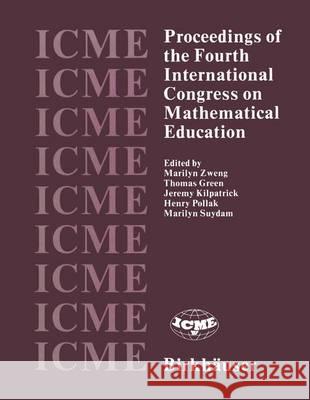
Proceedings of the Fourth International Congress on Mathematical Education

ISBN-13: 9780817630829 / Angielski / Miękka / 1983 / 725 str.
M. Zweng; Anna Green;Kilpatrick
Proceedings of the Fourth International Congress on Mathematical Education Zweng, M. 9780817630829 Birkhauser Boston - książkaWidoczna okładka, to zdjęcie poglądowe, a rzeczywista szata graficzna może różnić się od prezentowanej.

Proceedings of the Fourth International Congress on Mathematical Education

ISBN-13: 9780817630829 / Angielski / Miękka / 1983 / 725 str.

M. Zweng; Anna Green;Kilpatrick
cena 322,61
(netto: 307,25 VAT:  5%)

Najniższa cena z 30 dni: 308,26
Termin realizacji zamówienia:
ok. 22 dni roboczych
Bez gwarancji dostawy przed świętami

Darmowa dostawa!

Henry O. Pollak Chairman of the International Program Committee Bell Laboratories Murray Hill, New Jersey, USA The Fourth International Congress on Mathematics Education was held in Berkeley, California, USA, August 10-16, 1980. Previous Congresses were held in Lyons in 1969, Exeter in 1972, and Karlsruhe in 1976. Attendance at Berkeley was about 1800 full and 500 associate members from about 90 countries; at least half of these come from outside of North America. About 450 persons participated in the program either as speakers or as presiders; approximately 40 percent of these came from the U.S. or Canada. There were four plenary addresses; they were delivered by Hans Freudenthal on major problems of mathematics education, Hermina Sinclair on the relationship between the learning of language and of mathematics, Seymour Papert on the computer as carrier of mathematical culture, and Hua Loo-Keng on popularising and applying mathematical methods. Gearge Polya was the honorary president of the Congress; illness prevented his planned attendence but he sent a brief presentation entitled, "Mathematics Improves the Mind." There was a full program of speakers, panelists, debates, miniconferences, and meetings of working and study groups. In addition, 18 major projects from around the world were invited to make presentations, and various groups representing special areas of concern had the opportunity to meet and to plan their future activities.


Kategorie:
Nauka, Matematyka
Kategorie BISAC:
Mathematics > Matematyka
Gardening > General
Science > Study & Teaching
Wydawca:
Birkhauser Boston
Język:
Angielski
ISBN-13:
9780817630829
Rok wydania:
1983
Wydanie:
1983
Ilość stron:
725
Oprawa:
Miękka
Wolumenów:
01

1 — Plenary Session Addresses.- 1.1 Mathematics Improves the Mind.- 1.2 Major Problems of Mathematics Education.- 1.3 Young Children’s Acquisition of Language and Understanding of Mathematics.- Reactions to Hermina Sinclair’s Plenary Lecture.- 1.4 Some Experiences in Popularizing Mathematical Methods.- Reactions to Hua Loo-keng’s Plenary Lecture.- 2 — Universal Basic Education.- 2.1 Mathematics in General Primary Education.- 2.2 Back-to-Basics: Past, Present, Future.- 2.3 Suggested Mathematics Curricula for Students Who Leave School at Early Ages.- 3 — Elementary Education.- 3.1 Roots of Failure in Primary School Arithmetic.- 3.2 Do We Still Need Fractions in the ELementary Curriculum?.- 4 — Post-Secondary Education.- 4.1 Decline in Post-Secondary Students Continuing the Study of Mathematics.- 4.2 Is Calculus Essential?.- 4.3 Mathematics and the Physical Science and Engineering.- 4.4 Why We Must and How We Can Improve the Teaching of Post-Secondary Mathematics.- 4.5 Alternate Approaches to Beginning the Teaching of Calculus and the Effectiveness of These Methods.- 4.6 In What Ways Have the Mathematical Preparation of Students for Post-Secondary Mathematics Courses Changed?.- 4.7 Curriculum for A Mathematical Sciences Major.- 4.8 University Programs with an Industrial Problem Focus.- 5 — The Profession of Teaching.- 5.1 Current Status and Trends in Teacher Education.- 5.2 Integration of Content and Pedagogy in Pre-Service Teacher Education.- 5.3 Preparation in Mathematics of a Prospective Elementary Teacher Today, in View of the Current Trends in Mathematics, in Schools, and in Society.- 5.4 Evaluation of Teachers and Their Teaching.- 5.5 Hand-held Calculators and Teacher Education.- 5.6 Computers in Mathematics Teacher Education.- 5.7 The Mathematical Preparation of Secondary Teachers — Content and Method.- 5.8 Special Assistance for the Beginning Teacher.- 5.9 The Making of a Professional Mathematics Teacher.- 5.10 The Dilemma of Teachers Between Teaching What They Like and Teaching What the Pupils Need to Know: How Much Freedom Should Teachers Have to Add Materials, How Much Material, Which Teachers?.- 5.11 Integration of Mathematical and Pedagogical Content In-Service Teacher Education: Successful and Unsuccessful Attempts.- 5.12 In-Service Education for Secondary Teachers.- 5.13 Support Services for Teachers of Mathematics.- 5.14 What is a Professional Teacher of Mathematics?.- 6 — Geometry.- 6.1 Geometry in the Secondary School.- 6.2 Geometric Activities in the Elementary School.- 6.3 The Death of Geometry at the Post-Secondary Level.- 6.4 The Development of Children’s Spatial Ideas.- 7 — Stochastics.- 7.1 Statistics: Probability: Computer Science: Mathematics. Many Phases of One Program?.- 7.2 Vigor, Variety and Vision -- the Vitality of Statistics and Probability.- 7.3 The Place of Probability in the Curriculum.- 7.4 The Nature of Statistics to be Taught in Schools.- 7.5 Statistics and Probability in Teacher Education.- 8 — Applications.- 8.1 Mathematics and the Biological Sciences — Implications for Teaching.- 8.2 The Relationship of Mathematics and the Teaching of Mathematics with the Social Sciences.- 8.3 Applications, Modeling and Teacher Education.- 8.4 The Use of Modules to Introduce Applied Mathematics into the Curriculum.- 8.5 Teaching Applications of Mathematics.- 8.6 The Interface between Mathematics and Imployment.- 8.7 How Effective are Integrated Courses in Mathematics and Science for the Teaching of Mathematics?.- 8.8 Materials Available Worldwide for Teaching Applications of Mathematics at the School Level.- 8.9 Mutualism in Pure and Applied Mathematics.- 9 — Problem Solving.- 9.1 Teaching for Effective Problem Solving: A Challenging Problem.- 9.2 Real Problem Solving.- 9.3 Mathematization, Its Nature and Its Use in Education.- 9.4 The Mathematization of Situations Outside Mathematics from an Educational Point of View.- 10 — Special Mathematical Topics.- 10.1 Algebraic Coding Theory.- 10.2 Combinatorics.- 10.3 The Impact of Algorithms on Mathematics Teaching.- 10.4 Operations Research.- 10.5 Maxima and Minima Without Calculus.- 10.6 Exploratory Data Analysis.- 11 — Mathematics Curriculum.- 11.1 Successes and Failures of Mathematics Curricula in the Past Two Decades.- 11.2 Curriculum Recommendations for the 1980’s by Several National Committees.- 11.3 Curriculum Changes During the 1980’s.- 11.4 The Changing Curriculum — An International Perspective.- 11.5 Models of Curriculum Development.- 11.6 Mathematics for Secondary School Students.- 11.7 What Should be Dropped from the Secondary School Mathematics Curriculum to Make Room for New Topics?.- 11.8 Alternative Approaches to the Teaching of Algebra in the Secondary School.- 11.9 How Can You Use History of Mathematics in Teaching Mathematics in Primary and Secondary Schools?.- 12 — The Begle Memorial Series on Research in Mathematics Education.- 12.1 Critical Variables in Mathematics Education.- 12.2 Some Critical Variables Revisited.- 12.3 Some New Directions for Research in Mathematics Education.- 13 — Research in Mathematics Education.- 13.1 The Relevance of Philosophy and History of Science and Mathematics for Mathematical Education.- 13.2 Research in Mathematical Problem Solving.- 13.3 Researchable Questions Asked by Teachers.- 13.4 Alternative Methodologies for Research in Mathematics Education.- 13.5 Error Analyses of Childrens’ Arithmetic Performance.- 13.6 Comparative Study of the Development of Mathematical Education as a Professional Discipline in Different Countries.- 13.7 The Development of Mathematical Abilities in Children.- 13.8 The Child’s Concept of Number.- 13.9 Relation Between Research on Mathematics Education and Research on Science Education. Problems of Common Interest and Future Cooperation.- 13.10 Central Research Institutes for Mathematical Education. What Can They Contribute to the Development of the Discipline and the Interrelation between Theory and Practice?.- 13.11 The Functioning of Intelligence and the Understanding of Mathematics.- 13.12 The Young Adolescent’s Understanding of Mathematics.- 14 — Assessment.- 14.1 Assessing Pupils’ Performance in Mathematics.- 14.2 Issues, Methods and Results of National Mathematics Assessments.- 15 — Competitions.- 15.1 Mathematical Competitions, Contests, Olympiads.- 15.2 Mathematics Competitions: Philosophy, Organization and Content.- 16 — Language and Mathematics.- 16.1 Language and the Teaching of Mathematics.- 16.2 The Relationship Between the Development of Language in Children and the Development of Mathematical Concepts in Children.- 16.3 Teaching Mathematics in a Second Language.- 17 — Objectives.- 17.1 Teaching for Combined Process and Content Objectives.- 17.2 The Complementary Role of Intuitive and Analytical Reasoning.- 18 — Technology.- 18.1 The Effect of the Use of Calculators on the Initial Development and Acquisition of Mathematical Concepts and Skills.- 18.2 A Mini-Course on Symbolic and Algebraic Computer Programming Systems.- 18.3 The Use of Programmable Calculators in the Teaching of Mathematics.- 18.4 Perspectives and Experiences with Computer-Assisted Instruction in Mathematics.- 18.5 Computer Literacy / Awareness in Schools; What, How and for Whom?.- 18.6 The Technological Revolution and Its Impact on Mathematics Education.- 18.7 Calculators in the Pre-Secondary School.- 19 — Forms and Modes of Instruction.- 19.1 Distance Education for School-age Children.- 19.2 Teaching Mathematics in Mixed-Ability Groups.- 19.3 Approaching Mathematics through the Arts.- 19.4 The Use and Effectiveness of Mathematics instructional Games.- 19.5 Strategies for Improving Remediation Efforts.- 19.6 Individualized Instruction and Programmed Instruction.- 20 — Women and Mathematics.- 20.1 A Community Action Model to Increase the Participation of Girls and Young Women in Mathematics.- 20.2 Contributions by Women to Mathematics Education.- 20.3 The Status of Women and Girls in Mathematics: Progress and Problems.- 20.4 Special Problems of Women in Mathematics.- 21 — Special Groups of Students.- 21.1 Curriculum Organizations and Teaching Modes That Successfully Provide for the Gifted Learner.- 21.2 Distance Education for Adults.- 21.3 Adult Numeracy — Programmes for Adults Not in School.- 21.4 Problems of Defining the Mathematics Curriculum in Rural Communities.- 21.5 Participation of the Handicapped in Mathematics.

Green, Anna Anna Green is Senior Lecturer in History at the Un... więcej >


Udostępnij

Facebook - konto krainaksiazek.pl


Opinie o Krainaksiazek.pl na Opineo.pl

Partner Mybenefit

Krainaksiazek.pl w programie rzetelna firma Krainaksiaze.pl - płatności przez paypal

Czytaj nas na:

Facebook - krainaksiazek.pl
  • książki na zamówienie
  • granty
  • książka na prezent
  • kontakt
  • pomoc
  • opinie
  • regulamin
  • polityka prywatności

Zobacz:

  • Księgarnia czeska

  • Wydawnictwo Książkowe Klimaty

1997-2025 DolnySlask.com Agencja Internetowa

© 1997-2022 krainaksiazek.pl
     
KONTAKT | REGULAMIN | POLITYKA PRYWATNOŚCI | USTAWIENIA PRYWATNOŚCI
Zobacz: Księgarnia Czeska | Wydawnictwo Książkowe Klimaty | Mapa strony | Lista autorów
KrainaKsiazek.PL - Księgarnia Internetowa

Polityka prywatnosci - link
Krainaksiazek.pl - płatnośc Przelewy24
Przechowalnia Przechowalnia






