• Wyszukiwanie zaawansowane
  • Kategorie
  • Kategorie BISAC
  • Książki na zamówienie
  • Promocje
  • Granty
  • Książka na prezent
  • Opinie
  • Pomoc
  • Załóż konto
  • Zaloguj się

Proceedings of Second Asian Symposium on Cellular Automata Technology: ASCAT 2023 » książka


zaloguj się | załóż konto
Logo Krainaksiazek.pl

koszyk

konto

szukaj
topmenu
Księgarnia internetowa
Szukaj
Książki na zamówienie
Promocje
Granty
Książka na prezent
Moje konto
Pomoc
 
 
Wyszukiwanie zaawansowane
Pusty koszyk
Bezpłatna dostawa dla zamówień powyżej 20 złBezpłatna dostawa dla zamówień powyżej 20 zł

Kategorie główne

• Nauka
 [2946600]
• Literatura piękna
 [1856966]

  więcej...
• Turystyka
 [72221]
• Informatyka
 [151456]
• Komiksy
 [35826]
• Encyklopedie
 [23190]
• Dziecięca
 [619653]
• Hobby
 [140543]
• AudioBooki
 [1577]
• Literatura faktu
 [228355]
• Muzyka CD
 [410]
• Słowniki
 [2874]
• Inne
 [445822]
• Kalendarze
 [1744]
• Podręczniki
 [167141]
• Poradniki
 [482898]
• Religia
 [510455]
• Czasopisma
 [526]
• Sport
 [61590]
• Sztuka
 [243598]
• CD, DVD, Video
 [3423]
• Technologie
 [219201]
• Zdrowie
 [101638]
• Książkowe Klimaty
 [124]
• Zabawki
 [2473]
• Puzzle, gry
 [3898]
• Literatura w języku ukraińskim
 [254]
• Art. papiernicze i szkolne
 [8170]
Kategorie szczegółowe BISAC

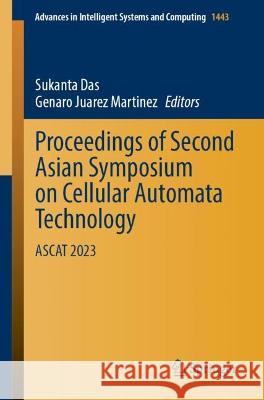
Proceedings of Second Asian Symposium on Cellular Automata Technology: ASCAT 2023

ISBN-13: 9789819906871 / Angielski
Sukanta Das; Genaro Juarez Martinez
Proceedings of Second Asian Symposium on Cellular Automata Technology: ASCAT 2023 Sukanta Das Genaro Juarez Martinez 9789819906871 Springer - książkaWidoczna okładka, to zdjęcie poglądowe, a rzeczywista szata graficzna może różnić się od prezentowanej.

Proceedings of Second Asian Symposium on Cellular Automata Technology: ASCAT 2023

ISBN-13: 9789819906871 / Angielski

Sukanta Das; Genaro Juarez Martinez
cena 887,69 zł
(netto: 845,42 VAT:  5%)

Najniższa cena z 30 dni: 848,19 zł
Termin realizacji zamówienia:
ok. 22 dni roboczych
Bez gwarancji dostawy przed świętami

Darmowa dostawa!

This book gathers selected research papers presented at the Second Asian Symposium on Cellular Automata Technology (ASCAT 2023), organized by academicians from Kolkata at Indian Institute of Engineering Science and Technology, Shibpur, West Bengal, India, and by researchers of Cellular Automata India, a research group which was created during the pandemic, during March 2–4, 2023. The book presents one of the most emergent areas in natural computing, cellular automaton (CA). CA is a paradigm of uniform fine-grained parallel computation which has been explored to understand complex systems by developing its model at the microscopic level. The book discusses many real-life problems in the domain of pattern recognition and classification, clustering, electronic circuit design, bioinformatics, material and mining engineering, modelling of physical and social systems, etc., by using CA.


This book gathers selected research papers presented at the Second Asian Symposium on Cellular Automata Technology (ASCAT 2023), organized by academicians from Kolkata at Indian Institute of Engineering Science and Technology, Shibpur, West Bengal, India, and by researchers of Cellular Automata India, a research group which was created during the pandemic, during March 2–4, 2023. The book presents one of the most emergent areas in natural computing, cellular automaton (CA). CA is a paradigm of uniform fine-grained parallel computation which has been explored to understand complex systems by developing its model at the microscopic level. The book discusses many real-life problems in the domain of pattern recognition and classification, clustering, electronic circuit design, bioinformatics, material and mining engineering, modelling of physical and social systems, etc., by using CA.

Kategorie:
Technologie
Kategorie BISAC:
Technology & Engineering > Engineering (General)
Computers > Image Processing
Wydawca:
Springer
Seria wydawnicza:
Advances in Intelligent Systems and Computing
Język:
Angielski
ISBN-13:
9789819906871

​​Part I: Invited Papers.- 1. Modelling physical systems with cellular automata.- 2. On visualization of three-dimensional cellular automata and tilings with head-mounted display.- 3. Brownian Circuits: from Computation to Neural Networks.- Part II: Accepted Papers.- 4. A Cellular Automata Based Clustering Technique for High-Dimensional Data.- 5. Cellular Automata based Sentiment Analysis.- 6. Cellular Automata with Large Cycle Generator.- 7. Design and Analysis of Regular Clock based 2:4 Decoder using T-Gate in QCA.- 8. Representation of Evolution of One-dimensional Homogeneous Cellular Automata Using Monoid Action.- 9. A Cellular Automata Based Approach on Assessment of Thickness of Stratified Mineral Deposits.- 10. On Non-linear Maximal Length Cellular Automata.- 11. Layered Cellular Automata and Pattern Classification.- 12. Analysis of One-Dimensional 4-State Cellular Automata Rules and DNA Evolutions.- 13. Modeling Spread of Contagious Disease by Temporally Stochastic Cellular Automata.- 14. Genealogy Interceded Phenotypic Analysis (GIPA) of ECA Rules.- 15. Isomorphism in Cellular Automata.- 16. A cellular automaton model for language shift in Algeria.- 17. Cellular Automata based Simulation of Intergranular Fracture using Hexagonal Discretization.

Prof. Sukanta Das currently works as an associate professor in the Department of Information Technology in Indian Institute of Engineering Science and Technology, Shibpur (formerly known as Bengal Engineering and Science University, Shibpur). He received his Ph.D. in 2007 from Bengal Engineering and Science University, Shibpur, and master’s in engineering in 2002 from Bengal Engineering College (DU) (currently known as IIEST, Shibpur) in Computer Science and Technology. He joined his alma mater as a faculty in 2003. He has been doing research in the different aspects of cellular automata for more than twenty years. His research area includes Cellular Automata: Theory and Applications. He is also a member of IFIP Working Group 1.5 (on “Cellular Automata and Discrete Complex Systems”) and several programming committees for international conferences on cellular automata. He has more than 70 articles under his name. Currently, he is exploring the computational abilities of cellular automata, non-uniformity in cellular automata,  chaos and randomness in cellular automata, and democracy and computation. Apart from the research, Prof. Das plays also an active role of science activist to advocate against pseudoscience, astrology, and mysticism, and to promote scientific outlook in society. 

Prof. Genaro Martínez is a full-time researcher at the National Polytechnic Institute in Mexico City. He is an active member of several institutions and laboratories around the world, such as the International Unconventional Computing Laboratory at the University of the West of England in the United Kingdom; the Foundation of Computer Science Laboratory at the Hiroshima University in Japan; the Centre for Chaos and Complex Networks at the City University of Hong Kong in China; the Unconventional Algorithms and Computing Lab at the Technical University of Ostrava in Czech Republic; the Laboratoire de Recherche Scientifique in France; and the Institut des Systèmes Complexes en Normandie in France. Prof. Martinez is an editorial member of the Journal of Cellular Automata, Complex Systems, Physica D, International Journal of Bifurcation and Chaos, Artificial Life, Nonlinear Dynamics, Chaos, Information Sciences, International Journal of Natural Computing Research, IEEE Transactions on Circuits and Systems, and the Mathematical Reviews, American Mathematical Society. Prof. Martinez together with Prof. Adamatzky had published the book "Designing Beauty: The Art of Cellular Automata". Also, he is leading two computational paradigms in cellular automata theory: colliders cellular automata and computation by competing patterns with cellular automata.

This book gathers selected research papers presented at the Second Asian Symposium on Cellular Automata Technology (ASCAT 2023), organized by academicians from Kolkata at Indian Institute of Engineering Science and Technology, Shibpur, West Bengal, India, and by researchers of Cellular Automata India, a research group which was created during the pandemic, during March 2–4, 2023. The book presents one of the most emergent areas in natural computing, cellular automaton (CA). CA is a paradigm of uniform fine-grained parallel computation which has been explored to understand complex systems by developing its model at the microscopic level. The book discusses many real-life problems in the domain of pattern recognition and classification, clustering, electronic circuit design, bioinformatics, material and mining engineering, modelling of physical and social systems, etc., by using CA.




Udostępnij

Facebook - konto krainaksiazek.pl


Opinie o Krainaksiazek.pl na Opineo.pl

Partner Mybenefit

Krainaksiazek.pl w programie rzetelna firma Krainaksiaze.pl - płatności przez paypal

Czytaj nas na:

Facebook - krainaksiazek.pl
  • książki na zamówienie
  • granty
  • książka na prezent
  • kontakt
  • pomoc
  • opinie
  • regulamin
  • polityka prywatności

Zobacz:

  • Księgarnia czeska

  • Wydawnictwo Książkowe Klimaty

1997-2025 DolnySlask.com Agencja Internetowa

© 1997-2022 krainaksiazek.pl
     
KONTAKT | REGULAMIN | POLITYKA PRYWATNOŚCI | USTAWIENIA PRYWATNOŚCI
Zobacz: Księgarnia Czeska | Wydawnictwo Książkowe Klimaty | Mapa strony | Lista autorów
KrainaKsiazek.PL - Księgarnia Internetowa

Polityka prywatnosci - link
Krainaksiazek.pl - płatnośc Przelewy24
Przechowalnia Przechowalnia



