• Wyszukiwanie zaawansowane
  • Kategorie
  • Kategorie BISAC
  • Książki na zamówienie
  • Promocje
  • Granty
  • Książka na prezent
  • Opinie
  • Pomoc
  • Załóż konto
  • Zaloguj się

Problems and Theorems in Analysis II: Theory of Functions. Zeros. Polynomials. Determinants. Number Theory. Geometry » książka

zaloguj się | załóż konto
Logo Krainaksiazek.pl

koszyk

konto

szukaj
topmenu
Księgarnia internetowa
Szukaj
Książki na zamówienie
Promocje
Granty
Książka na prezent
Moje konto
Pomoc
 
 
Wyszukiwanie zaawansowane
Pusty koszyk
Bezpłatna dostawa dla zamówień powyżej 20 złBezpłatna dostawa dla zamówień powyżej 20 zł

Kategorie główne

• Nauka
 [2946600]
• Literatura piękna
 [1856966]

  więcej...
• Turystyka
 [72221]
• Informatyka
 [151456]
• Komiksy
 [35826]
• Encyklopedie
 [23190]
• Dziecięca
 [619653]
• Hobby
 [140543]
• AudioBooki
 [1577]
• Literatura faktu
 [228355]
• Muzyka CD
 [410]
• Słowniki
 [2874]
• Inne
 [445822]
• Kalendarze
 [1744]
• Podręczniki
 [167141]
• Poradniki
 [482898]
• Religia
 [510455]
• Czasopisma
 [526]
• Sport
 [61590]
• Sztuka
 [243598]
• CD, DVD, Video
 [3423]
• Technologie
 [219201]
• Zdrowie
 [101638]
• Książkowe Klimaty
 [124]
• Zabawki
 [2473]
• Puzzle, gry
 [3898]
• Literatura w języku ukraińskim
 [254]
• Art. papiernicze i szkolne
 [8170]
Kategorie szczegółowe BISAC

Problems and Theorems in Analysis II: Theory of Functions. Zeros. Polynomials. Determinants. Number Theory. Geometry

ISBN-13: 9783540636861 / Angielski / Miękka / 1997 / 392 str.
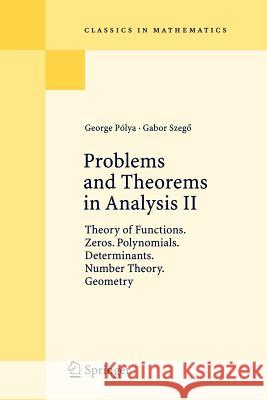
George Polya; Gabor Szegv; Gabor Szego
Problems and Theorems in Analysis II: Theory of Functions. Zeros. Polynomials. Determinants. Number Theory. Geometry Billigheimer, C. E. 9783540636861 Springer - książkaWidoczna okładka, to zdjęcie poglądowe, a rzeczywista szata graficzna może różnić się od prezentowanej.

Problems and Theorems in Analysis II: Theory of Functions. Zeros. Polynomials. Determinants. Number Theory. Geometry

ISBN-13: 9783540636861 / Angielski / Miękka / 1997 / 392 str.

George Polya; Gabor Szegv; Gabor Szego
cena 221,90 zł
(netto: 211,33 VAT:  5%)

Najniższa cena z 30 dni: 212,02 zł
Termin realizacji zamówienia:
ok. 22 dni roboczych
Bez gwarancji dostawy przed świętami

Darmowa dostawa!

Few mathematical books are worth translating 50 years after original publication. Polya-Szego is one It was published in German in 1924, and its English edition was widely acclaimed when it appeared in 1972. In the past, more of the leading mathematicians proposed and solved problems than today. Their collection of the best in analysis is a heritage of lasting value."


Kategorie:
Nauka, Matematyka
Kategorie BISAC:
Mathematics > Mathematical Analysis
Mathematics > Rachunek różniczkowy
Wydawca:
Springer
Seria wydawnicza:
Classics in Mathematics
Język:
Angielski
ISBN-13:
9783540636861
Rok wydania:
1997
Numer serii:
000004602
Ilość stron:
392
Waga:
0.57 kg
Wymiary:
23.4 x 15.5 x 2.2
Oprawa:
Miękka
Wolumenów:
01

From the reviews: "... In the past, more of the leading mathematicians proposed and solved problems than today, and there were problem departments in many journals. Pólya and Szego must have combed all of the large problem literature from about 1850 to 1925 for their material, and their collection of the best in analysis is a heritage of lasting value. The work is unashamedly dated. With few exceptions, all of its material comes from before 1925. We can judge its vintage by a brief look at the author indices (combined). Let's start on the C's: Cantor, Carathéodory, Carleman, Carlson, Catalan, Cauchy, Cayley, Cesàro,... Or the L's: Lacour, Lagrange, Laguerre, Laisant, Lambert, Landau, Laplace, Lasker, Laurent, Lebesgue, Legendre,... Omission is also information: Carlitz, Erdös, Moser, etc."
-Bull.Americ.Math.Soc.

Four. Functions of One Complex Variable. Special Part.- 1. Maximum Term and Central Index, Maximum Modulus and Number of Zeros.- § 1 (1–40) Analogy between ?(r) and M(r), v(r) and N(r).- § 2 (41–47) Further Results on ?(r) and v(r).- § 3 (48–66) Connection between ?(r), v(r), M(r) and N(r).- § 4 (67–76) ?(r) and M(r) under Special Regularity Assumptions.- 2. Schlicht Mappings.- § 1 (77–83) Introductory Material.- § 2 (84–87) Uniqueness Theorems.- § 3 (88–96) Existence of the Mapping Function.- § 4 (97–120) The Inner and the Outer Radius. The Normed Mapping Function.- § 5 (121–135) Relations between the Mappings of Different Domains.- § 6 (136–163) The Koebe Distortion Theorem and Related Topics.- 3. Miscellaneous Problems.- § 1 (164–174.2) Various Propositions.- § 2 (175–179) A Method of E. Landau.- § 3 (180–187) Rectilinear Approach to an Essential Singularity.- § 4 (188–194) Asymptotic Values of Entire Functions.- § 5 (195–205) Further Applications of the Phragmén-Lindelöf Method.- § 6 (*206–*212) Supplementary Problems.- Five. The Location of Zeros.- 1. Rolle’s Theorem and Descartes’ Rule of Signs.- § 1 (1–21) Zeros of Functions, Changes of Sign of Sequences.- § 2 (22–27) Reversals of Sign of a Function.- § 3 (28–41) First Proof of Descartes’ Rule of Signs.- § 4 (42–52) Applications of Descartes’ Rule of Signs.- § 5 (53–76) Applications of Rolle’s Theorem.- § 6 (77–86) Laguerre’s Proof of Descartes’ Rule of Signs.- § 7 (87–91) What is the Basis of Descartes’ Rule of Signs?.- § 8 (92–100) Generalizations of Rolle’s Theorem.- 2. The Geometry of the Complex Plane and the Zeros of Polynomials.- § 1 (101–110) Center of Gravity of a System of Points with respect to a Point.- § 2 (111–127) Center of Gravity of a Polynomial with respect to a Point. A Theorem of Laguerre.- § 3 (128–156) Derivative of a Polynomial with respect to a Point. A Theorem of Grace.- 3. Miscellaneous Problems.- § 1 (157–182) Approximation of the Zeros of Transcendental Functions by the Zeros of Rational Functions.- § 2 (183–189.3) Precise Determination of the Number of Zeros by Descartes’ Rule of Signs.- § 3 (190–196.1) Additional Problems on the Zeros of Polynomials.- Six. Polynomials and Trigonometric Polynomials.- § 1 (1–7) Tchebychev Polynomials.- § 2 (8–15) General Problems on Trigonometric Polynomials.- § 3 (16–28) Some Special Trigonometric Polynomials.- § 4 (29–38) Some Problems on Fourier Series.- § 5 (39–43) Real Non-negative Trigonometric Polynomials.- § 6 (44–49) Real Non-negative Polynomials.- § 7 (50–61) Maximum-Minimum Problems on Trigonometric Polynomials.- § 8 (62–66) Maximum-Minimum Problems on Polynomials.- § 9 (67–76) The Lagrange Interpolation Formula.- § 10 (77–83) The Theorems of S. Bernstein and A. Markov.- § 11 (84–102) Legendre Polynomials and Related Topics.- § 12 (103–113) Further Maximum-Minimum Problems on Polynomials.- Seven. Determinants and Quadratic Forms.- § 1 (1–16) Evaluation of Determinants. Solution of Linear Equations.- § 2 (17–34) Power Series Expansion of Rational Functions.- § 3 (35–43.2) Generation of Positive Quadratic Forms.- § 4 (44–54.4) Miscellaneous Problems.- § 5 (55–72) Determinants of Systems of Functions.- Eight. Number Theory.- 1. Arithmetical Functions.- § 1 (1–11) Problems on the Integral Parts of Numbers.- § 2 (12–20) Counting Lattice Points.- § 3 (21–27.2) The Principle of Inclusion and Exclusion.- § 4 (28–37) Parts and Divisors.- § 5 (38–42) Arithmetical Functions, Power Series, Dirichlet Series.- § 6 (43–64) Multiplicative Arithmetical Functions.- § 7 (65–78) Lambert Series and Related Topics.- § 8 (79–83) Further Problems on Counting Lattice Points.- 2. Polynomials with Integral Coefficients and Integral-Valued Functions.- § 1 (84–93) Integral Coefficients and Integral-Valued Polynomials.- § 2 (94–115) Integral-Valued Functions and their Prime Divisors.- § 3 (116–129) Irreducibility of Polynomials.- 3. Arithmetical Aspects of Power Series.- § 1 (130–137) Preparatory Problems on Binomial Coefficients.- § 2 (138–148) On Eisenstein’s Theorem.- § 3 (149–154) On the Proof of Eisenstein’s Theorem.- § 4 (155–164) Power Series with Integral Coefficients Associated with Rational Functions.- § 5 (165–173) Function-Theoretic Aspects of Power Series with Integral Coefficients.- § 6 (174–187) Power Series with Integral Coefficients in the Sense of Hurwitz.- § 7 (188–193) The Values at the Integers of Power Series that Converge about z = ?.- 4. Some Problems on Algebraic Integers.- § 1 (194–203) Algebraic Integers. Fields.- § 2 (204–220) Greatest Common Divisor.- § 3 (221–227.2) Congruences.- § 4 (228–237) Arithmetical Aspects of Power Series.- 5. Miscellaneous Problems.- § 1 (237.1–244.4) Lattice Points in Two and Three Dimensions.- § 2 (245–266) Miscellaneous Problems.- Nine. Geometric Problems.- § 1 (1–25) Some Geometric Problems.- Errata.- § 1 Additional Problems to Part One.- New Problems in English Edition.- Author Index.- Topics.

Biography of George Pólya

Born in Budapest, December 13, 1887, George Pólya initially studied law, then languages and literature in Budapest. He came to mathematics in order to understand philosophy, but the subject of his doctorate in 1912 was in probability theory and he promptly abandoned philosophy.
After a year in Göttingen and a short stay in Paris, he received an appointment at the ETH in Zürich. His research was multi-faceted, ranging from series, probability, number theory and combinatorics to astronomy and voting systems. Some of his deepest work was on entire functions. He also worked in conformal mappings, potential theory, boundary value problems, and isoperimetric problems in mathematical physics, as well as heuristics late in his career. When Pólya left Europe in 1940, he first went to Brown University, then two years later to Stanford, where he remained until his death on September 7, 1985.


Biography of Gabor Szegö

Born in Kunhegyes, Hungary, January 20, 1895, Szegö studied in Budapest and Vienna, where he received his Ph. D. in 1918, after serving in the Austro-Hungarian army in the First World War. He became a privatdozent at the University of Berlin and in 1926 succeeded Knopp at the University of Kšnigsberg. It was during his time in Berlin that he and Pólya collaborated on their great joint work, the Problems and Theorems in Analysis. Szegö's own research concentrated on orthogonal polynomials and Toeplitz matrices. With the deteriorating situation in Germany at that time, he moved in 1934 to Washington University, St. Louis, where he remained until 1938, when he moved to Stanford. As department head at Stanford, he arranged for Pólya to join the Stanford faculty in 1942. Szegö remained at Stanford until his death on August 7, 1985.

Polya, George George Polya is professor emeritus at Stanford Uni... więcej >


Udostępnij

Facebook - konto krainaksiazek.pl


Opinie o Krainaksiazek.pl na Opineo.pl

Partner Mybenefit

Krainaksiazek.pl w programie rzetelna firma Krainaksiaze.pl - płatności przez paypal

Czytaj nas na:

Facebook - krainaksiazek.pl
  • książki na zamówienie
  • granty
  • książka na prezent
  • kontakt
  • pomoc
  • opinie
  • regulamin
  • polityka prywatności

Zobacz:

  • Księgarnia czeska

  • Wydawnictwo Książkowe Klimaty

1997-2025 DolnySlask.com Agencja Internetowa

© 1997-2022 krainaksiazek.pl
     
KONTAKT | REGULAMIN | POLITYKA PRYWATNOŚCI | USTAWIENIA PRYWATNOŚCI
Zobacz: Księgarnia Czeska | Wydawnictwo Książkowe Klimaty | Mapa strony | Lista autorów
KrainaKsiazek.PL - Księgarnia Internetowa

Polityka prywatnosci - link
Krainaksiazek.pl - płatnośc Przelewy24
Przechowalnia Przechowalnia






