• Wyszukiwanie zaawansowane
  • Kategorie
  • Kategorie BISAC
  • Książki na zamówienie
  • Promocje
  • Granty
  • Książka na prezent
  • Opinie
  • Pomoc
  • Załóż konto
  • Zaloguj się

Probability and Social Science: Methodological Relationships Between the Two Approaches » książka


zaloguj się | załóż konto
Logo Krainaksiazek.pl

koszyk

konto

szukaj
topmenu
Księgarnia internetowa
Szukaj
Książki na zamówienie
Promocje
Granty
Książka na prezent
Moje konto
Pomoc
 
 
Wyszukiwanie zaawansowane
Pusty koszyk
Bezpłatna dostawa dla zamówień powyżej 20 złBezpłatna dostawa dla zamówień powyżej 20 zł

Kategorie główne

• Nauka
 [2952079]
• Literatura piękna
 [1850969]

  więcej...
• Turystyka
 [71058]
• Informatyka
 [151066]
• Komiksy
 [35579]
• Encyklopedie
 [23181]
• Dziecięca
 [620496]
• Hobby
 [139036]
• AudioBooki
 [1646]
• Literatura faktu
 [228729]
• Muzyka CD
 [379]
• Słowniki
 [2932]
• Inne
 [445708]
• Kalendarze
 [1409]
• Podręczniki
 [164793]
• Poradniki
 [480107]
• Religia
 [510956]
• Czasopisma
 [511]
• Sport
 [61267]
• Sztuka
 [243299]
• CD, DVD, Video
 [3411]
• Technologie
 [219640]
• Zdrowie
 [100984]
• Książkowe Klimaty
 [124]
• Zabawki
 [2281]
• Puzzle, gry
 [3363]
• Literatura w języku ukraińskim
 [258]
• Art. papiernicze i szkolne
 [8020]
Kategorie szczegółowe BISAC

Probability and Social Science: Methodological Relationships Between the Two Approaches

ISBN-13: 9789400728783 / Angielski / Twarda / 2012 / 310 str.
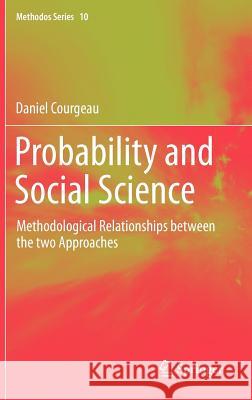
Daniel Courgeau
Probability and Social Science: Methodological Relationships Between the Two Approaches Courgeau, Daniel 9789400728783 Springer - książkaWidoczna okładka, to zdjęcie poglądowe, a rzeczywista szata graficzna może różnić się od prezentowanej.

Probability and Social Science: Methodological Relationships Between the Two Approaches

ISBN-13: 9789400728783 / Angielski / Twarda / 2012 / 310 str.

Daniel Courgeau
cena 603,81
(netto: 575,06 VAT:  5%)

Najniższa cena z 30 dni: 578,30
Termin realizacji zamówienia:
ok. 22 dni roboczych.

Darmowa dostawa!
inne wydania

This work examines in depth the methodological relationships that probability and statistics have maintained with the social sciences from their emergence. It covers both the history of thought and current methods.

First it examines in detail the history of the different paradigms and axioms for probability, from their emergence in the seventeenth century up to the most recent developments of the three major concepts: objective, subjective and logicist probability. It shows the statistical inference they permit, different applications to social sciences and the main problems they encounter.

On the other side, from social sciences-particularly population sciences-to probability, it shows the different uses they made of probabilistic concepts during their history, from the seventeenth century, according to their paradigms: cross-sectional, longitudinal, hierarchical, contextual and multilevel approaches. While the ties may have seemed loose at times, they have more often been very close: some advances in probability were driven by the search for answers to questions raised by the social sciences; conversely, the latter have made progress thanks to advances in probability.

This dual approach sheds new light on the historical development of the social sciences and probability, and on the enduring relevance of their links. It permits also to solve a number of methodological problems encountered all along their history.


Kategorie:
Nauka, Socjologia i społeczeństwo
Kategorie BISAC:
Social Science > Methodology
Mathematics > Prawdopodobieństwo i statystyka
Social Science > Socjologia
Wydawca:
Springer
Seria wydawnicza:
Methodos
Język:
Angielski
ISBN-13:
9789400728783
Rok wydania:
2012
Wydanie:
2012
Numer serii:
000303882
Ilość stron:
310
Waga:
0.65 kg
Wymiary:
23.39 x 15.6 x 2.06
Oprawa:
Twarda
Wolumenów:
01
Dodatkowe informacje:
Glosariusz/słownik
Wydanie ilustrowane

Courgeau has written a masterpiece on the co-evolution of probability theory and the social sciences. The co-evolution was not always harmonious and applications of probability theory in the social sciences have sometimes been criticized. Courgeau attributes this to a misunderstanding of the various approaches to probability. Social scientists barely distinguish between these approaches, often assume that probability can only be objective, or interpret the Bayesian approach incorrectly. Courgeau advocates the use of probability concepts in the social sciences because they enable us to formalize the risks and uncertainties that are at the heart of the social sciences. The awareness is growing that we live in a risk society and need to be prepared to make important decisions under conditions of uncertainty and incomplete knowledge. The awareness is also growing that society at large feels the consequences of games of chance some humans and organizations play today. There is no other option than to use the best knowledge on chance mechanisms available to tame uncertainties, even if it requires a fundamental transformation of the social sciences. Anyone concerned about the future of the social sciences should read this important book.

From the book review by Frans Willekens, Netherlands Interdisciplinary Demographic Institute (NIDI), The Hague, The Netherlands, published in European Journal of Population / Revue européenne de Démographie © Springer Science+Business Media Dordrecht 201310.1007/s10680-013-9285-6

The purpose of this book is to examine historical connections between probability and social science, demography in particular. The Author, Daniel Courgeau, Professor Emeritus at INED, Paris, is a distinguished French demographer, renowned for his pioneering methodological work on event history analysis and multi-level modelling in population studies, and for keen interest in probability issues. That such a volume was published in the year commemorating the 350th anniversary of both John Graunt's Bills of Mortality, which marks the beginning of modern social sciences, as well as of Logic, or The Art of Thinking by Antoine Arnauld and Pierre Nicole, whom the Author sees as precursors of applied probability and statistical decision analysis, is a fine coincidence indeed.

The book is structured into two parts, the first one dealing with the history of probability and its impact on social sciences, and the second one, conversely, with how advances in social sciences influenced the developments of probability theory. These two parts are preceded by a General Introduction to the whole volume, which outlines the history of probability and social sciences, in particular since the 17th century, and provides the reader with a roadmap through the entire book. Each of the two parts has a separate brief introduction and a succinct conclusion; finally, the whole volume ends with a General Conclusion, which is slightly longer and broader in scope. Importantly for readers in a hurry, who nevertheless want to have a flavour of the contents, all the introductions and conclusions together are almost standalone, and enable quick orientation in the main messages.

... In summary, this book is a very welcome compendium on the history and perspectives of probability and social sciences, brought together in one volume, which can be fully recommended especially for academics and doctoral students of quantitative social sciences.

From the book review by Jakub Bijak and Eric Silverman, University of Southampton, United Kingdom, published in Population Studies, 67(1), 2013, DOI:10.1080/00324728.2013.765163. http://www.tandfonline.com/toc/rpst20/current

General Introduction.- Part 1: From Probability to Social Sciences.- Introduction to Part 1.- Chapter 1: The Objectivist Approach.- Chapter 2: The Epistemic Approach: Subjectivist Interpretation.- Chapter 3: The Epistemic Approach: Logicist Interpretation.- Conclusion of Part 1.- Part II: From Population Sciences to Probability.- Introduction to Part II.- Chapter 4: The Dispersion of Measures in Population Sciences.- Chapter 5: Closer Links between Population Sciences and Probability.- Conclusion of Part II.- General Conclusion.- Glossary.- References.- Subject Index.- Author Index.

This work examines in depth the methodological relationships that probability and statistics have maintained with the social sciences from their emergence. It covers both the history of thought and current methods.

First it examines in detail the history of the different paradigms and axioms for probability, from their emergence in the seventeenth century up to the most recent developments of the three major concepts: objective, subjective and logicist probability. It shows the statistical inference they permit, different applications to social sciences and the main problems they encounter.

On the other side, from social sciences—particularly population sciences—to probability, it shows the different uses they made of probabilistic concepts during their history, from the seventeenth century, according to their paradigms: cross-sectional, longitudinal, hierarchical, contextual and multilevel approaches. While the ties may have seemed loose at times, they have more often been very close: some advances in probability were driven by the search for answers to questions raised by the social sciences; conversely, the latter have made progress thanks to advances in probability.

This dual approach sheds new light on the historical development of the social sciences and probability, and on the enduring relevance of their links. It permits also to solve a number of methodological problems encountered all along their history.




Udostępnij

Facebook - konto krainaksiazek.pl


Opinie o Krainaksiazek.pl na Opineo.pl

Partner Mybenefit

Krainaksiazek.pl w programie rzetelna firma Krainaksiaze.pl - płatności przez paypal

Czytaj nas na:

Facebook - krainaksiazek.pl
  • książki na zamówienie
  • granty
  • książka na prezent
  • kontakt
  • pomoc
  • opinie
  • regulamin
  • polityka prywatności

Zobacz:

  • Księgarnia czeska

  • Wydawnictwo Książkowe Klimaty

1997-2026 DolnySlask.com Agencja Internetowa

© 1997-2022 krainaksiazek.pl
     
KONTAKT | REGULAMIN | POLITYKA PRYWATNOŚCI | USTAWIENIA PRYWATNOŚCI
Zobacz: Księgarnia Czeska | Wydawnictwo Książkowe Klimaty | Mapa strony | Lista autorów
KrainaKsiazek.PL - Księgarnia Internetowa

Polityka prywatnosci - link
Krainaksiazek.pl - płatnośc Przelewy24
Przechowalnia Przechowalnia



