• Wyszukiwanie zaawansowane
  • Kategorie
  • Kategorie BISAC
  • Książki na zamówienie
  • Promocje
  • Granty
  • Książka na prezent
  • Opinie
  • Pomoc
  • Załóż konto
  • Zaloguj się

Principles of Systems Science » książka


zaloguj się | załóż konto
Logo Krainaksiazek.pl

koszyk

konto

szukaj
topmenu
Księgarnia internetowa
Szukaj
Książki na zamówienie
Promocje
Granty
Książka na prezent
Moje konto
Pomoc
 
 
Wyszukiwanie zaawansowane
Pusty koszyk
Bezpłatna dostawa dla zamówień powyżej 20 złBezpłatna dostawa dla zamówień powyżej 20 zł

Kategorie główne

• Nauka
 [2949524]
• Literatura piękna
 [1817948]

  więcej...
• Turystyka
 [70715]
• Informatyka
 [151291]
• Komiksy
 [35671]
• Encyklopedie
 [23176]
• Dziecięca
 [612440]
• Hobby
 [136066]
• AudioBooki
 [1740]
• Literatura faktu
 [226030]
• Muzyka CD
 [378]
• Słowniki
 [2918]
• Inne
 [445441]
• Kalendarze
 [1181]
• Podręczniki
 [166545]
• Poradniki
 [469898]
• Religia
 [508035]
• Czasopisma
 [502]
• Sport
 [61392]
• Sztuka
 [242759]
• CD, DVD, Video
 [3348]
• Technologie
 [219537]
• Zdrowie
 [98738]
• Książkowe Klimaty
 [124]
• Zabawki
 [2382]
• Puzzle, gry
 [3543]
• Literatura w języku ukraińskim
 [259]
• Art. papiernicze i szkolne
 [7107]
Kategorie szczegółowe BISAC

Principles of Systems Science

ISBN-13: 9781493951390 / Angielski / Miękka / 2016 / 755 str.
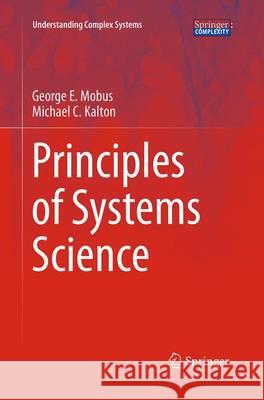
George E. Mobus; Michael C. Kalton
Principles of Systems Science George E. Mobus Michael C. Kalton 9781493951390 Springer - książkaWidoczna okładka, to zdjęcie poglądowe, a rzeczywista szata graficzna może różnić się od prezentowanej.

Principles of Systems Science

ISBN-13: 9781493951390 / Angielski / Miękka / 2016 / 755 str.

George E. Mobus; Michael C. Kalton
cena 221,37
(netto: 210,83 VAT:  5%)

Najniższa cena z 30 dni: 192,74
Termin realizacji zamówienia:
ok. 16-18 dni roboczych.

Darmowa dostawa!

This pioneering text provides a comprehensive introduction to systems structure, function, and modeling as applied in all fields of science and engineering. Systems understanding is increasingly recognized as a key to a more holistic education and greater problem solving skills, and is also reflected in the trend toward interdisciplinary approaches to research on complex phenomena. While the concepts and components of systems science will continue to be distributed throughout the various disciplines, undergraduate degree programs in systems science are also being developed, including at the authors' own institutions. However, the subject is approached, systems science as a basis for understanding the components and drivers of phenomena at all scales should be viewed with the same importance as a traditional liberal arts education. Principles of Systems Science contains many graphs, illustrations, side bars, examples, and problems to enhance understanding. From basic principles of organization, complexity, abstract representations, and behavior (dynamics) to deeper aspects such as the relations between information, knowledge, computation, and system control, to higher order aspects such as auto-organization, emergence and evolution, the book provides an integrated perspective on the comprehensive nature of systems. It ends with practical aspects such as systems analysis, computer modeling, and systems engineering that demonstrate how the knowledge of systems can be used to solve problems in the real world. Each chapter is broken into parts beginning with qualitative descriptions that stand alone for students who have taken intermediate algebra. The second part presents quantitative descriptions that are based on pre-calculus and advanced algebra, providing a more formal treatment for students who have the necessary mathematical background. Numerous examples of systems from every realm of life, including the physical and biological sciences, humanities, social sciences, engineering, pre-med and pre-law, are based on the fundamental systems concepts of boundaries, components as subsystems, processes as flows of materials, energy, and messages, work accomplished, functions performed, hierarchical structures, and more. Understanding these basics enables further understanding both of how systems endure and how they may become increasingly complex and exhibit new properties or characteristics.

  • Serves as a textbook for teaching systems fundamentals in any discipline or for use in an introductory course in systems science degree programs
  • Addresses a wide range of audiences with different levels of mathematical sophistication
  • Includes open-ended questions in special boxes intended to stimulate integrated thinking and class discussion
  • Describes numerous examples of systems in science and society
  • Captures the trend towards interdisciplinary research and problem solving

Kategorie:
Nauka, Fizyka
Kategorie BISAC:
Science > Fizyka matematyczna
Technology & Engineering > Engineering (General)
Business & Economics > Economics - Theory
Wydawca:
Springer
Seria wydawnicza:
Understanding Complex Systems
Język:
Angielski
ISBN-13:
9781493951390
Rok wydania:
2016
Wydanie:
Softcover Repri
Numer serii:
000307910
Ilość stron:
755
Oprawa:
Miękka
Wolumenów:
01
Dodatkowe informacje:
Wydanie ilustrowane

"Principles of systems science consists of 14 chapters organized in five parts. ... This book is a feast--full of systems theory and sage guidance about systems practice." (Ernest Hughes, Computing Reviews, computingreviews.com, August, 2016)

Part I: Introduction to Systems Science.- A Helicopter View.- Systems Principles in the Real World: Understanding Drug Resistant TB.- Part II: Structural and Functional Aspects.- Organized Wholes.- Networks: Connections Within and Without.- Complexity.- Behavior: System Dynamics.- Part III: The Intangible Aspects of Organization: Maintaining and Adapting.- Information, Meaning, Knowledge, and Communications.- Computational Systems.- Cybernetics: The Role of Information and Computation in Systems.- Part IV: Evolution.- Auto-Organization and Emergence.- Evolution.- Part V: Methodological Aspects.- Systems Analysis.- Systems Modeling.- Systems Engineering.

George E. Mobus is an Associate Professor of Computer Science & Systems and Computer Engineering & Systems in the Institute of Technology at the University of Washington Tacoma. In addition to teaching computer science and engineering courses, he teaches courses in systems science to a broad array of students from across the campus. He received his PhD in computer science from the University of North Texas in 1994. His dissertation, and subsequent research program at Western Washington University, involved developing autonomous robot agents by emulating natural intelligence as opposed to using some form of artificial intelligence. He is reviving this research agenda now that hardware elements have caught up with the processing requirements for simulating real biological neurons. He also received an MBA from San Diego State University in 1983, doing a thesis on the modeling of decision support systems based on the hierarchical cybernetic principles presented in this volume. He did this while actually managing an embedded systems manufacturing and engineering company in Southern California. His baccalaureate degree was earned at the University of Washington (Seattle) in 1973, in zoology. He studied the energetics of living systems and the interplay between information, evolution, and complexity. By using some control algorithms that he had developed in both his undergraduate and MBA degrees in programming embedded control systems he solved some interesting problems that led to promotion from a software engineer (without a degree) to the top spot in the company.

Michael C. Kalton is Professor Emeritus of Interdisciplinary Arts and Sciences at the University of Washington Tacoma. He came to systems science through the study of how cultures arise from and reinforce different ways of thinking about and interacting with the world. After receiving a Bachelor’s degree in Philosophy and Letters, a Master’s degree in Greek, and a Licentiate in Philosophy from St. Louis University, he went to Harvard University where in 1977 he received a joint Ph.D. degree in East Asian Languages and Civilizations, and Comparative Religion.  He has done extensive research and publication on the Neo-Confucian tradition, the dominant intellectual and spiritual tradition throughout East Asia prior to the 20th century. Environmental themes of self-organizing relational interdependence and the need to fit in the patterned systemic flow of life drew his attention due to their resonance with East Asian assumptions about the world.   Ecosystems joined social systems in his research and teaching, sharing a common matrix in the study of complex systems, emergence and evolution.  The interdisciplinary character of his program allowed this integral expansion of his work; systems thinking became the thread of continuity in courses ranging from the world’s great social, religious, and intellectual traditions to environmental ethics and the systems dynamics of contemporary society.  He sees a deep and creative synergy between pre-modern Neo-Confucian thought and contemporary systems science; investigating this potential cross-fertilization is now his major research focus.

This pioneering text provides a comprehensive introduction to systems structure, function, and modeling as applied in all fields of science and engineering. Systems understanding is increasingly recognized as a key to a more holistic education and greater problem solving skills, and is also reflected in the trend toward interdisciplinary approaches to research on complex phenomena. The subject of systems science, as a basis for understanding the components and drivers of phenomena at all scales, should be viewed with the same importance as a traditional liberal arts education.

Principles of Systems Science contains many graphs, illustrations, side bars, examples, and problems to enhance understanding. From basic principles of organization, complexity, abstract representations, and behavior (dynamics) to deeper aspects such as the relations between information, knowledge, computation, and system control, to higher order aspects such as auto-organization, emergence and evolution, the book provides an integrated perspective on the comprehensive nature of systems. It ends with practical aspects such as systems analysis, computer modeling, and systems engineering that demonstrate how the knowledge of systems can be used to solve problems in the real world.  Each chapter is broken into parts beginning with qualitative descriptions that stand alone for students who have taken intermediate algebra. The second part  presents quantitative descriptions that are based on pre-calculus and advanced algebra, providing a more formal treatment for students who have the necessary mathematical background. Understanding these basics enables further understanding both of how systems endure and how they may become increasingly complex and exhibit new properties or characteristics.

·         Serves as a textbook for teaching systems fundamentals in any discipline or for use in an introductory course in systems science degree programs

·         Addresses a wide range of audiences with different levels of mathematical sophistication

·         Includes open-ended questions in special boxes intended to stimulate integrated thinking and class discussion

·         Describes numerous examples of systems in science and society

·         Captures the trend towards interdisciplinary research and problem solving



Udostępnij

Facebook - konto krainaksiazek.pl


Opinie o Krainaksiazek.pl na Opineo.pl

Partner Mybenefit

Krainaksiazek.pl w programie rzetelna firma Krainaksiaze.pl - płatności przez paypal

Czytaj nas na:

Facebook - krainaksiazek.pl
  • książki na zamówienie
  • granty
  • książka na prezent
  • kontakt
  • pomoc
  • opinie
  • regulamin
  • polityka prywatności

Zobacz:

  • Księgarnia czeska

  • Wydawnictwo Książkowe Klimaty

1997-2026 DolnySlask.com Agencja Internetowa

© 1997-2022 krainaksiazek.pl
     
KONTAKT | REGULAMIN | POLITYKA PRYWATNOŚCI | USTAWIENIA PRYWATNOŚCI
Zobacz: Księgarnia Czeska | Wydawnictwo Książkowe Klimaty | Mapa strony | Lista autorów
KrainaKsiazek.PL - Księgarnia Internetowa

Polityka prywatnosci - link
Krainaksiazek.pl - płatnośc Przelewy24
Przechowalnia Przechowalnia





